
Wealth Management in Lake Forest: Building Long-Term Security

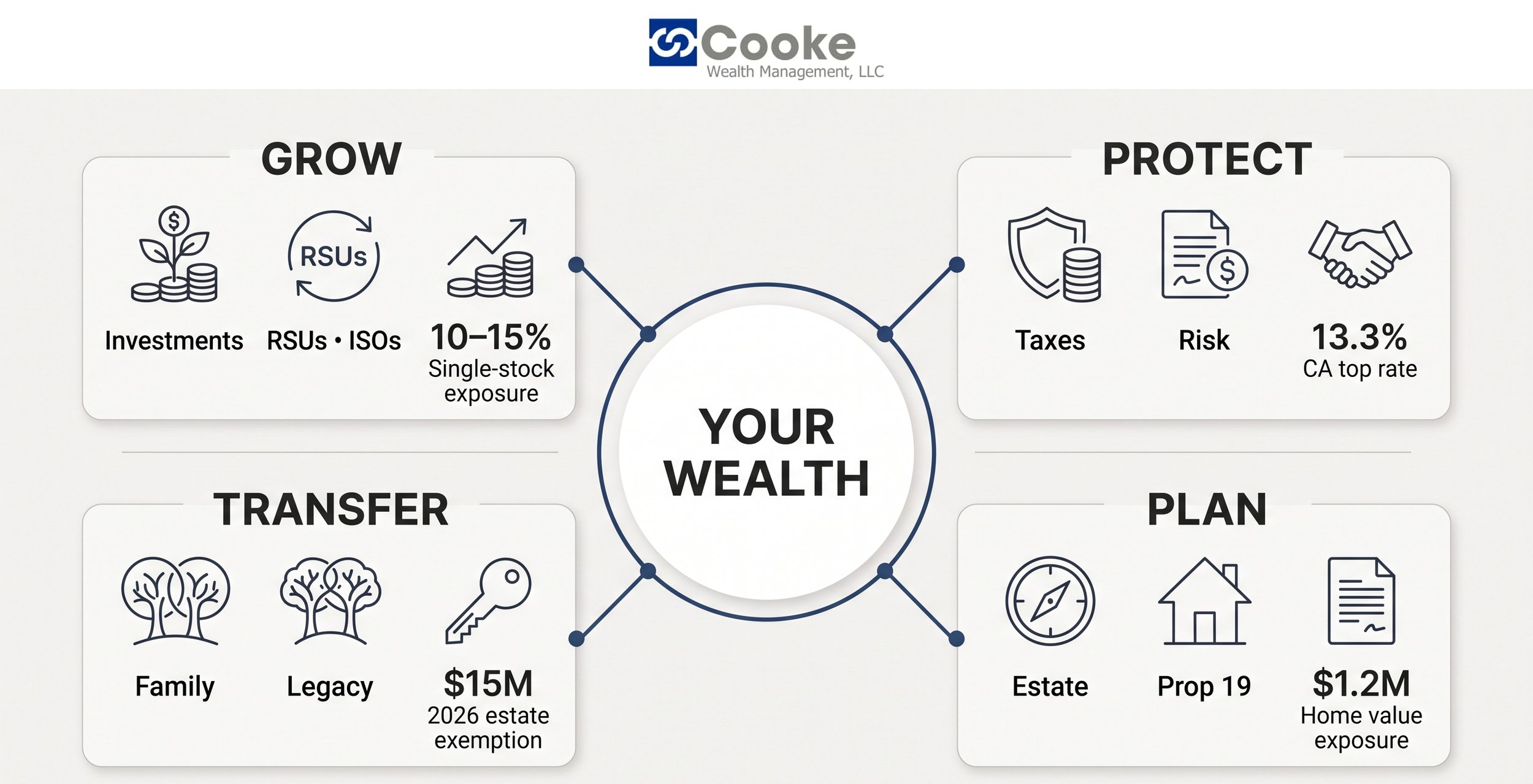
Wealth management in Lake Forest looks different once it's your home, your stock plan, and your family on the line, not a set of numbers on a page. The median home here sells for close to $1.2 million, and household income runs $135,175, well above the county average.
That's a lot of built-up value sitting in a market where good decisions compound and bad ones do too. Building it is only half the job. Keeping it safe from taxes and risk, then getting it to the people or causes you care about, is the other half.
Cooke Wealth Management is built on one condition: fee-only fiduciary status, so compensation doesn't shift depending on which products land in your portfolio. The team brings more than 40 years of combined experience as CFP professionals, and financial planning here starts with your full balance sheet, not the accounts already under management alone.
The process begins with a free discovery session, before anything gets recommended.
Why Wealth Management Looks Different in Lake Forest
Lake Forest isn't a typical mass-market suburb, at least financially. That income and home equity add up to real net worth, and close to 15% of residents are already 65 or older, old enough that today's decisions become someone else's inheritance before long.
A high income and an expensive house are inputs, not a strategy. Tax exposure, investment risk, and how the estate eventually transfers are what a plan has to tie together, and that's where most generic advice stops short.
Cost of living compounds the picture. Lake Forest carries a cost of living index of 164.9 against a national average of 100, driven mostly by a housing index of 300. Proposition 13 caps how much a home's assessed value can climb each year, which is why many longtime owners here pay property tax on a fraction of what the home is worth, at least until it changes hands.
Growing What You Have: Investment Management Without the Guesswork
Plenty of Lake Forest households built wealth through RSUs, ISOs, or one successful company, and that creates its own kind of risk. Vesting schedules and the alternative minimum tax add another layer on top of the concentration itself for anyone holding options. Most advisors cap employer or single-stock exposure at 10% to 15% of a portfolio, a threshold Chesapeake Financial Planning lays out in its concentration risk guidance. Anything above 20% counts as overconcentrated, and the past 30% starts looking more like speculation than investing.
Diversifying out of a concentrated position takes planning of its own, since a large unrealized gain triggers a real tax bill the moment you sell. That's a separate problem from finding an advisor whose incentives point the same direction as yours.
Only about 4.92% of financial professionals operate as fee-only fiduciaries, according to a 2025 analysis by Human Investing, which means the rest of the industry still earns commissions tied to specific products. Our breakdown of fee-only fiduciary standards in Orange County covers what to ask before hiring anyone.
Protecting What You've Built: Taxes and Risk
California taxes capital gains as ordinary income. There's no lower rate for a long-term hold, the way federal law allows one. A large stock sale or business exit can push you into the state's top bracket, 13.3%, stacked on top of whatever the IRS takes. We've written before about what that means for California capital gains, and it changes how and when a sale should happen.
Risk management gets less attention than it deserves. LIMRA's 2024 research puts the number at 102 million adults, 42% of the population, who say they lack enough life insurance or have none at all. That gap matters more once real assets, a business, or a growing family enter the picture, since the cost of being wrong isn't hypothetical.
Passing It On: Estate Planning After the 2026 Tax Change
The rules changed fast. The federal estate and gift tax exemption jumped to $15 million per person this year, or $30 million for a married couple using portability, made permanent under the One Big Beautiful Bill Act with no scheduled sunset, according to Morgan Lewis's analysis of the law. A year earlier, that exemption sat at $13.99 million, on track to fall back near $7 million once the prior law expired.
That shift doesn't make estate planning optional. Most households in Lake Forest won't owe federal estate tax at these levels, yet a will or trust drafted around the old numbers can still misdirect assets, skip a beneficiary update, or leave a dependent unprotected.
Passing down a house here carries its own trap, too. Proposition 19 can trigger a full property tax reassessment on an inherited home unless the transfer qualifies for an exclusion, turning a manageable legacy tax bill into a much larger one overnight. Multi-generational transfers and charitable giving both deserve a second look under the new rules, and our guide to multi-generational wealth planning in Orange County walks through both.
Where Wealth Plans in Lake Forest Break Down
A few patterns show up again and again. Plenty of people hold onto a concentrated stock position out of loyalty or habit, long after it's grown past a safe share of net worth. Others treat a five-year-old estate plan as finished, even though the exemption rules have changed twice in two years.
Underinsurance is a quieter mistake, since nothing forces the issue until it's too late to fix. A stock or business sale often closes before anyone checks what California's capital gains treatment will do to the proceeds. None of these need a complicated fix. They need someone looking at the full picture before a decision gets made, not after.
Why Lake Forest Families Work With Cooke Wealth Management
Cooke Wealth Management has worked with Orange County families since 2003, built around a father-daughter team where both advisors hold the CFP designation. What further sets the firm apart is its foundation in biblical stewardship: the idea that clients are stewards of what they've been given, not accumulators of it, with the goal of financial peace and the freedom to be generous.
Fiduciary Guidance You Can Trust
As fiduciaries, the team is legally and ethically bound to act in a client's best interest at all times, a standard that matters most when markets get volatile. That's often when the industry sees a jump in "guaranteed" products or high-commission annuities that can benefit the salesperson more than the client.
A fiduciary instead gives an objective read on those options, usually pointing clients toward lower-cost alternatives that fit their actual risk tolerance. That standard still describes a small share of the industry.
If a concentrated position, an outdated estate plan, or a coverage gap sounds familiar, schedule a discovery session to see what a plan built around your full picture looks like.
Frequently Asked Questions
What's the difference between wealth management and regular financial planning?
Wealth management usually covers more ground: investment management, tax strategy, estate coordination, and risk management under one plan instead of separate, disconnected decisions. The two terms overlap in practice, but wealth management implies the pieces are managed together rather than one at a time.
How much money do I need to hire a wealth manager?
Most full-service wealth management firms set minimums between $500,000 and $2 million in investable assets, though the dollar figure matters less than the complexity behind it. A concentrated stock position, a business, or an estate approaching the new $15 million exemption threshold can justify wealth management at a lower asset level than the minimum alone would suggest. A discovery session is the fastest way to find out where a specific situation lands.
How much did the federal estate tax exemption change for 2026?
The federal estate and gift tax exemption rose to $15 million per person, or $30 million for a married couple, under the One Big Beautiful Bill Act signed in 2025. That's a jump from $13.99 million the year before. Without the law, it was on track to fall back near $7 million once the old tax rules expired.
Are California municipal bonds worth it for high earners?
California doesn't tax interest from California-issued municipal bonds, and neither does the federal government. That puts them among the few investments that fully sidestep the state's 13.3% top bracket. They won't outperform a diversified portfolio over time, but for someone already in that bracket, the after-tax yield on a muni bond often beats a comparable taxable bond once the tax savings are counted.
How much of my portfolio should be in one stock?
Most advisors treat 10% to 15% in a single stock as the upper comfort zone, with anything past 20% considered overconcentrated. The harder question is what to do once you're already past that line. A multi-year sale schedule, an exchange fund, or an options-based hedge are the common paths, and the right choice depends on the tax basis and how much of the position needs to come off the table.
Is Cooke Wealth Management a fee-only fiduciary?
Yes. Cooke Wealth Management operates as a fee-only fiduciary, meaning compensation doesn't change based on which products a client ends up holding. Anyone can verify that directly through the SEC's Investment Adviser Public Disclosure database, which lists a firm's registration status and fee structure in its Form ADV filing.