
Fee-Only Fiduciary Financial Advisor in Orange County: Why the Standard You Choose Matters

Finding a fee-only fiduciary financial advisor near you is one of the more important decisions in a long-term financial plan. The difference between advisor types matters because the financial services industry is not governed by one uniform standard.
Two professionals using the title “financial advisor” may operate under very different legal and compensation structures. One may be legally required to act in your best interest across the advisory relationship. Another may be operating under a product-sales or broker-dealer model where the obligation is narrower.
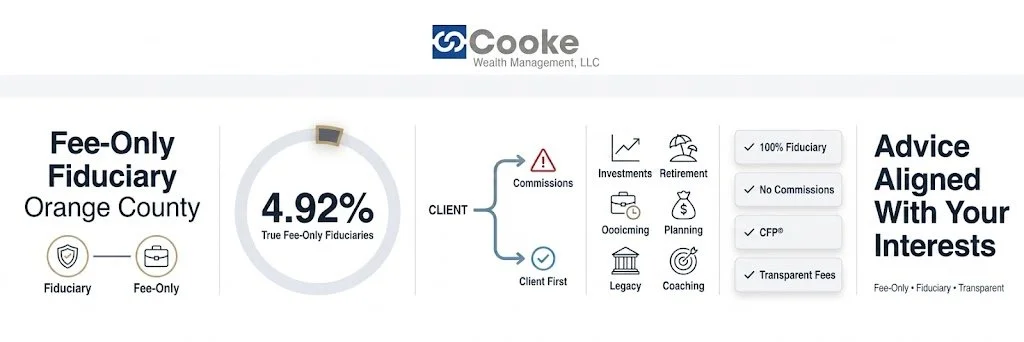
Cooke Wealth Management is a fee-only fiduciary firm serving individuals and families in Orange County. The firm’s work includes financial planning, retirement planning, investment management, wealth transfer guidance, and financial coaching, all built around the premise that advice should follow the client’s priorities, not the advisor’s compensation structure. If you are evaluating what separates this standard from other advisory models, Cooke’s financial planning services are a useful starting point.
What “Fee-Only Fiduciary” Actually Means
“Fiduciary” refers to a legal obligation. Under the Investment Advisers Act of 1940, registered investment advisers generally owe clients a fiduciary duty. The SEC has described that duty as including both a duty of care and a duty of loyalty.
“Fee-only” refers to how the advisor is paid. According to the National Association of Personal Financial Advisors, fee-only advisors are compensated directly by clients and do not accept commissions for their work.
Together, those two standards describe an advisor whose compensation is designed to reduce product-sales conflicts. They are paid by the client, not by commissions, revenue sharing, referral arrangements, or product placement incentives.
That distinction matters because many consumers searching for a “financial advisor near me” will encounter professionals who use fiduciary language without being fee-only, or who act under a broker-dealer framework rather than an ongoing advisory fiduciary relationship. A 2025 Human Investing analysis, drawing on Bureau of Labor Statistics and FINRA data, estimated that only 4.92% of financial professionals operate as fee-only fiduciaries.
Why the Standard Matters
Most major planning decisions are interconnected. Retirement withdrawal strategy affects taxes. Social Security timing affects portfolio income needs. Insurance decisions affect estate liquidity. Investment structure affects after-tax outcomes.
Commission-based advisors are not necessarily dishonest. But compensation structure matters. An advisor who receives a higher commission on one product than another has a conflict that should be understood before a recommendation is accepted.
The difference between the fiduciary standard and the broker-dealer standard is also worth understanding. SEC Regulation Best Interest, adopted in 2019, requires broker-dealers to act in a retail customer’s best interest when making a recommendation involving securities or an investment strategy.
A registered investment adviser’s fiduciary duty is different because it applies to the advisory relationship. For families making decisions across decades, that ongoing obligation can be an important planning foundation.
Vanguard’s Advisor’s Alpha research has also emphasized the potential value of behavioral coaching, particularly helping clients stay aligned with long-term plans during periods of market stress.
What the Fee-Only Model Looks Like
Fee-only advisors usually charge in one of three ways: a flat annual retainer, an hourly rate, or a percentage of assets under management. Registered investment advisers disclose their fee structure in Form ADV, which is available through the SEC’s Investment Adviser Public Disclosure database.
Some clients prefer a flat or hourly arrangement. Others prefer an AUM model, where the advisor’s revenue rises and falls with the value of the managed portfolio. Each structure has tradeoffs, but all are easier to evaluate when the fee is transparent.
Recent Kitces industry research has shown continued growth in planning fees, retainers, and hybrid fee structures as firms expand beyond investment-only service models.
What Fiduciary Duty Looks Like in Practice
A fiduciary advisor should surface conflicts before they affect the recommendation. If an advisor has a referral arrangement, compensation incentive, affiliated product relationship, or other material conflict, the client should know.
In practice, advice should begin with the full financial picture: income, spending, taxes, investment accounts, insurance needs, estate documents, retirement timeline, and family priorities. A fiduciary is not required to predict the future perfectly. The obligation is to be thorough, transparent, and aligned with the client’s best interest.
Why Titles Can Be Misleading
The title “financial advisor” is not enough. Terms such as financial planner, wealth manager, and investment consultant do not automatically tell you how someone is paid or what legal standard applies.
More meaningful markers include Registered Investment Adviser registration, CFP certification, and membership in organizations such as NAPFA. The CFP Board’s Code of Ethics and Standards of Conduct requires CFP professionals to act as fiduciaries when providing financial advice.
Still, a CFP designation does not automatically mean the advisor is fee-only. Fiduciary duty and compensation model are related, but they are not identical.
Before hiring an advisor, investors can check FINRA BrokerCheck and the SEC’s IAPD tool.
Five Questions Worth Asking Before You Sign Anything
1. Do they offer the services you actually need?
Some advisors focus primarily on investment management. Others provide broader planning across retirement income, taxes, insurance, estate coordination, cash flow, and charitable giving. Confirm that the service model fits the complexity of your situation.
2. Do they work with clients like you?
A client nearing retirement may need different planning expertise than a young accumulator or business owner. Ask about the advisor’s typical client profile and whether your situation fits.
3. Do they have an asset minimum?
Many fee-only RIA firms set minimum asset levels. Flat-fee and hourly models may be alternatives for clients who want fiduciary guidance but do not meet an AUM minimum.
4. Do their values align with yours?
For some clients, the “how” of planning matters as much as the numbers. Advisors who incorporate values-based or faith-informed planning may provide a different experience than firms focused only on portfolio management.
5. What is the full after-tax cost of the fee?
Investment advisory fees are generally no longer deductible by individuals as miscellaneous itemized deductions. The Tax Cuts and Jobs Act suspended those deductions beginning in 2018, and later federal tax legislation made the disallowance permanent. Clients should ask how advisory fees fit into the broader after-tax plan.
How Cooke Wealth Management Works With Orange County Clients
Cooke Wealth Management is a fee-only fiduciary firm based in Orange County. The practice is built around long-term client relationships rather than one-time transactions.
The firm’s work includes financial planning, retirement planning, investment management, wealth transfer guidance, and financial coaching. For clients whose decisions intersect with personal values or faith-based principles, Cooke can bring that perspective into the planning process as part of clarifying priorities and tradeoffs.
As a fiduciary, Cooke is required to act in each client’s best interest and disclose material conflicts. As a fee-only firm, it does not earn commissions on products it recommends.
If you are evaluating advisors in Orange County, a discovery conversation can help determine whether Cooke Wealth Management fits your needs.
Nine Questions That Reveal How an Advisor Works
Compensation and conflicts:
Are you fee-only? If not, what other compensation do you receive?
Do you have referral arrangements, revenue-sharing agreements, or business relationships that could affect your recommendations?
Where can I find your Form ADV, and can you walk me through it?
Fiduciary clarity:
Are you a fiduciary 100% of the time, or only when giving certain types of advice?
Are you registered as an RIA with the SEC or your state?
Are you a CFP professional or NAPFA member?
Service and fit:
What does your typical client look like?
Do you offer comprehensive planning or primarily investment management?
How do you handle situations where my goals and the numbers are in tension?
No advisor will be right for every client. But an advisor who cannot answer these questions clearly, or becomes evasive when compensation and conflicts come up, may not meet the standard you are looking for.
The Right Advisor Changes What Is Possible
Choosing a fee-only fiduciary financial advisor is not just a credentialing exercise. It is a decision about whose interests are structurally protected when advice is given.
Most people have limited windows to get major financial decisions right: retirement income sequencing, estate coordination, tax-aware investment strategy, insurance planning, and wealth transfer. The quality of guidance during those windows matters.
Cooke Wealth Management works with individuals and families in Orange County who want a plan built around their goals and values, delivered by advisors who are legally and structurally aligned with the client. Whether the issue is retirement, investments, wealth transfer, or a broader financial plan, the starting point is a conversation about what you are trying to accomplish.
Reach out to Cooke Wealth Management to start that conversation.
Frequently Asked Questions
What is the difference between a fee-only and a fee-based financial advisor?
A fee-only advisor is compensated exclusively by client fees and receives no commissions or third-party payments. A fee-based advisor may charge client fees but may also earn commissions on certain financial products. Both may use fiduciary language, but the compensation structures create different conflict profiles.
What happens to my investments if I switch to a fee-only fiduciary advisor?
Switching advisors does not automatically trigger taxes. Many assets can be transferred in-kind from one custodian to another without being sold. However, proprietary funds or certain legacy products may need to be reviewed carefully. For retirement accounts, the IRS generally requires indirect rollovers to be completed within 60 days. The IRS also limits IRA-to-IRA indirect rollovers to one per 12-month period. A direct trustee-to-trustee transfer can reduce those risks.
Does a fee-only fiduciary advisor handle tax planning, or do I still need an accountant?
Many fee-only fiduciary advisors incorporate tax-aware planning into withdrawal strategy, Roth conversion timing, asset location, charitable giving, and Social Security decisions. That is different from tax preparation, which is usually handled by a CPA or enrolled agent. Clients with complex situations generally benefit from coordinated work between the advisor and tax professional.
How long should I give a new advisor before evaluating the relationship?
Investment outcomes should usually be evaluated over a full market cycle, not a few months. Communication quality, planning responsiveness, transparency, and follow-through should be visible much sooner. An advisor should update the plan when major life events occur.
Can I work with a fee-only fiduciary advisor remotely, or do I need someone local?
Yes. Remote advisory relationships are now common. Video meetings, secure portals, shared planning software, and electronic signatures make geography less important for many clients. A local Orange County advisor may still offer advantages when California tax issues, local estate professionals, or in-person planning conversations matter.