
Retirement Planning in Costa Mesa: Income Strategies for Every Stage

Retirement planning in Costa Mesa runs on different numbers than most advice assumes. California doesn't tax Social Security, but it generally taxes withdrawals from a 401(k), IRA, or pension as ordinary income, in the same category as a paycheck.Census figures place the median value of an owner-occupied home above $1.1 million, and a commonly cited cost of living index near 164.9, with a housing index near 348, puts day-to-day expenses well above the national average.
This piece walks through how households may approach that gap at each stage: building savings in your 30s and 40s, catching up in your 50s and 60s, and turning savings into income once you retire. The moves that may fit depend on your stage, your tax picture, and the timeline you actually have.
Cooke Wealth Management works with Orange County families on exactly this kind of staged planning, building retirement income strategies around a client's actual timeline instead of a template. CFP professionals at the firm typically map contribution strategy, Social Security timing, and withdrawal order before a fund recommendation, because that coordination may matter more for eventual income than chasing performance alone.
The Retirement Planning process starts with a free discovery session, where your current stage gets assessed before anything gets recommended.
Why Retirement Planning Looks Different in Costa Mesa
Median household income in Costa Mesa sits near $111,500, and about 13% of residents are already 65 or older, according to Census Bureau estimates. One often cited local index places the cost of living near 164.9, which would mean day-to-day expenses running roughly 65% above the national average, with housing as the main driver.
Taxes add another layer. California's income tax brackets reach 9.3% once taxable income passes $70,607 for a single filer, a threshold plenty of retirees cross once Social Security, pension income, and account withdrawals are added together. The top rate of 13.3% only applies above $1 million in taxable income, so most households won't see it, but the 9.3% bracket catches far more people than the headline rate suggests.
Social Security is the one exception. California doesn't tax those benefits at the state level, even though the federal government still might depending on your total income. That single distinction changes which accounts make sense to draw from first, a point worth revisiting once you're withdrawing.
Building the Base: Income Strategies in Your 30s and 40s
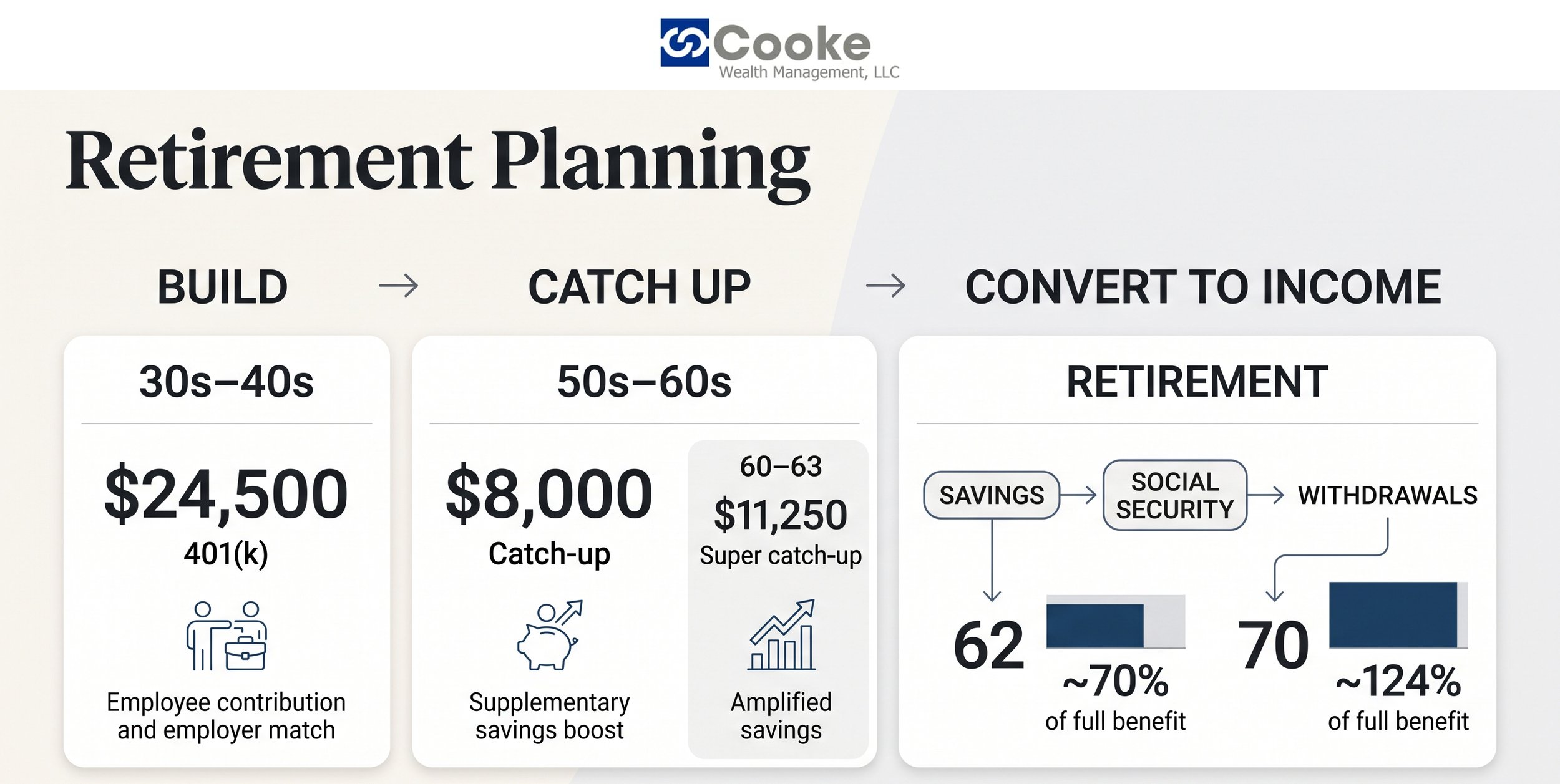
Retirement planning in your 30s and 40s is about grabbing every tax break before your expenses grow. In 2026, you can put $24,500 into your 401(k). If your employer offers a match, take it. Leaving that money behind is a mistake. You can add another $7,500 to a traditional or Roth IRA.
The choice between traditional and Roth can matter more in California than in other states. Every dollar you put into a Roth account today avoids California state tax when you withdraw it later. Our Six Steps to Prepare for Retirement guide explains how inflation and market swings change that math for your specific stage.
Closing the Gap: Income Strategies in Your 50s and 60s
This is the decade where the numbers either come together or they don't, and it's also when the tax code starts working harder in your favor. Anyone 50 or older can add a catch-up contribution of $8,000 to a 401(k) in 2026, and workers aged 60 to 63 get an even larger "super catch-up" of $11,250 under SECURE 2.0.
This stretch is also the window for Roth conversions, moving pre-tax money into a Roth IRA during lower-income years before Social Security and required withdrawals start stacking on top of each other. Our retirement saving tips for every age covers how to time these moves without pushing yourself into a higher bracket by accident.
Turning Savings Into a Paycheck: Income Strategies After You Retire
When to Start Social Security
Claiming Social Security at 62 locks in about 70% of your full benefit for life, while waiting until 70 pushes that figure to roughly 124%, based on claiming data compiled by Charles Schwab. Full retirement age is 67 for anyone born in 1960 or later.
Health, other income, and whether a spouse's benefit is involved all shape the right age to file. Still, a 54-point swing between the earliest and latest claiming date is wide enough to run as a real projection instead of a guess.
Required Minimum Distributions
SECURE 2.0 raised the age for required minimum distributions to 73 for people born between 1951 and 1959, and to 75 for anyone born in 1960 or later, according to RMD rules tracked by SmartAsset. Missing a distribution triggers a 25% excise tax on the amount that should have come out, cut to 10% if it's corrected within two years. That penalty is steep enough that RMD tracking usually belongs on a calendar, not in memory.
Sequencing Your Withdrawals
Because California taxes 401(k), IRA, and pension withdrawals but not Social Security, the order accounts get tapped in has a direct effect on your state tax bill. Pulling from taxable brokerage accounts first, then tax-deferred accounts, and saving Roth funds for last is a common default, though it isn't automatically right for every household, especially once RMDs are forcing withdrawals regardless of sequence.
Where Retirement Plans in Costa Mesa Go Wrong
A few mistakes show up often enough to name directly. Claiming Social Security at 62 out of habit, rather than a real comparison of the lifetime numbers, is one. Treating RMDs as a future problem instead of a fixed deadline with a 25% penalty attached is another.
A third is underestimating how much a 164.9 cost of living index compounds over a 20 or 30 year retirement, particularly on the housing side. None of these are complicated to avoid once the numbers are laid out against your accounts and timeline.
Why Costa Mesa Households Work With Cooke Wealth Management
Cooke Wealth Management has operated in Orange County since 2003, built around a father-daughter advisory team where both principals hold the CFP designation.
As a fiduciary, we are legally obligated to recommend what's best for the client rather than what pays the largest commission, which counts for more here than fund selection ever will. A bad Social Security or withdrawal decision is hard to undo once it's made.
If you're weighing when to start Social Security, how to sequence withdrawals, or whether your current savings rate gets you where you want to be, Cooke Wealth Management's retirement planning can work with you to help process is built to answer those questions with your specific numbers rather than a rule of thumb. Schedule a discovery session to see where your plan stands today.
Frequently Asked Questions
How much money do I need to retire in Costa Mesa?
There's no single number, but a common starting framework is 25 to 30 times your expected annual expenses, adjusted upward for Costa Mesa's cost of living index of 164.9. A household spending $80,000 a year, for example, might target somewhere between $2 million and $2.4 million before factoring in Social Security and any pension income.
Does California tax Social Security benefits?
No, California does not tax Social Security benefits at the state level, though the federal government may tax a portion depending on your total combined income. California does tax withdrawals from 401(k)s, IRAs, and pensions as ordinary income, which is why account sequencing matters more here than in states with no income tax at all.
When is the right age to start Social Security?
There's no single right age, since health, other income, and spousal benefits all factor in. What's fixed is the math: benefits grow about 8% for each year you delay past full retirement age, and that growth stops the moment you turn 70, so waiting any longer buys nothing.
What age do required minimum distributions start now?
Required minimum distributions start at 73 for people born between 1951 and 1959, and at 75 for anyone born in 1960 or later, under SECURE 2.0. One exception is worth knowing: Roth 401(k) balances have been exempt from RMDs since 2024, the same treatment Roth IRAs have always had, so money parked there isn't forced out on a schedule.
Is it worth hiring a local fiduciary advisor instead of a robo-advisor or call center?
For straightforward accumulation, a robo-advisor can be a reasonable low-cost option. Once Social Security timing, California-specific tax exposure, Roth conversions, and withdrawal sequencing all need to work together, a fiduciary who reviews your actual accounts tends to catch coordination issues that a standardized algorithm isn't built to flag.