
What Is a SLAT? Spousal Lifetime Access Trusts for High-Net-Worth Couples

taxable estate while enabling the other spouse to maintain access to them. This strategy removes the assets and their future growth from the estate without completely relinquishing household financial access.
However, SLATs are irrevocable and depend on an intact marriage. In California, community property laws also require specific legal steps prior to funding.
At Cooke Wealth Management, a fee-only fiduciary firm in Southern California, our financial planning process determines how much a couple can comfortably transfer, identifies the optimal assets to contribute, and ensures sufficient ongoing cash flow for the household.
If you are considering a SLAT, schedule a discovery session with our team to evaluate your options.
Understanding SLATs
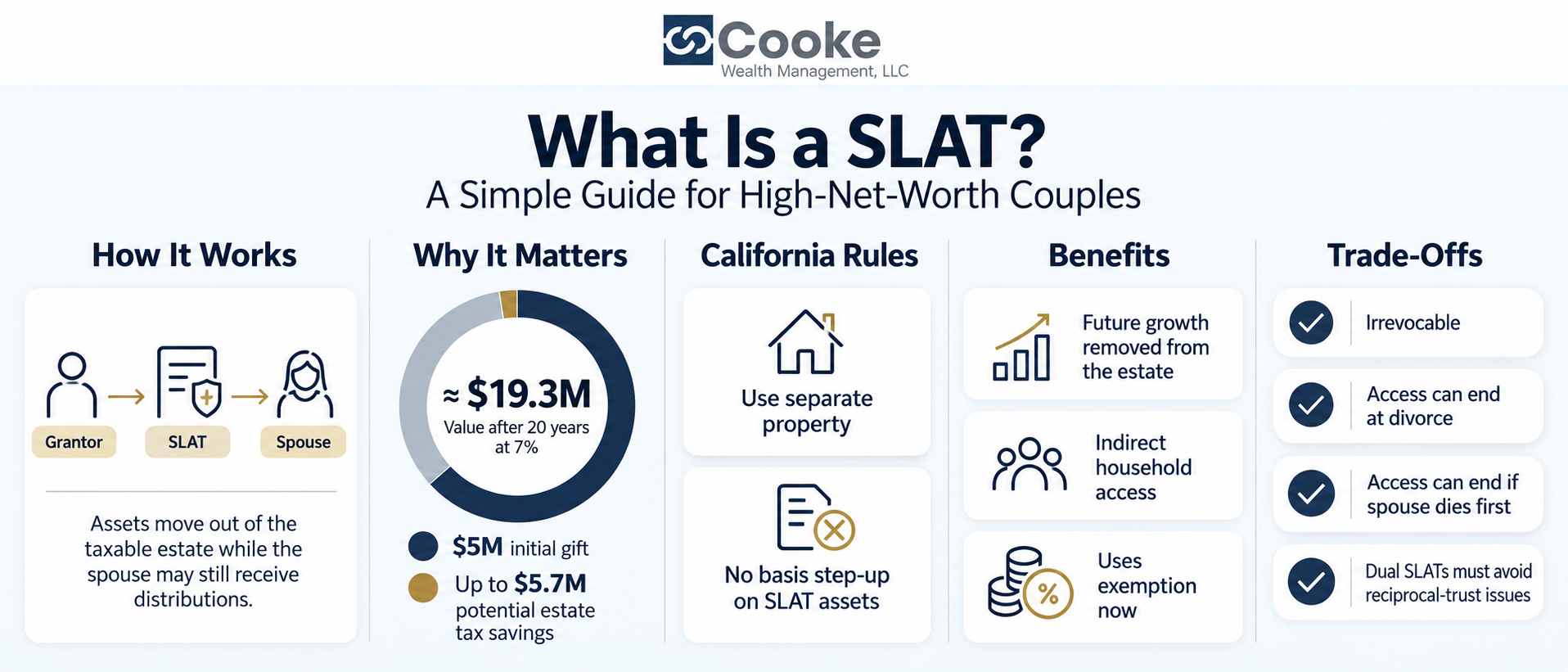
A SLAT is an irrevocable trust created and funded by one spouse for the benefit of the other spouse, and often their children or grandchildren. Because this transfer constitutes a completed gift, it utilizes the donor spouse's federal gift and estate tax exemption, effectively removing the assets and all future appreciation from both spouses' taxable estates.
Every SLAT involves three primary roles:
Grantor: The donor spouse who creates the trust and funds it with their separate property.
Beneficiary Spouse: The recipient of trust distributions, typically limited to health, education, maintenance, and support (HEMS) standards.
Trustee: The party responsible for managing assets and authorizing distributions. While the beneficiary spouse may serve as trustee under HEMS restrictions, an independent or corporate trustee is otherwise required.
Access to the trust is indirect: while the grantor cannot make direct withdrawals, distributions to the beneficiary spouse can continue supporting household financial needs during the marriage. This indirect access is what distinguishes a SLAT from a direct gift to descendants.
Most SLATs are structured as grantor trusts for tax purposes, requiring the grantor to pay annual income taxes on trust earnings. This allows the trust principal to compound without tax drag while further reducing the grantor's taxable estate. Per IRS Rev. Rul. 2004-64, these tax payments are not treated as additional taxable gifts.
Why SLATs Matter After the 2026 Exemption Change
SLATs were historically driven by urgency around the expiring exemption. That deadline is gone: under the One Big Beautiful Bill Act, the federal gift and estate tax exemption is $15 million per person for 2026, indexed for inflation without a scheduled sunset, according to Morgan Lewis.
The key question now is whether your total estate will exceed the $30 million combined exemption for married couples. For example, funding a SLAT with $5 million in growth assets at a 7% annual return yields roughly $19.3 million in 20 years. That removes $14.3 million in appreciation from both estates, saving up to $5.7 million under the 40% top federal estate tax rate.
Because the transfer is valued on the date of the gift, all future growth belongs entirely to the trust. Consequently, SLATs are ideal for couples nearing or exceeding $30 million, or holding rapid-appreciation assets, provided they retain sufficient personal liquidity outside the trust.
California Considerations: Community Property and Basis Step-Up
As a community property state, California introduces two key structural considerations for SLATs:
1. Funding Must Utilize Separate Property
If a trust is funded with community property, half of the assets legally belong to the beneficiary spouse. That share could be treated as their own contribution, risking inclusion in their taxable estate.
To prevent this, couples typically execute a transmutation agreement to convert community assets into the donor spouse's separate property prior to funding. Under California Family Code § 852, this agreement must be in writing, explicitly state the change in ownership, and be signed by the spouse waiving their interest.
2. Transmutation Relinquishes Income Tax Benefits
Under IRC § 1014(b)(6), community property receives a full step-up on the basis of fair market value upon the first spouse's death. Conversely, assets held within a SLAT receive no basis step-up, as confirmed by the IRS in Rev. Rul. 2023-2.
Consider a rental property purchased for $1 million and now valued at $4 million. If retained as community property, the surviving spouse could sell it after the first death with minimal taxable capital gains. Inside a SLAT, the property retains its original $1 million cost basis (less depreciation), exposing a subsequent sale to substantial tax liabilities at federal rates alongside California's capital gains rate, which taxes gains as ordinary income.
For California couples, establishing a SLAT involves trading an income tax advantage (the dual basis step-up) for estate tax protection. This tradeoff is only advantageous if projected estate tax savings exceed the income tax cost. Consequently, high-basis or rapidly appreciating assets are often better suited for a SLAT than highly appreciated, low-basis real estate intended for long-term retention.
Key Benefits and Strategic Trade-Offs of a SLAT
A SLAT works when the tax benefits outweigh the loss of control.
| Pros | Cons |
|---|---|
|
Moves future growth out of both spouses' taxable estates
|
Irrevocable once funded |
| The beneficiary spouse can still receive distributions | The grantor's indirect access ends with a divorce or the beneficiary spouse's death |
| The grantor's income tax payments shrink the estate further | The grantor owes income tax on trust earnings every year |
| Uses exemption now, in case Congress lowers it later | No step-up in basis on trust assets at death |
Where SLATs Can Go Wrong
1. Divorce Risks
In the event of a divorce, a former spouse may remain a trust beneficiary, preventing the grantor from reclaiming transferred assets. To mitigate this risk, attorneys frequently incorporate a "floating spouse" provision, which defines the beneficiary as the grantor's current spouse. While this clause can redirect future distributions, it does not restore asset ownership to the grantor.
2. Death of the Beneficiary Spouse
Should the beneficiary spouse predecease the grantor, the grantor's indirect access to trust funds terminates, and the remaining assets typically pass to children or secondary beneficiaries. Maintaining life insurance on the beneficiary spouse is a common strategy to offset this potential financial shortfall.
3. The Reciprocal Trust Doctrine
When spouses establish dual SLATs for each other, substantially identical trust provisions risk IRS invalidation under the reciprocal trust doctrine. In United States v. Estate of Grace (1969), the Supreme Court held that interrelated trusts placing both spouses in substantially the same economic position cause trust assets to be included in their gross estates. To avoid this outcome, dual SLATs must feature distinct terms, funding dates, asset types, and trustees.
4. Income Tax Burden and Basis Considerations
Because grantor trust status obligates the grantor to pay annual income taxes on trust growth, tax liabilities can become significant as the portfolio grows. To manage tax exposure and planning efficiency, SLAT agreements often include a substitution power allowing the grantor to swap personal high-basis assets or cash for low-basis trust assets of equal value. Reacquiring low-basis assets before death restores the potential for a step-up in basis, though this strategy requires diligent ongoing monitoring.
Consulting a Fiduciary Advisor
While an estate planning attorney drafts the trust documents, the underlying financial decisions require careful analysis: determining how much wealth can be permanently gifted without compromising long-term living standards, and identifying which assets offer optimal tax efficiency once lost step-up in basis is factored in. These critical evaluations form the foundation of a comprehensive estate plan.
As a fee-only fiduciary firm in Orange County, Cooke Wealth Management guides families through these complex decisions without product sales or commission conflicts. If you are evaluating whether a SLAT aligns with your overarching financial strategy, schedule a discovery session with our team today.
Frequently Asked Questions
Can you undo a SLAT once it's set up?
No, a SLAT can't be undone once it's funded because it's irrevocable. The grantor can't take assets back or change beneficiaries on their own.
What's the difference between a SLAT and an ILIT?
A SLAT holds assets for a spouse's benefit during the grantor's lifetime, while an irrevocable life insurance trust (ILIT) is built to own a life insurance policy and keep the death benefit out of the estate. Some SLATs also own life insurance, which combines the two.
Do I have to file a gift tax return when I fund a SLAT?
Yes, funding a SLAT is a taxable gift that has to be reported on IRS Form 709, which is generally due April 15 of the year after the gift. No gift tax is owed as long as the gift fits within the grantor's remaining lifetime exemption, which is $15 million per person in 2026.
Can we split gifts to a SLAT so both of us use our exemptions?
Spouses usually can't split the full gift to a SLAT, because the beneficiary spouse's own share doesn't qualify. Under IRC § 2513 and Treas. Reg. § 25.2513-1(b)(4), splitting applies only to the portion going to other beneficiaries, and only if that portion can be measured and separated from the spouse's share.
Does California have a state estate tax?
California hasn't had a state estate tax since January 1, 2005, according to the California State Controller's Office. A SLAT here is aimed only at the federal estate tax, which tops out at 40%.
This article is educational and isn't legal or tax advice. Talk with an estate planning attorney and tax professional before creating a SLAT.