
Wealth Management Orange County: Planning for Long-Term Financial Security

Long-term financial security in Orange County rarely comes from a single good decision — it comes from a plan that holds together across market cycles, career changes, and decades of shifting priorities. Finding a wealth management partner who treats that as an ongoing responsibility, rather than a one-time transaction, tends to make the biggest difference over time.
Cooke Wealth Management is an independent, fee-based wealth management firm based in Irvine, serving individuals and families throughout Orange County and Southern California. The firm's approach centers on coordinated financial planning rather than isolated investment advice.
Why "Long-Term" Changes the Planning Approach
A plan built for the next year looks different from one built to last thirty or forty years. Long-term security requires anticipating decisions you haven't faced yet — a career change, a market downturn, a health event — rather than optimizing only for current circumstances.
What Wealth Management Actually Includes
The Core Areas of a Coordinated Plan
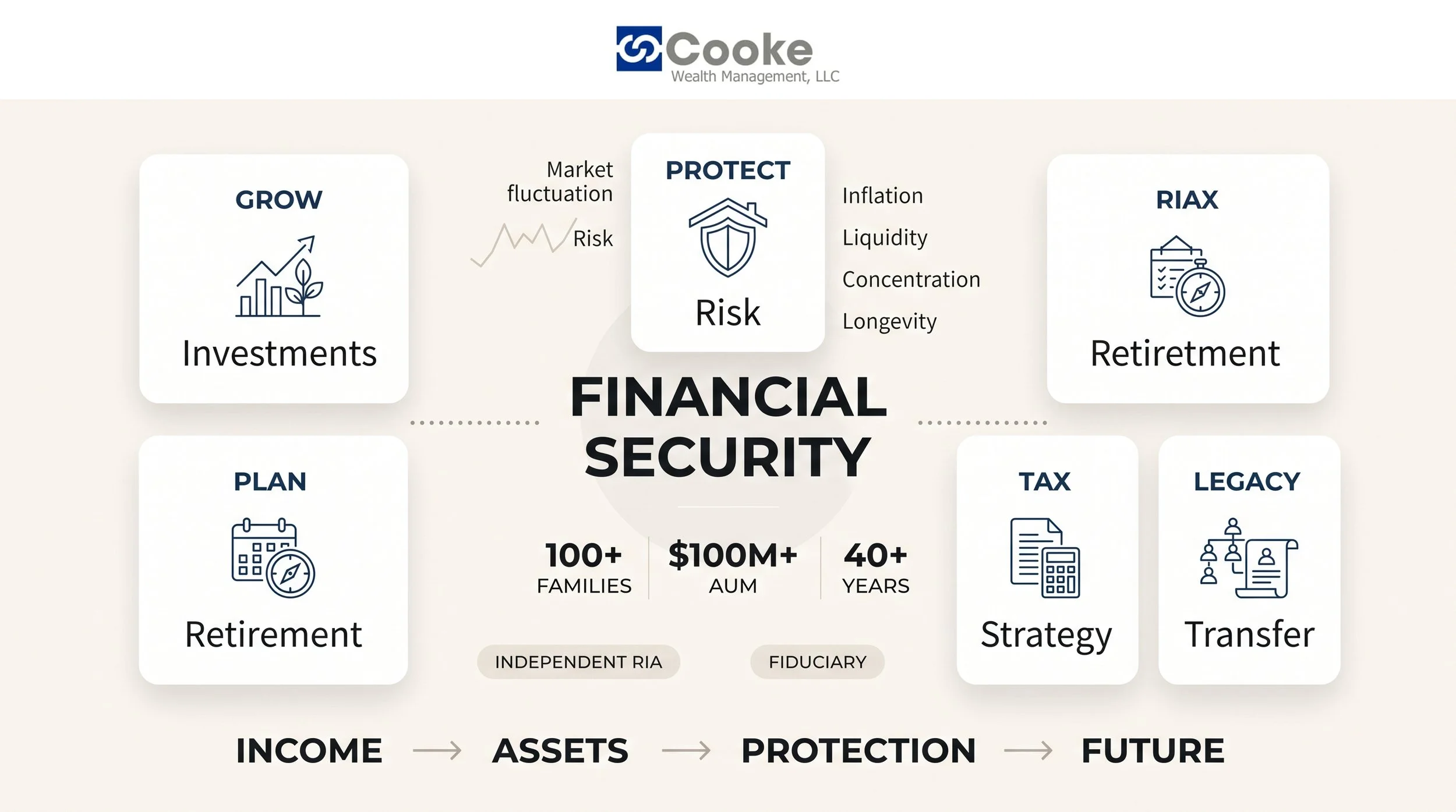
Wealth management typically covers retirement income planning, tax-aware investment strategy, insurance review, and wealth transfer guidance, evaluated together rather than as separate tasks. A decision in one area — say, when to claim Social Security — routinely affects taxes, healthcare costs, and portfolio withdrawals at the same time.
How Cooke Wealth Management Structures This Work
Cooke Wealth Management organizes its work around investment management, retirement planning, financial planning, and wealth transfer strategy. The firm builds a personalized plan for each client, then works with them on an ongoing basis to implement and adjust it as circumstances change.
Why Orange County Households Face Distinct Planning Challenges
A High Cost of Living Shapes the Math
Orange County's cost of living, particularly housing, changes what "enough" looks like for retirement compared to national averages. A retirement plan built around generic assumptions can significantly understate what's actually needed to maintain a comparable lifestyle locally.
A Mix of Careers, Equity, and Real Estate
The region's economy includes technology, healthcare, real estate, and small business ownership, each bringing its own planning considerations — equity compensation, business cash flow, or concentrated real estate holdings. A generic retirement calculator rarely accounts for these situations well.
A Financial Security Risk Map
Why Multiple Risks Have to Be Managed Together
Long-term financial security depends on managing several risks at once, because solving one problem can sometimes create another. The SEC notes that appropriate asset allocation depends on both time horizon and risk tolerance, while FINRA identifies market, inflation, liquidity, and concentration as distinct forms of investment risk that each require their own response.
A Quick Reference for Common Risks and Responses
| Risk | What can go wrong | Planning response |
|---|---|---|
| Market | A portfolio declines when assets are needed | Asset allocation and periodic rebalancing |
| Inflation | Rising costs erode purchasing power | Long-term growth and inflation-aware income planning |
| Longevity | Retirement assets are depleted too soon | Sustainable withdrawal and income strategies |
| Liquidity | Wealth cannot be accessed when needed | Appropriate cash reserves and liquid assets |
| Concentration | One stock, property, or asset drives too much of the outcome | Diversification and exposure monitoring |
| Tax | Taxes reduce the amount available for spending or retirement | Tax-aware distribution and investment decisions |
| Income | A job loss or business disruption reduces cash flow | Emergency reserves and contingency planning |
How These Risks Interact With Each Other
These risks also interact. A concentrated portfolio can suffer a major market decline, while insufficient liquidity may force an investor to sell during that downturn. Similarly, holding too much cash can reduce market exposure but leave long-term purchasing power vulnerable to inflation.
Liquidity and Concentration, Defined More Precisely
FINRA notes that liquidity risk concerns how easily an investment can be converted to cash, while concentration can amplify losses when too much wealth is tied to one investment or asset class. Understanding both precisely helps clarify why a portfolio that looks diversified on paper can still carry meaningful exposure to either risk.
Matching, Not Eliminating, Risk
The goal, therefore, isn't to eliminate risk — something no investment strategy can do — but to match each risk with an appropriate response. A long-term plan should be revisited as goals, financial circumstances, and time horizons change, with rebalancing used when a portfolio moves away from its intended allocation.
The Fiduciary Standard and Why It Matters
What Fiduciary Duty Actually Requires
Under the Investment Advisers Act of 1940, Registered Investment Advisers generally owe clients a fiduciary duty, meaning they must act in the client's best interest rather than simply recommend a "suitable" product. That obligation applies across the ongoing advisory relationship, not just at the point of a single transaction.
Fiduciary Duty Doesn't Mean Zero Conflicts
Being a fiduciary doesn't mean an advisor has no conflicts of interest — nearly every advisor has some form of compensation that could create potential incentives. What matters is whether those conflicts are identified and disclosed, which is why reviewing an advisor's Form ADV through the SEC's Investment Adviser Public Disclosure database is a useful step before committing to a relationship.
Independence Reduces Certain Conflicts
An independent, fee-only firm isn't tied to a parent company's proprietary product lineup, which reduces the incentive to steer clients toward in-house investments. Cooke Wealth Management operates as an independent Registered Investment Adviser, drawing recommendations from a broad universe of options rather than a limited menu.
How the Financial Planning Process Works
Starting With a Complete Financial Picture
Effective planning starts with a full view of income, expenses, investments, insurance, taxes, and long-term goals. Skipping this step is one of the most common reasons plans fail to hold up — recommendations built on incomplete information tend to break down the first time circumstances change.
An Ongoing Relationship, Not a Static Document
From there, a personalized plan gets built around a client's specific goals and revisited as life evolves. Cooke Wealth Management frames this as an ongoing relationship: clients work with their advisor to implement the plan, then adjust it over time rather than receiving a document that sits untouched for years.
Milestones That Typically Call for a Plan Update
Certain life events tend to require a fresh look at an existing plan, including:
A career change, promotion, or business transition
Marriage, divorce, or the birth of a child
Buying or selling a home in Orange County's market
An inheritance or unexpected windfall
Retirement approaching within the next five to ten years
Choosing a Wealth Management Firm in Orange County
Questions Worth Asking Before You Commit
A few direct questions can reveal how a firm actually operates: Are you a fiduciary at all times, or only in certain situations? How are you compensated, and what conflicts exist in your business? What does your typical client's situation look like, and does mine fit that profile?
Why Local Familiarity Still Matters
An advisor familiar with Orange County brings context that matters — local real estate dynamics, California-specific tax considerations, and an understanding of the region's cost of living. That local grounding, paired with a genuinely coordinated planning process, often distinguishes a firm worth hiring from one that simply has a nearby office.
Why Families Choose Cooke Wealth Management
A Track Record Built on Long-Term Relationships
Cooke Wealth Management has served more than 100 families and manages over $100 million in assets, with advisors bringing more than 40 years of combined industry experience. The firm's stated goal is to help clients avoid costly mistakes and build genuine confidence in their financial future.
A Values-Informed, Fiduciary Structure
The firm also incorporates biblical principles and academic research into its planning process, which resonates with some Orange County families specifically. Paired with its structure as an independent Registered Investment Adviser, that approach gives clients a planning relationship built around their stated priorities rather than a product to sell.
Start Planning for Long-Term Security
Financial security over the long term isn't something you achieve once and then stop thinking about — it's built and maintained through a plan that matches each risk with an appropriate response and adapts as your life does. The right Orange County wealth management partner treats that process as a decades-long relationship, not a single transaction.
Cooke Wealth Management works with individuals and families throughout Orange County and Southern California to build personalized financial plans grounded in fiduciary guidance. If you're ready to talk through your goals, scheduling a Discovery Session is a straightforward way to see whether the fit is right.
Frequently Asked Questions
What does a wealth management firm in Orange County actually do?
A wealth management firm typically coordinates investment management, retirement planning, tax-aware strategy, insurance review, and wealth transfer guidance into a single plan. The goal is to align financial decisions across all these areas rather than treating them as separate, unrelated tasks. Scope varies by firm, so it's worth confirming exactly what's included.
How does Orange County's cost of living affect retirement planning?
Orange County's housing costs and overall cost of living are higher than national averages, which changes how much is genuinely "enough" for a comparable retirement lifestyle. A generic retirement calculator based on national figures can significantly understate local needs. A planner familiar with the region can build more accurate projections.
Why can't a financial plan just eliminate risk entirely?
No investment strategy can eliminate risk, since risk and potential return are inherently connected, and different risks often require different, sometimes competing, responses. For example, holding more cash reduces market risk but increases exposure to inflation risk over time. The goal of a long-term plan is to match each risk with an appropriate response rather than to avoid risk altogether.
What is concentration risk, and why does it matter for long-term planning?
Concentration risk is the risk of amplified losses from having too much wealth tied to a single investment, property, or employer. Over a multi-decade planning horizon, this risk can compound if left unaddressed, particularly for households with significant equity compensation or real estate holdings. A coordinated plan evaluates diversification alongside other long-term goals.
How is an independent wealth management firm different from a bank or brokerage?
An independent firm isn't tied to a parent company's proprietary products, which can reduce certain conflicts of interest when making recommendations. Bank and brokerage advisors may have incentives to recommend in-house funds or products. Confirming an advisor's independence and fiduciary status is a reasonable first step in any evaluation.
How often should a long-term financial plan be reviewed?
Most advisors recommend at least an annual review, with additional check-ins after major life events like a job change, inheritance, or approaching retirement. A plan that isn't revisited regularly can become outdated as circumstances shift, especially over a multi-decade horizon. Rebalancing is also typically recommended whenever a portfolio has moved meaningfully away from its intended allocation.
How do I get started with Cooke Wealth Management?
Cooke Wealth Management offers a free Discovery Session to discuss your financial goals and determine whether the firm's approach fits your needs. From there, the firm builds a personalized plan rather than applying a generic template. You can schedule that initial conversation directly through the firm's contact page.