
Financial Advisor Orange County CA: Services Backed by Experience and Results

Choosing a financial advisor in Orange County often comes down to a simple question: has this firm actually done this work before, for people in situations like mine? Marketing language is easy to produce, but a track record built on real client relationships is harder to fake.
Cooke Wealth Management is an independent, fee-based Registered Investment Adviser based in Irvine, serving individuals and families throughout Orange County and Southern California with over 40 years of combined industry experience among its advisors.
What "Results" Should Actually Mean
In financial planning, "results" shouldn't be confused with guaranteed investment performance, since no advisor can promise specific returns. What experience and process can deliver is a coordinated plan, disciplined execution, and fewer costly mistakes over time — outcomes that are measurable in a different way than a single year's returns.
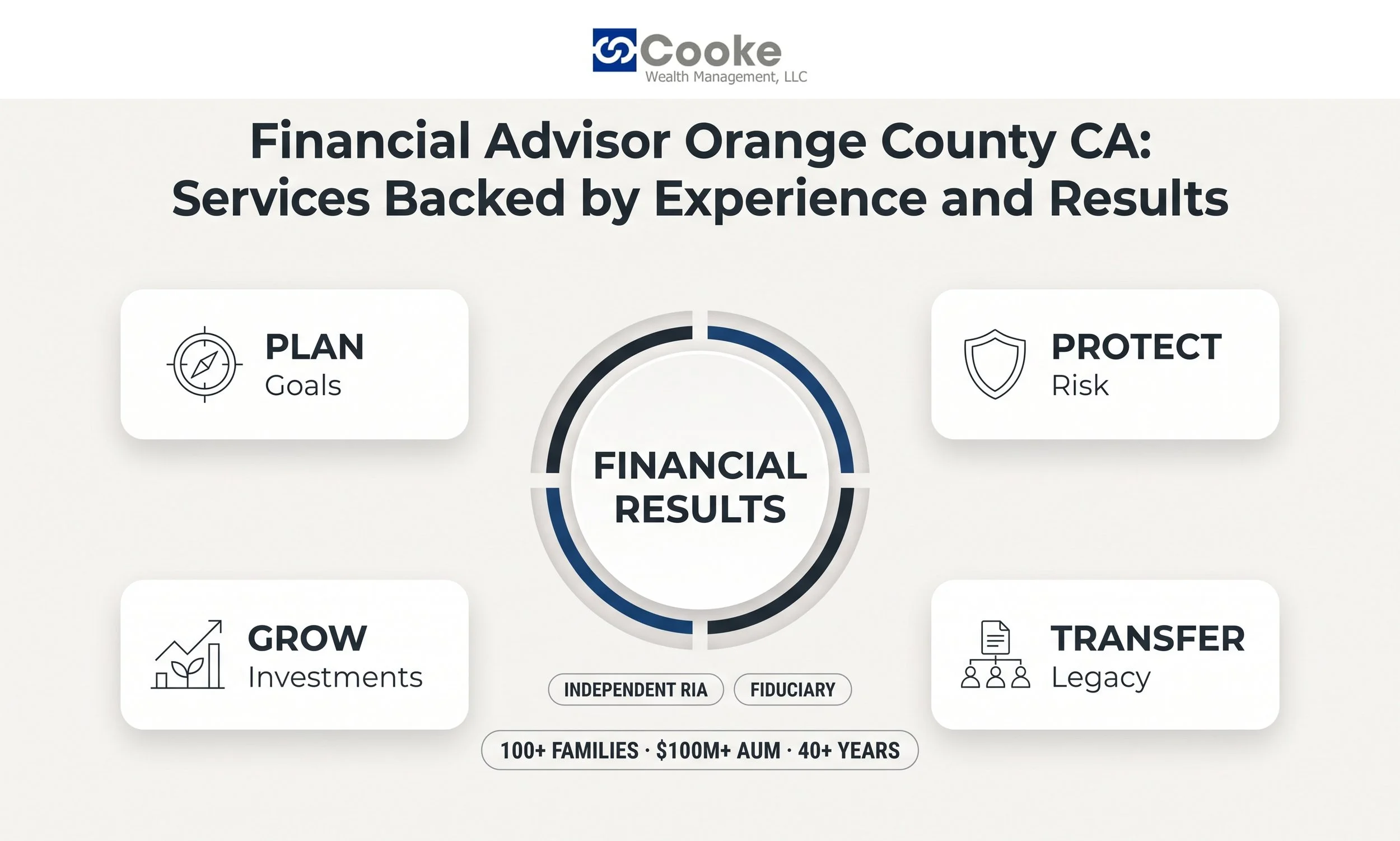
What Should Financial Advisor Results Actually Look Like?
Beyond Beating a Benchmark
The results of financial advice shouldn't be measured solely by whether a portfolio beats a particular benchmark in a given year. A more useful measure is whether the advice improves a client's ability to pursue defined financial goals while managing the risks that could derail them. The SEC notes that asset allocation should reflect an investor's risk tolerance and time horizon, while diversification can help reduce portfolio risk.
A Practical Framework for Evaluating Results
A practical framework for evaluating financial planning results includes:
Retirement readiness: Can projected income and assets support the client's desired retirement lifestyle?
Risk management: Have significant financial risks been identified and addressed?
Diversification: Is wealth overly concentrated in one company, property, industry, or asset class?
Tax efficiency: Are investment, withdrawal, and account decisions being evaluated for their potential tax consequences?
Liquidity: Are enough accessible assets available for emergencies and near-term obligations?
Estate readiness: Are beneficiaries, ownership arrangements, and wealth-transfer objectives properly coordinated?
Goal progress: Is the financial plan producing measurable progress toward specific objectives?
Decision quality: Are major financial decisions being made through a consistent process rather than emotional or short-term reactions?
Why Costs Belong in the Evaluation
Costs should also be part of the evaluation. The SEC warns that investment fees and expenses can significantly reduce portfolio value over time, making cost awareness an important component of financial outcomes rather than an afterthought.
What "Experience and Results" Should Actually Mean
This approach makes "experience and results" more meaningful: results become measurable improvements in financial preparedness, risk management, efficiency, and progress toward personal goals — not unsupported promises of superior investment returns. A firm willing to be evaluated on these terms is generally one worth taking seriously.
The Services a Full-Service Financial Advisor Provides
Financial Planning as the Foundation
Cooke Wealth Management's financial planning work starts with a complete view of a client's income, expenses, investments, insurance, and long-term goals. From there, a personalized plan is built and implemented, rather than a client receiving a generic template disconnected from their actual circumstances.
Investment Management Aligned With Goals
Investment management involves building and maintaining a portfolio suited to a client's specific timeline, risk tolerance, and objectives. This is where the diversification and cost-awareness principles above show up directly in day-to-day portfolio decisions.
Retirement Planning Built Around a Specific Question
Retirement planning addresses a deceptively simple question: how much is actually enough, given a client's goals and expected lifestyle. Answering it well requires coordinating investment withdrawals, Social Security timing, and tax planning rather than relying on a single savings target.
Wealth Transfer Guidance for the Next Generation
Wealth transfer planning coordinates the tax-efficient movement of assets to heirs, addressing beneficiary designations, estate documents, and timing decisions. This work tends to matter most for clients who see their estate as something to steward deliberately rather than distribute by default.
Why Experience Matters in Financial Planning
Patterns That Only Show Up Over Time
Experienced advisors have generally seen a wider range of client situations — market downturns, unexpected life events, tax law changes — which helps them anticipate problems before they occur rather than reacting to them. This kind of pattern recognition is difficult to replicate without years of direct client work.
A Track Record Built on Client Relationships
Cooke Wealth Management has served more than 100 families and manages over $100 million in assets, figures that reflect a sustained track record of client relationships rather than a single successful campaign. Longevity in this business, particularly through multiple market cycles, says something about how a firm has actually performed for its clients over time.
The Fiduciary Standard Behind the Services
A Legal Obligation, Not a Marketing Claim
Under the Investment Advisers Act of 1940, Registered Investment Advisers generally owe clients a fiduciary duty, meaning they're legally required to act in the client's best interest. This standard applies across the advisory relationship, not just at the moment a specific recommendation is made.
Fiduciary Duty and Disclosed Conflicts
Being a fiduciary doesn't mean an advisor has zero conflicts of interest — nearly every advisor has some form of compensation that creates potential incentives. What matters is whether those conflicts are identified and disclosed, which can be verified through an advisor's Form ADV on the SEC's Investment Adviser Public Disclosure database.
Independence as a Structural Safeguard
Cooke Wealth Management operates as an independent Registered Investment Adviser, meaning it isn't built around promoting a parent company's proprietary product lineup. That independence supports recommendations drawn from a broad universe of options rather than a narrower menu tied to one company's revenue goals.
How Risk Management Fits Into Service Quality
Managing Several Risks at Once
A financial advisor's value shows up partly in how well they manage risk across a plan, not just how a portfolio performs in a strong market. FINRA identifies market, inflation, liquidity, and concentration as distinct forms of investment risk, each requiring a different planning response rather than a single blanket strategy.
Concentration Risk for Orange County Clients
Concentration risk — too much wealth tied to a single stock, employer, or property — is a common issue for Orange County clients with equity compensation or real estate-heavy portfolios. FINRA warns that concentration can amplify losses, making this a specific area where an experienced advisor should proactively address exposure rather than leave it unmentioned.
What Sets Cooke Wealth Management Apart
A Values-Informed Approach
Cooke Wealth Management incorporates biblical principles alongside academic research and hands-on planning experience, an approach that resonates with some Orange County families specifically. This layer sits on top of, rather than replaces, the firm's technical planning process and fiduciary structure.
Combining Experience With Structural Accountability
The combination of decades of combined advisor experience and a fiduciary, independent structure is meant to give clients both practical know-how and legal accountability. Neither element alone fully addresses what most clients are actually looking for in an advisory relationship.
How to Evaluate a Financial Advisor's Track Record
Questions Worth Asking Directly
A few direct questions can help evaluate whether a firm's experience translates into meaningful service: How long has the firm been operating, and how many clients does it currently serve? What does your typical client's situation look like, and does mine fit that profile? Are you a fiduciary at all times, and how are you compensated?
Verifying Claims Independently
Beyond asking directly, reviewing a firm's Form ADV and Form CRS provides independent documentation of its business history, services, and disclosed conflicts. This step matters because marketing claims about experience and results should be verifiable, not simply taken on faith.
Work With an Advisor Whose Track Record You Can Verify
Experience and results in financial advising aren't things to take on faith — they should be reflected in a firm's actual client history, service structure, and regulatory disclosures, and measured against a client's own progress rather than a single benchmark. A firm willing to be transparent about all of this is generally one worth taking seriously.
Cooke Wealth Management works with individuals and families throughout Orange County and Southern California, backed by more than 40 years of combined advisor experience and a fiduciary structure. If you're ready to talk through your goals, scheduling a Discovery Session is a straightforward way to see whether the fit is right.
Frequently Asked Questions
What services does a full-service financial advisor typically offer?
A full-service financial advisor typically offers financial planning, investment management, retirement planning, and wealth transfer guidance, coordinated together rather than provided as separate, unrelated services. The exact scope varies by firm, so it's worth confirming what's actually included before hiring one. Some clients want all of these services, while others want only specific pieces.
How should I actually measure a financial advisor's results?
Results are better measured by progress toward specific goals — retirement readiness, risk management, diversification, tax efficiency, liquidity, and estate readiness — rather than by whether a portfolio beat a particular benchmark in a given year. Decision quality, meaning whether major choices follow a consistent process rather than emotional reactions, is also part of this picture. No single number fully captures whether a financial plan is working.
How do fees affect long-term investment results?
Even seemingly small fees can meaningfully reduce a portfolio's value over time, since fees compound the same way returns do. The SEC has illustrated that a 1% annual fee, compared to a 0.25% fee, can reduce a $100,000 portfolio's value by tens of thousands of dollars over 20 years. Understanding and comparing fees is an important part of evaluating any advisor or investment.
Does more experience guarantee better investment returns?
No. Experience can improve how well an advisor manages risk, coordinates planning decisions, and anticipates problems, but it doesn't guarantee specific investment outcomes, since all investments carry some degree of risk. What experience typically does provide is a more disciplined, tested process for handling a wide range of client situations.
What is concentration risk, and why should Orange County clients pay attention to it?
Concentration risk is the risk of amplified losses from having too much wealth tied to a single investment, property, or employer. This is a common issue for Orange County clients with equity compensation or significant real estate holdings. An experienced advisor should proactively evaluate this risk rather than address it only after a problem arises.
Is a fiduciary advisor automatically free of conflicts of interest?
No. Fiduciary duty requires an advisor to identify and either eliminate or fully disclose conflicts of interest, not to have none at all. Understanding how conflicts are disclosed and managed matters more than assuming a fiduciary label means conflict-free advice.
How do I get started with Cooke Wealth Management?
Cooke Wealth Management offers a free Discovery Session to discuss your financial goals and determine whether the firm's experience and approach fit your needs. From there, the firm builds a personalized plan rather than applying a generic template. You can schedule that initial conversation directly through the firm's contact page.