
Retirement Planning Advisors Newport Beach Residents Trust for Lasting Income

Retirement planning in Newport Beach carries a specific kind of pressure: the goal isn't just accumulating enough to retire, but building income that reliably lasts through decades of uncertain markets, rising costs, and an unpredictable lifespan. Finding an advisor who treats "lasting income" as the actual objective — not just a portfolio balance — makes a meaningful difference in how that retirement plays out.
Cooke Wealth Management is an independent, fiduciary wealth management firm based in nearby Irvine, providing retirement planning for families throughout Newport Beach, Orange County, and Southern California. A large account balance means little if it can't reliably support spending for 20 or 30 years, so this guide focuses on what actually makes retirement income last.
Why Newport Beach Retirees Face Distinct Income Challenges
A Higher Cost of Living Changes the Math
Newport Beach's cost of living, particularly housing and healthcare, means retirement income needs to stretch further than national averages suggest. A generic retirement calculator built around national figures can significantly understate what's actually required to maintain a comparable lifestyle locally.
Concentrated Assets Complicate Income Planning
Many Newport Beach retirees carry concentrated wealth in real estate, business interests, or equity compensation accumulated over a career. Converting these assets into reliable income requires more coordination than simply drawing down a diversified investment account.
Build a Retirement Income Map, Not Just a Withdrawal Strategy
Coordinating Sources, Not Just Following a Rule
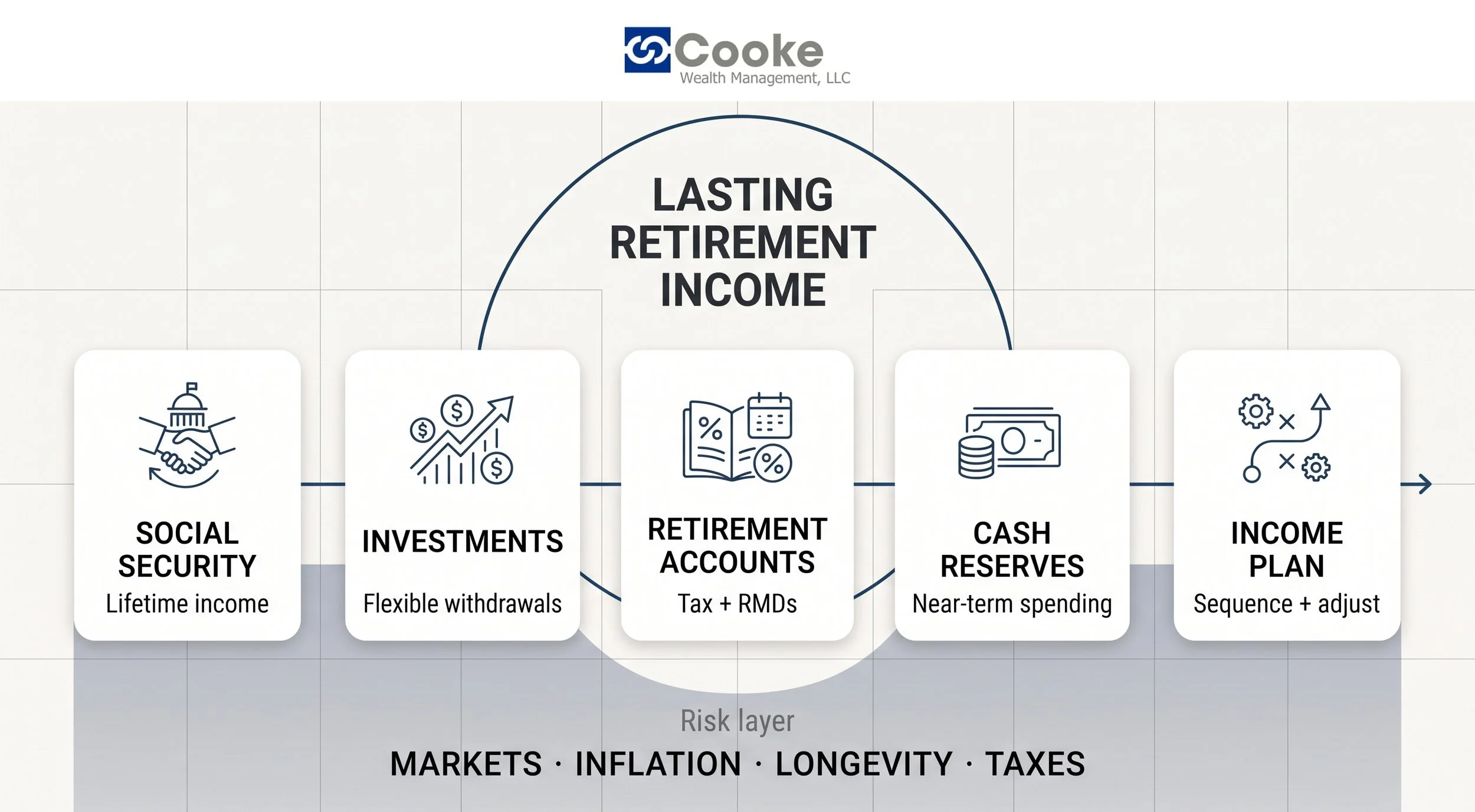
Lasting retirement income rarely comes from a single account or withdrawal rule. It comes from coordinating the different sources of income so that each plays an appropriate role at different stages of retirement. Social Security, for example, can provide lifetime income, with delayed retirement credits increasing benefits for those who wait beyond full retirement age, up to age 70.
Mapping Each Income Source to Its Role
| Income Source | Potential Role | Planning Question |
|---|---|---|
| Social Security | Lifetime income | When should benefits begin? |
| Taxable investments | Flexible withdrawals | Which assets should be sold first? |
| Traditional IRA/401(k) | Taxable retirement income | How should withdrawals interact with taxes and RMDs? |
| Roth assets | Tax-free qualified withdrawals | Should these assets be preserved for later retirement? |
| Cash reserves | Near-term spending | How much liquidity is appropriate? |
| Pension or annuity income | Guaranteed income | Which essential expenses can be covered without portfolio withdrawals? |
Which essential expenses can be covered without portfolio withdrawals?
Why the Interaction Between Sources Gets Complicated
The interaction between these sources is where retirement-income planning becomes more complex. Traditional IRAs and many retirement plans generally require minimum distributions beginning at age 73, while original owners of Roth IRAs aren't required to take RMDs during their lifetime. That means the timing and order of withdrawals can affect both cash flow and taxes.
Allocation Still Has to Fit the Retiree, Not a Formula
Investment allocation also needs to reflect the retiree's time horizon and risk tolerance, rather than following a universal portfolio formula. A retiree drawing income for essential expenses has different needs than one using investments purely for discretionary spending.
Turning a General Goal Into a Measurable Strategy
A strong retirement plan therefore maps which income source funds which expenses, when each source should be tapped, and how the strategy changes as circumstances evolve. That turns "lasting income" from a general objective into a coordinated, measurable retirement strategy.
What "Lasting Income" Actually Requires
Sequencing Withdrawals Across Account Types
Sustainable retirement income typically depends on sequencing withdrawals across taxable, tax-deferred, and tax-free accounts in a way that manages the overall tax burden year to year. Cooke Wealth Management's retirement planning work focuses on this kind of sequencing, since the order withdrawals happen in can materially affect how long a portfolio lasts.
Managing Required Minimum Distributions
Required minimum distributions from certain retirement accounts begin at a specific age and are generally taxable, which can affect both tax brackets and Medicare premium costs if not planned for in advance. Coordinating these distributions with other withdrawals is a key part of keeping a retirement income plan tax-efficient over time.
Sequence-of-Returns Risk and Why It Matters So Much
Why Timing Can Matter More Than Average Returns
A market downturn shortly before or after retirement can do more lasting damage than the same downturn a decade earlier, because there's less time to recover before ongoing withdrawals are required. This is known as sequence-of-returns risk, and it's one of the more overlooked threats to a retirement income plan.
Strategies That Help Manage This Risk
Common approaches to managing this risk include maintaining a cash reserve to avoid selling investments during a downturn, adjusting withdrawal rates based on market conditions, and diversifying income sources so retirement isn't entirely dependent on portfolio performance in any given year. A financial planner can help determine which combination of these strategies fits a specific retirement timeline.
Inflation and Longevity: The Two Long-Term Threats
Why Inflation Erodes Income Over Decades
Inflation risk, the gradual loss of purchasing power, becomes more consequential the longer a retirement lasts. A retirement income plan built around static, non-adjusting withdrawals can leave a retiree with meaningfully less real purchasing power a decade or two into retirement.
Planning for a Retirement That Could Last 30 Years
Longevity risk, the possibility of outliving retirement assets, has become more relevant as life expectancies have increased. A sustainable withdrawal strategy needs to account for a retirement that could realistically last three decades, not just the first ten or fifteen years.
The Fiduciary Standard and Why It Matters for Income Planning
A Legal Obligation Across the Retirement Relationship
Under the Investment Advisers Act of 1940, Registered Investment Advisers generally owe clients a fiduciary duty, meaning they're legally required to act in the client's best interest across the advisory relationship. This matters particularly for retirement income planning, since the relationship typically spans decades rather than a single transaction.
Fiduciary Duty Doesn't Eliminate Conflicts, But It Requires Disclosure
Being a fiduciary doesn't mean an advisor has zero conflicts of interest — nearly every advisor has some form of compensation that creates potential incentives. What matters is whether those conflicts are identified and disclosed, which can be verified through an advisor's Form ADV on the SEC's Investment Adviser Public Disclosure database.
What Retirement-Focused Planning Includes
Coordinating Income, Investments, and Insurance
A retirement-focused plan typically coordinates income sequencing, investment management, insurance needs, and estate considerations rather than treating each in isolation. Cooke Wealth Management's investment management work builds portfolios aligned with a client's income needs and risk tolerance, since a retirement portfolio generally requires a different approach than one built purely for accumulation.
An Ongoing Relationship That Adjusts Over Time
Retirement income needs change as circumstances evolve — healthcare costs increase, spending patterns shift, and market conditions vary from year to year. Cooke Wealth Management frames retirement planning as an ongoing relationship, revisiting the plan regularly rather than delivering a single static projection.
Choosing a Retirement Planning Advisor in Newport Beach
Questions Worth Asking Directly
A few direct questions can reveal how an advisor approaches retirement income specifically: How do you sequence withdrawals across different account types? How do you address sequence-of-returns risk near retirement? Are you a fiduciary 100% of the time, and how are you compensated?
Why Local Familiarity Still Matters
An advisor familiar with Newport Beach brings context that matters — local real estate dynamics, California-specific tax considerations, and an understanding of the area's cost of living. That local grounding, paired with genuine retirement income expertise, often distinguishes an advisor worth trusting from one who simply has a nearby office.
Why Newport Beach Residents Trust Cooke Wealth Management
A Track Record Built on Long-Term Relationships
Cooke Wealth Management has served more than 100 families and manages over $100 million in assets, with advisors bringing more than 40 years of combined industry experience. That experience includes working with retirees whose income needs to last across multiple decades and market cycles.
A Fiduciary, Independent Structure
As an independent Registered Investment Adviser, Cooke Wealth Management operates under a fiduciary standard rather than a narrower, commission-driven model. That structure is designed to align the firm's obligations directly with each client's retirement outcomes, not a product to sell.
Build Retirement Income That's Built to Last
Retirement planning isn't just about reaching a savings target — it's about mapping every income source to its role and building income that holds up across market downturns, inflation, and a retirement that could last decades. That requires a plan specifically built around sustainability, not just accumulation.
Cooke Wealth Management works with individuals and families throughout Newport Beach, Orange County, and Southern California to build retirement income plans grounded in fiduciary guidance. If you're ready to talk through your retirement goals, scheduling a Discovery Session is a straightforward way to see whether the fit is right.
Frequently Asked Questions
What does it mean to build a "retirement income map"?
A retirement income map coordinates different income sources — Social Security, taxable investments, retirement accounts, and cash reserves — assigning each a specific role rather than relying on a single withdrawal rule. It also accounts for how these sources interact through taxes and required distributions. This turns a general savings goal into a specific, coordinated strategy.
What is sequence-of-returns risk, and why does it matter so much near retirement?
Sequence-of-returns risk is the danger that poor investment performance early in retirement, combined with ongoing withdrawals, can permanently damage a portfolio's ability to last. It matters more in the years just before and after retirement than during the accumulation years, since there's less time to recover from a downturn. Strategies like cash reserves and flexible withdrawal rates can help manage this risk.
When should I claim Social Security to maximize lasting income?
The right claiming age depends on your health, other income sources, and overall retirement income strategy, since claiming earlier reduces the monthly benefit while waiting increases it through delayed retirement credits up to age 70. There's no single correct answer for everyone, which is why this decision should be evaluated alongside the rest of a retirement income plan.
How do required minimum distributions affect retirement income planning?
Required minimum distributions generally begin at age 73 for traditional IRAs and many retirement plans and are taxable as income, while Roth IRA owners aren't required to take them during their lifetime. Failing to plan for RMDs can push retirees into a higher tax bracket than expected or affect Medicare premium costs. Coordinating these distributions with other withdrawals in advance helps manage this impact.
How does inflation affect a retirement income plan over time?
Inflation gradually erodes purchasing power, meaning a fixed amount of retirement income buys less over time unless the withdrawal strategy accounts for rising costs. A retirement plan built around static, non-adjusting withdrawals can leave a retiree with meaningfully reduced purchasing power a decade or two into retirement. Planning for inflation-aware income growth is an important part of a sustainable strategy.
Why do Newport Beach retirees often need more specialized income planning?
Newport Beach retirees frequently have concentrated wealth in real estate, business interests, or equity compensation, along with a higher local cost of living than national averages. Converting these assets into reliable income requires more coordination than a standard withdrawal strategy. A local advisor familiar with these dynamics can build more accurate, sustainable projections.
How do I get started with Cooke Wealth Management?
Cooke Wealth Management offers a free Discovery Session to discuss your retirement income goals and determine whether the firm's approach fits your needs. From there, the firm builds a personalized plan rather than applying a generic template. You can schedule that initial conversation directly through the firm's contact page.