
What to Expect from a Leading Financial Advisor in Irvine: A Complete Guide

Choosing a financial advisor in Irvine is a decision that shapes decades of financial outcomes, yet many people go into that search without a clear sense of what a genuinely good advisor relationship should actually look like. This guide walks through what to expect at each stage — from the first conversation to years into an ongoing relationship.
Cooke Wealth Management is an independent, fee-based Registered Investment Adviser based in Irvine, California, serving families throughout Orange County and Southern California with more than 40 years of combined advisor experience.
Why Expectations Matter Before You Start
Going into an advisor search without a clear picture of what to expect makes it harder to recognize red flags or evaluate whether a firm is actually a good fit. Understanding the process in advance turns the search into an informed comparison rather than a leap of faith.
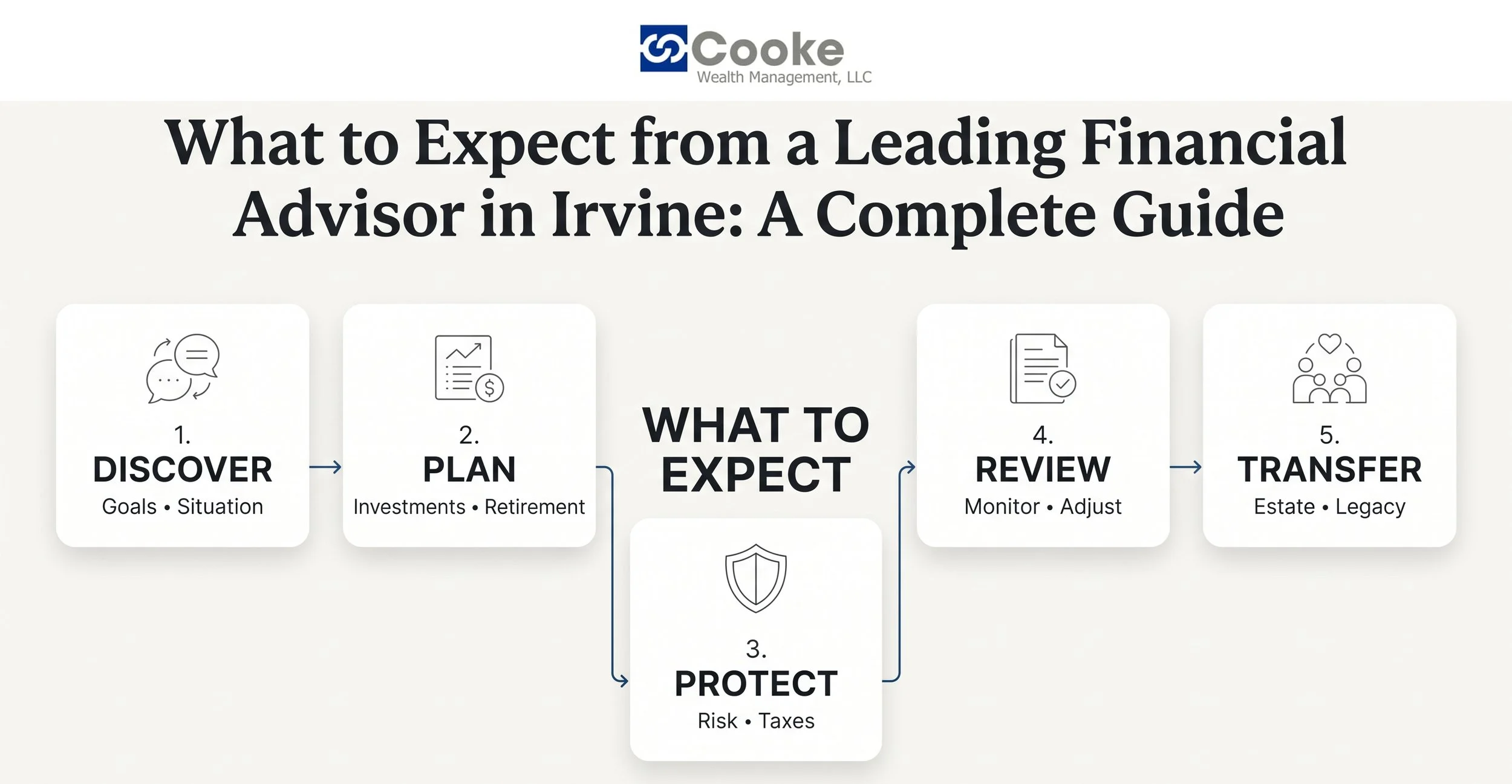
What to Expect From the Initial Consultation
A Conversation Focused on Your Situation, Not a Sales Pitch
A leading financial advisor typically starts with a conversation focused on understanding your goals, current financial picture, and concerns, rather than immediately pitching specific products. Cooke Wealth Management frames this as a Discovery Session, designed to determine whether the firm's approach genuinely fits your needs before any commitment is made.
Questions You Should Expect to Be Asked
Expect to be asked about your income, expenses, existing investments, insurance coverage, family situation, and long-term goals. A thorough initial conversation should feel more like an intake process for a comprehensive plan than a quick chat leading straight to a product recommendation.
What Should a Financial Advisor Actually Deliver?
More Than a Portfolio Statement
A financial advisor's value should be visible in more than a portfolio statement. A genuinely comprehensive relationship should produce a structured process that connects your financial goals, resources, risks, and decisions over time. CFP Board's financial planning framework moves from understanding a client's circumstances and identifying goals through analysis, recommendations, implementation, and ongoing monitoring — giving consumers a useful benchmark for what a complete planning relationship should involve.
A Reference Table for What You Should Receive
| Advisor Deliverable | What You Should Actually Receive |
|---|---|
| Financial plan | Documented goals, assumptions, priorities, and recommendations |
| Investment strategy | An allocation connected to your risk tolerance and time horizon |
| Retirement plan | Income sources, spending needs, withdrawal strategy, and scenarios |
| Risk review | Identification of liquidity, concentration, longevity, and other relevant risks |
| Tax planning | Investment and withdrawal decisions evaluated for tax consequences |
| Estate coordination | Beneficiary and wealth-transfer considerations integrated into the plan |
| Ongoing monitoring | A defined review process with progress tracked against objectives |
| Decision support | Analysis of alternatives before significant financial decisions |
Why This Distinction Matters When Comparing Advisors
This distinction matters when comparing advisors in Irvine. "Investment management" or "financial planning" can describe very different levels of service, so prospective clients should ask what the engagement actually produces and how recommendations will be updated. Investment recommendations should also reflect factors such as risk tolerance and time horizon, which the SEC identifies as important considerations when determining an appropriate asset allocation.
The Better Question to Ask
Ultimately, the best question is not simply "what services do you offer?" but "what will I receive, how will we measure progress, and how will the plan change as my circumstances change?" A leading advisor should be able to answer all three clearly and specifically.
What to Expect From Fiduciary Duty and Transparency
A Clear Answer About Legal Obligations
A leading advisor should be able to clearly explain whether they're a fiduciary at all times, since Registered Investment Advisers generally owe clients this duty under the Investment Advisers Act of 1940. Vague or evasive answers to this question are worth treating as a warning sign regardless of how polished the rest of the conversation feels.
Transparency About Compensation and Conflicts
Expect a clear explanation of how the advisor is compensated and what conflicts of interest, if any, exist in their business. Being a fiduciary doesn't mean an advisor has zero conflicts — it means those conflicts must be identified and disclosed, which you can also verify independently through the SEC's Investment Adviser Public Disclosure database.
What to Expect From Investment Management
Portfolios Aligned With Your Timeline and Goals
Cooke Wealth Management's investment management approach builds portfolios aligned with each client's specific timeline, risk tolerance, and goals rather than a generic model applied to every client the same way.
Clear Communication About Fees and Costs
Expect a clear breakdown of any fees associated with managing your investments, since the SEC has noted that even small ongoing fees can significantly reduce portfolio value over time. A leading advisor should proactively explain costs rather than requiring you to dig for them.
What to Expect From Retirement Planning
A Specific Answer to "How Much Is Enough?"
Cooke Wealth Management's retirement planning work is built around answering how much is genuinely enough for your specific retirement goals, rather than applying a generic savings rule. Expect a discussion of income sources, Social Security timing, and how withdrawals will be sequenced across different account types.
Ongoing Adjustments, Not a One-Time Projection
A leading advisor treats retirement planning as an evolving process, revisiting projections as your circumstances, tax laws, and market conditions change. A projection delivered once and never updated isn't a retirement plan — it's a snapshot that goes stale quickly.
What to Expect Regarding Risk Management
Proactive Identification of Risk, Not Just Reaction
A leading advisor should proactively identify risks that could disrupt your plan — market, inflation, liquidity, longevity, and concentration risk among them — rather than waiting for a problem to surface. FINRA outlines these as distinct categories of investment risk, each requiring its own planning response.
Direct Attention to Concentration Risk
If you hold significant equity compensation or concentrated real estate, expect your advisor to raise diversification directly rather than leave it unaddressed. FINRA warns that concentration can amplify losses, and a leading advisor treats this as a priority conversation, not an afterthought.
What to Expect From an Ongoing Relationship
Regular Reviews, Not a One-Time Interaction
Expect at least an annual review of your financial plan, along with additional check-ins after major life events like a job change, inheritance, or approaching retirement. A firm that disappears after the initial planning phase isn't providing the kind of ongoing guidance a comprehensive relationship requires.
Adjustments as Your Life Changes
A leading advisor adjusts your plan as circumstances evolve rather than expecting your life to fit a static document. This is especially relevant for Irvine clients navigating career changes, business ownership, or shifting family needs over time.
What to Expect From Wealth Transfer and Estate Coordination
Coordination With Estate Documents and Beneficiaries
Expect your advisor to review beneficiary designations, coordinate with your estate planning attorney, and discuss wealth transfer objectives as part of the broader plan. This coordination matters because retirement accounts and other assets don't automatically transfer according to your intentions without proper documentation.
A Long-Term View of Generational Wealth
A leading advisor treats wealth transfer as an ongoing consideration throughout the planning relationship, not a topic reserved for late in life. Cooke Wealth Management's approach incorporates this kind of long-horizon thinking as part of its broader planning process.
Why Cooke Wealth Management Meets These Expectations
Experience Built on Long-Term Client Relationships
Cooke Wealth Management has served more than 100 families and manages over $100 million in assets, with advisors bringing more than 40 years of combined industry experience. The firm's stated goal is to help clients avoid costly mistakes and build genuine confidence in their financial future.
A Values-Informed, Fiduciary Approach
The firm also incorporates biblical principles and academic research into its planning process, an approach that resonates with some Orange County families specifically. Combined with its structure as an independent Registered Investment Adviser, that approach gives clients both a values-aligned relationship and legal accountability.
Start Your Search With Clear Expectations
Knowing what to expect from a leading financial advisor makes it far easier to recognize whether a firm is genuinely built to serve your interests. The right advisor relationship should feel collaborative, transparent, and ongoing — not a single transaction followed by silence.
Cooke Wealth Management works with individuals and families throughout Irvine, Orange County, and Southern California to build personalized financial plans grounded in fiduciary guidance. If you're ready to see whether the fit is right, scheduling a Discovery Session is a straightforward first step.
Frequently Asked Questions
What should I expect from an initial meeting with a financial advisor?
A strong initial meeting should focus on understanding your goals, financial situation, and concerns rather than immediately pitching specific products or services. Expect to be asked detailed questions about your income, expenses, investments, and long-term objectives. This conversation should help both you and the advisor determine whether the relationship is a good fit.
What should a financial advisor actually deliver beyond investment returns?
A comprehensive relationship should deliver a documented financial plan, an investment strategy tied to your risk tolerance and time horizon, retirement projections, a risk review, tax-aware planning, estate coordination, and an ongoing monitoring process. Asking what specifically you'll receive, rather than just what services are offered, is a more useful way to evaluate an advisor.
How do I know if a financial advisor is actually a fiduciary?
Ask directly whether the advisor is a fiduciary 100% of the time, and verify their registration and disclosures through the SEC's Investment Adviser Public Disclosure database. Reviewing their Form ADV and Form CRS provides independent documentation of their fees, services, and any conflicts of interest.
What fees should I expect to pay a financial advisor?
Fee structures vary by firm and typically include a flat retainer, an hourly rate, or a percentage of assets under management. A leading advisor should clearly explain their fee structure upfront, since even small ongoing fees can meaningfully affect portfolio value over time.
How often should I expect to meet with my financial advisor?
Most advisory relationships include at least an annual review, with additional meetings following major life events such as a job change, inheritance, or approaching retirement. A firm that doesn't proactively schedule reviews may not be providing the level of ongoing guidance a comprehensive plan requires.
What should a comprehensive financial plan actually include?
A comprehensive plan typically covers retirement income planning, tax-aware investment strategy, insurance review, and wealth transfer guidance, coordinated together rather than addressed separately. It should also identify specific risks relevant to your situation, such as concentration or liquidity risk.
How do I get started with Cooke Wealth Management?
Cooke Wealth Management offers a free Discovery Session to discuss your financial goals and determine whether the firm's approach fits your needs. From there, the firm builds a personalized plan rather than applying a generic template. You can schedule that initial conversation directly through the firm's contact page.