
Retirement Planning in Orange County: Financial Planners for Every Stage of Life

Retirement planning looks different at 30 than it does at 60, yet many people don't revisit their strategy until a milestone forces the issue. Working with a financial planner who understands how needs shift across decades can prevent costly gaps between where your plan is and where your life actually stands.
Cooke Wealth Management is an independent, fiduciary wealth management firm based in Irvine, serving individuals and families throughout Orange County and Southern California. The firm's retirement planning approach is built around a simple question: how much is actually enough, given your specific goals and timeline?
Why a Life-Stage Approach Matters
A 30-year-old accumulating savings and a 65-year-old drawing income face fundamentally different risks and decisions. A planner who treats every client the same way, regardless of stage, tends to miss the specific tradeoffs that matter most at each point in the journey.
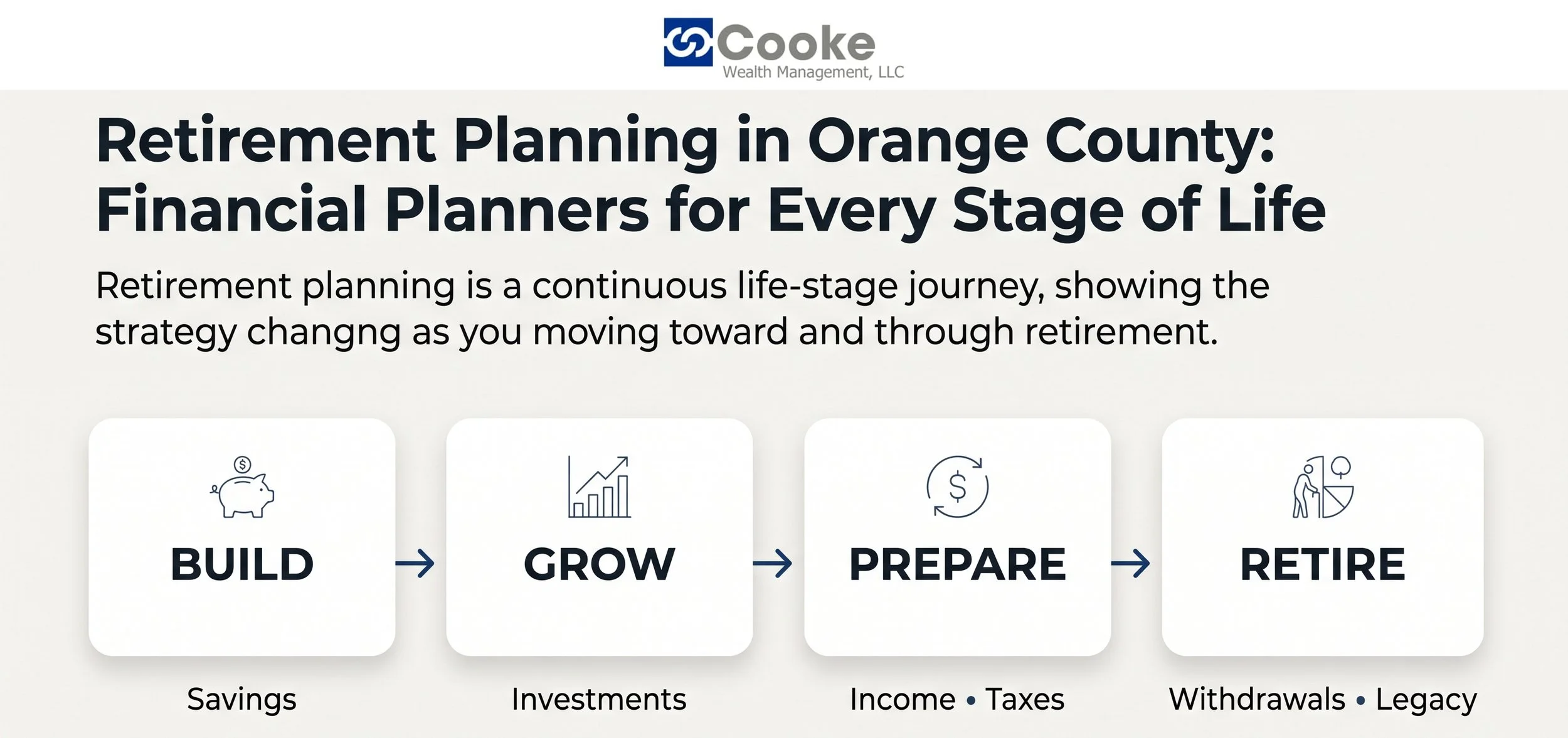
Retirement Planning by Life Stage: The Decisions Change
It's Not Just a Savings Target Tied to Age
Retirement planning shouldn't be reduced to a savings target tied to your age. The more useful question is which financial decisions matter most at your current stage of life, since the right move at 30 is often the wrong move at 55.
Your 20s and 30s: Building the Foundation
In your 20s and 30s, the focus is often on building a foundation: deciding between Roth and traditional retirement accounts, establishing emergency savings, managing debt, and choosing an investment mix appropriate for a long time horizon. The IRS provides current contribution limits for retirement accounts, which can help inform these early decisions — for 2026, that includes a $24,500 401(k) limit and a $7,500 IRA limit.
Your 30s and 40s: Competing Priorities
By your 30s and 40s, retirement savings may compete with a mortgage, education costs, and other family priorities. The decision becomes less about simply saving and more about how to divide limited cash flow among competing goals.
Your 40s and 50s: Getting More Precise
During the 40s and 50s, planning typically becomes more precise: Are current savings sufficient? Should contributions increase? Has too much wealth become concentrated in one investment or employer? This is often when Cooke Wealth Management's investment management work shifts toward reassessing risk and diversification alongside a client's updated timeline.
Your 50s and Early 60s: The Questions Get Consequential
In the 50s and early 60s, the questions become more consequential. When can you realistically retire? How will healthcare be funded? When should Social Security begin? How should taxes influence withdrawals? The Social Security Administration notes that claiming age directly affects the amount of retirement benefits received, which makes this decision one of the more consequential ones in a pre-retirement plan.
Once Retirement Begins: From Accumulation to Income
Once retirement begins, the focus shifts from accumulation to sustainable income. Retirees need to determine how much they can spend, which accounts to draw from, and how withdrawals affect taxes and future income.
Later in Retirement: RMDs, Estate, and Legacy
Later in retirement, required minimum distributions, estate planning, charitable giving, and wealth transfer become increasingly important. The IRS provides specific rules governing RMDs from retirement accounts, and missing those rules can carry meaningful tax consequences.
The Plan Should Evolve With the Decisions in Front of You
A strong retirement plan therefore evolves with the decisions in front of you — not simply the number of candles on your birthday cake. A planner who understands this can help you focus on what actually matters right now, rather than applying a one-size-fits-all checklist.
Why Fiduciary Guidance Matters at Every Stage
A Standard That Doesn't Change With Age
Regardless of life stage, fiduciary duty means an advisor is legally required to act in a client's best interest. Under the Investment Advisers Act of 1940, Registered Investment Advisers generally owe clients this duty across the advisory relationship, not just at the point of a single transaction.
Why That Matters for Long-Term Planning
Retirement decisions often unfold over years or decades, so an advisor's ongoing obligations matter more than a one-time recommendation. Cooke Wealth Management operates as an independent Registered Investment Adviser, meaning its guidance isn't built around a parent company's proprietary product lineup.
Choosing a Retirement-Focused Financial Planner in Orange County
Questions Worth Asking Before You Commit
A few direct questions can reveal how a planner actually works: How do you approach clients at different life stages? Are you a fiduciary at all times? How are you compensated, and do you receive commissions on any recommended products?
Why Local Context Still Helps
An Orange County-based planner brings familiarity with California-specific tax considerations and the region's cost of living, both of which affect how much is genuinely "enough" for retirement locally. That local grounding, paired with a process built around your specific life stage, often matters more than a firm's size or name recognition.
Why Families Across Every Stage Choose Cooke Wealth Management
Experience Spanning Decades of Client Relationships
Cooke Wealth Management has served more than 100 families and manages over $100 million in assets, with advisors bringing more than 40 years of combined industry experience. That range of experience means the firm has worked with clients across early career, mid-career, pre-retirement, and retirement itself.
A Personalized Plan, Not a Template
The firm builds a customized plan for each client rather than applying a generic model based on age alone. Combined with its fiduciary structure, that approach is meant to help clients avoid costly mistakes and gain confidence at whatever stage they're currently in.
Start Planning for Your Stage of Life
Retirement planning isn't a single decision made once — it's a series of decisions that evolve as your life does. The right financial planner adjusts the plan as you move through each stage, rather than treating retirement planning as something to figure out only when it's imminent.
Cooke Wealth Management works with individuals and families throughout Orange County and Southern California at every stage of their financial journey. If you're ready to talk through where you stand, scheduling a Discovery Session is a straightforward way to get started.
Frequently Asked Questions
At what age should I start retirement planning?
Retirement planning can start as soon as you have earned income, even if contributions are small at first. Starting early gives your savings more time to compound, which often matters more than the size of any individual contribution. A planner can help even in your 20s by focusing on habits and account structure rather than complex strategy.
How much should I have saved for retirement by age 50?
There's no single universal target, since the right amount depends on your desired lifestyle, expected retirement age, and other income sources like Social Security. A financial planner can build a projection specific to your situation rather than relying on a generic multiple-of-income rule. Reassessing that target periodically is often more useful than fixating on one number.
What is sequence-of-returns risk, and why does it matter near retirement?
Sequence-of-returns risk is the danger that poor investment performance early in retirement, combined with ongoing withdrawals, can permanently damage a portfolio's ability to last. It matters more in the years just before and after retirement than during the accumulation years, since there's less time to recover from a downturn. Strategies like adjusting withdrawal rates or maintaining a cash reserve can help manage this risk.
When should I claim Social Security?
The right claiming age depends on your health, other income sources, and overall retirement income strategy, since claiming earlier reduces the monthly benefit while waiting increases it. There's no single correct answer for everyone, which is why this decision is often evaluated alongside the rest of a retirement income plan. A financial planner can model different claiming scenarios based on your specific situation.
Do I need a different financial planner as I move through different life stages?
Not necessarily, but it's worth confirming that your current planner has experience across the stage you're entering, whether that's mid-career accumulation or in-retirement income planning. A firm that works with clients across all stages, like Cooke Wealth Management, can often provide continuity as your needs evolve. Switching planners at every stage can create gaps in an otherwise coordinated plan.
How do required minimum distributions affect my retirement income plan?
Required minimum distributions are mandatory withdrawals from certain retirement accounts that begin at a specific age and are generally taxable as income. Failing to plan for them can push retirees into a higher tax bracket than expected or affect Medicare premium costs. Coordinating withdrawals across account types in advance can help manage this impact.
How do I get started with Cooke Wealth Management?
Cooke Wealth Management offers a free Discovery Session to discuss your financial goals and determine whether the firm's approach fits your needs, regardless of what stage of life you're in. From there, the firm builds a personalized plan rather than applying a generic template. You can schedule that initial conversation directly through the firm's contact page.
*We recommend that you consult a tax or financial advisor about your individual situation.