
Biblical Wealth Management: Christian Financial Advisors in Orange County

Managing money well is hard enough without wondering whether your advisor's priorities match your own. For Christians, that question runs deeper than fees and returns — it touches stewardship, generosity, and how faith shapes financial decisions.
Cooke Wealth Management is an Irvine-based, independent financial planning and investment management firm. It combines biblical principles with fiduciary guidance for families across Orange County and Southern California.
Why This Search Feels Different for Christian Families
Searching for a "Christian financial advisor near me" often comes from a specific frustration: generic financial advice doesn't account for how faith shapes decisions about giving, debt, work, and legacy. Families want a planning process that treats those priorities as central, not as an afterthought bolted onto a standard investment pitch.
What Biblical Wealth Management Actually Means
Stewardship, Not Just Accumulation
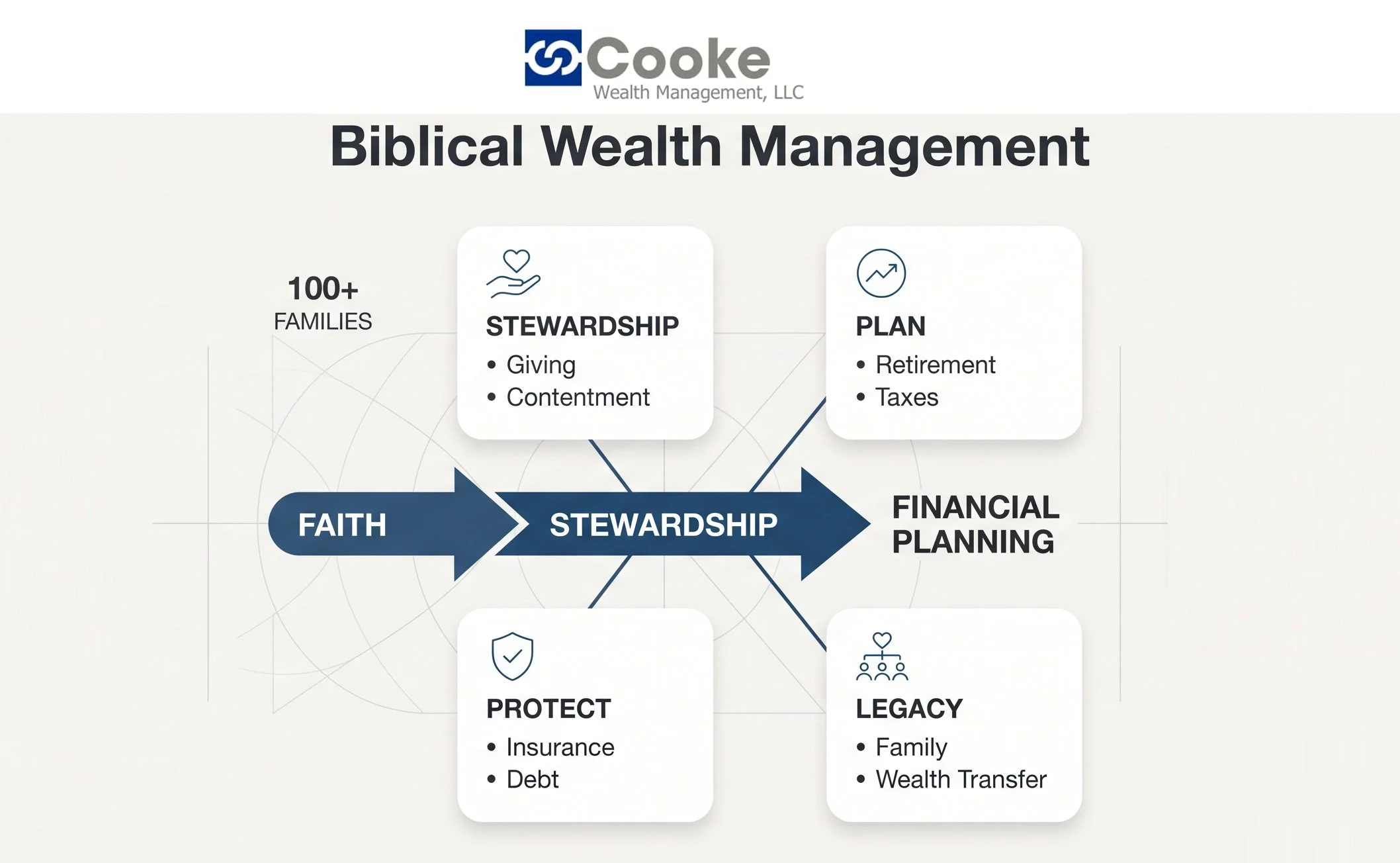
Biblical wealth management isn't a separate investment strategy or a special class of mutual funds. It's a framework for financial planning that treats money as something to be managed on behalf of a higher purpose, not simply accumulated for its own sake. Concepts like stewardship, generosity, contentment, and long-term provision for family shape how recommendations get made.
How That Shows Up in a Plan
In practice, this shows up in how an advisor frames tradeoffs. A retirement withdrawal strategy, a charitable giving plan, or a decision about how much to leave heirs all get evaluated against a client's stated values, not just against a spreadsheet. The technical work — tax planning, portfolio construction, insurance review — still has to be sound. The values simply inform which options get prioritized.
Areas Where the Framework Applies
This approach can touch nearly every part of a financial plan. Common areas include:
Retirement income sequencing and how much is genuinely "enough"
Charitable giving strategy, including donor-advised funds and appreciated stock gifts
Debt management and decisions about leverage
Insurance coverage sized to actual family needs, not maximized commissions
Wealth transfer and how an estate plan reflects family values
Biblical Wealth Management vs. Biblically Responsible Investing
Two Related, Not Identical, Concepts
Biblical wealth management and Biblically Responsible Investing (BRI) are related but not interchangeable. Biblical wealth management is the broader planning framework — it applies stewardship, generosity, and contentment across retirement planning, giving, debt, insurance, taxes, and wealth transfer. BRI is narrower: it governs how a portfolio is actually built, often screening out companies tied to industries like gambling, tobacco, alcohol, or pornography.
Morningstar's 2026 faith-based investing research tracks non-denominational Christian funds as their own category. It notes that screening methodologies vary significantly between strategies, which can affect sector exposure, diversification, and cost.
Why the Distinction Matters When Vetting an Advisor
Working with someone who incorporates biblical principles into planning doesn't automatically mean every holding passes a BRI screen. Some clients want values-driven planning without restricting their investment universe, while others want a screen applied to the portfolio itself.
The better question isn't "are you a Christian financial advisor," but whether principles are applied to planning, investment selection, or both. Reviewing an advisor's Form ADV through the SEC's Investment Adviser Public Disclosure database is a useful way to confirm services, fees, and conflicts before deciding.
Why Fiduciary Duty Still Matters Here
A Legal Standard, Not a Faith Statement
A biblical worldview and a fiduciary duty are not the same thing, and conflating them can lead clients to skip real diligence. Fiduciary duty is a legal standard: under the Investment Advisers Act of 1940, registered investment advisers generally must act in a client's best interest. Faith language alone does not create that obligation.
Fiduciary Duty vs. a Suitability Standard
Some professionals who use "advisor" in their title operate under a suitability or "best interest" standard tied to a specific transaction, rather than an ongoing fiduciary obligation. That distinction affects how conflicts get disclosed and how recommendations get made over the life of a relationship, not just at the point of sale.
What to Confirm Before Signing
An advisor can describe their work in faith-based terms while still operating under a commission or product-sales model with narrower obligations. Confirming that a firm is a Registered Investment Adviser, and asking directly whether they are fee-only, is still the first step — regardless of how the firm frames its mission.
Financial Planning Built Around Stewardship
Retirement, Taxes, and Insurance Together
For families who want their finances to reflect their faith, planning usually needs to cover more ground than investment selection alone. Retirement income planning, tax-aware withdrawal sequencing, insurance coverage, and wealth transfer all intersect, and decisions in one area affect the others. Cooke Wealth Management's retirement planning work is built around helping clients figure out how much is actually enough, rather than defaulting to a generic savings target.
Investment Management and Wealth Transfer
Investment management fits into that same picture. Cooke Wealth Management builds custom portfolios intended for growth, stability, and income, aligned with a client's specific goals rather than a one-size-fits-all model. Wealth transfer planning — coordinating the tax-efficient movement of assets to the next generation — often becomes especially important for clients who see their estate as something to steward on behalf of their family.
Financial Coaching as Part of the Process
Beyond technical planning, some firms incorporate financial coaching to help clients build healthier habits around spending, saving, and giving over time. For families trying to align daily financial behavior with long-term values, that ongoing accountability can matter as much as the initial plan.
Choosing a Christian Financial Advisor in Orange County
Questions Worth Asking Directly
Not every advisor who mentions faith has built a planning process around it. Worthwhile questions include how a firm defines biblical stewardship in a planning context, whether those principles show up in specific recommendations or only in marketing language, and whether the advisor is a fiduciary 100% of the time.
A Short Vetting Checklist
Before signing an agreement, it helps to confirm a few basics: the firm's registration status, its fee structure, whether it applies any investment screens, and how it discloses conflicts of interest. Asking to walk through a sample financial plan, rather than just a sales pitch, can also reveal how the firm actually works.
Why Local Presence Still Counts
Local presence can matter too. An Orange County advisor who understands California-specific tax considerations, works within driving distance for in-person meetings, and knows the region's cost of living and real estate dynamics brings context a remote generalist may not. That local knowledge, paired with a values-aligned planning process, is often what clients are actually looking for.
Why Cooke Wealth Management Fits This Model
Experience Behind the Approach
Cooke Wealth Management has served over 100 families and manages more than $100 million in assets, drawing on more than 40 years of combined industry experience among its advisors. The firm describes its approach as combining biblical principles with academic research and hands-on experience, aimed at helping clients avoid costly mistakes and gain confidence in their financial decisions.
A Fiduciary Structure by Design
As a Registered Investment Adviser, Cooke Wealth Management is structurally positioned to act as a fiduciary rather than operate under a narrower sales-based standard. For Orange County families who want retirement planning, investment management, and wealth transfer guidance delivered through a lens that takes their faith seriously, that combination of fiduciary structure and stated values is the starting point worth evaluating.
Bringing Faith and Financial Planning Together
Choosing a financial advisor is rarely just a math problem. For Christian families in Orange County, the decision often comes down to finding a firm that takes both the numbers and the values behind them seriously.
Cooke Wealth Management works with individuals and families throughout Orange County and Southern California who want a financial plan grounded in biblical stewardship. If that's the guidance you're looking for, scheduling a Discovery Session is a reasonable next step.
Frequently Asked Questions
What does "biblical wealth management" mean in practice?
Biblical wealth management applies principles like stewardship, generosity, and contentment to financial planning decisions such as retirement income, giving, and wealth transfer. It doesn't replace standard financial planning techniques — it shapes which tradeoffs and priorities guide the recommendations. A firm practicing this approach should be able to explain specifically how those principles show up in your plan.
What's the difference between biblical wealth management and Biblically Responsible Investing?
Biblical wealth management is the overall planning framework across retirement, giving, debt, insurance, taxes, and estate decisions. Biblically Responsible Investing is specifically about how a portfolio is constructed, often through screens that exclude certain industries. An advisor can offer one, both, or neither, so it's worth asking directly how principles are applied.
Is a Christian financial advisor automatically a fiduciary?
No. Fiduciary status is a legal standard tied to registration as an investment adviser, not to a firm's faith-based positioning. It's worth asking directly whether an advisor is a fiduciary at all times, and confirming their registration through the SEC's Investment Adviser Public Disclosure database.
What services does a firm like Cooke Wealth Management offer?
Cooke Wealth Management provides financial planning, retirement planning, investment management, and wealth transfer guidance for families in Orange County and Southern California. Planning typically starts with a full picture of income, taxes, investments, and long-term goals before specific recommendations are made.
How is a fee-only advisor different from other financial advisors?
A fee-only advisor is paid directly by clients and does not accept commissions on the products they recommend, which reduces certain sales-related conflicts of interest. A commission-based or fee-based advisor may earn additional compensation tied to specific products, which is worth understanding before signing an agreement.
Do I need to live in Orange County to work with a local Christian financial advisor?
Not necessarily. Many advisory relationships now happen remotely through video meetings and secure client portals. That said, a local Orange County advisor may offer advantages when California-specific tax rules, local estate attorneys, or in-person meetings are a priority.
How do I start working with Cooke Wealth Management?
Cooke Wealth Management offers a free Discovery Session where prospective clients discuss their financial goals and determine whether the firm's approach fits their needs. From there, the firm builds a personalized plan rather than applying a standard template. Interested families can schedule that conversation directly through the firm's contact page.
*We recommend that you consult a tax or financial advisor about your individual situation.