
Biblical Retirement: Wisdom from Proverbs on Wealth and Longevity

Retirement planning is often treated as a purely financial exercise — spreadsheets, projections, withdrawal rates. But for Christians, Scripture has been offering guidance on wealth, diligence, and long-term planning for thousands of years, and Proverbs in particular has quite a bit to say about it.
Cooke Wealth Management is an independent, fiduciary wealth management firm based in Irvine, California, that incorporates biblical principles into its retirement planning process for families throughout Orange County and Southern California.
Why Proverbs Speaks to Retirement Planning
Proverbs wasn't written with 401(k)s in mind, but its themes — diligence, foresight, contentment, and wise counsel — map directly onto the decisions that shape a retirement plan. Reading these principles alongside modern financial planning can offer a fuller picture than either one alone.
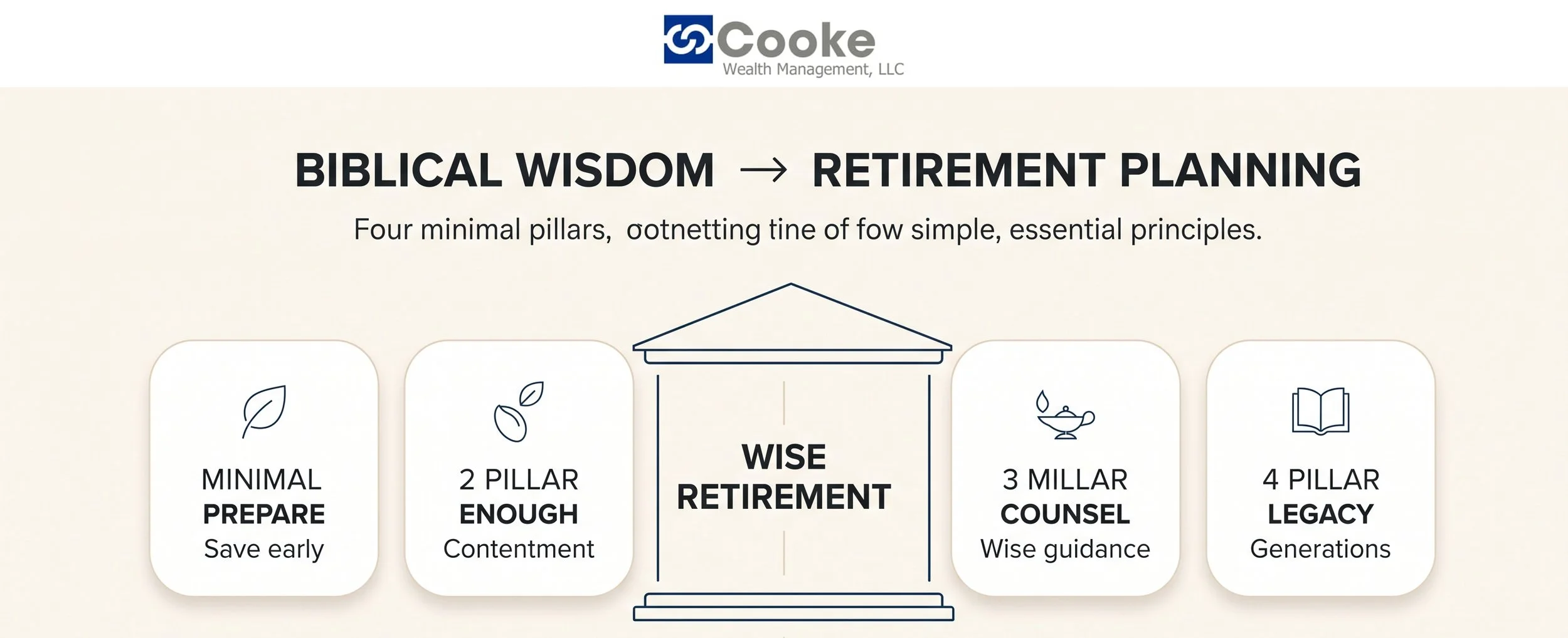
From Proverbs Principles to Retirement Decisions
The Ant, Diligence, and When to Start Saving
The wisdom of Proverbs can be translated into a practical retirement framework when biblical principles are connected to the financial decisions they can help inform. Proverbs 6:6–8 points to the ant as an example of preparing in advance and gathering provisions before they're needed. In modern retirement planning, that principle can mean deciding when to start saving, how much to contribute, and how consistently to revisit the plan rather than waiting until retirement is close.
Contentment and Defining "Enough"
Contentment creates a different question: not simply how much wealth can be accumulated, but what "enough" actually looks like. Defining an appropriate retirement lifestyle and spending goal can help prevent indefinite accumulation from becoming the objective itself.
Wise Counsel and Vetting an Advisor
Wise counsel translates into being deliberate about whose financial guidance you trust. That means evaluating an advisor's registration, compensation, services, and potential conflicts rather than relying solely on shared values. The SEC's Investor.gov recommends checking whether an investment professional is registered before hiring them.
Generational Responsibility and Beneficiary Planning
Generational responsibility can shape estate and beneficiary planning. Retirement accounts don't automatically transfer according to a family's intentions; beneficiaries must generally be designated under the applicable plan or IRA procedures, and different distribution rules can apply after the owner's death.
Long-Term Thinking and the Social Security Decision
Finally, long-term thinking means planning for a retirement that could last decades. Social Security benefits can generally begin at 62, while delaying them can increase the monthly benefit up to age 70, making the claiming decision part of a broader longevity strategy.
A Framework, Not a Formula
The result is a framework in which Proverbs informs the purpose and posture behind retirement decisions, while modern financial planning determines how those principles can be implemented. Neither piece works especially well without the other.
Wise Counsel and the Value of Good Advisors
Multiple Counselors, Better Decisions
Proverbs repeatedly emphasizes that plans succeed with the input of multiple counselors, and that avoiding good advice tends to lead to poor outcomes. This principle applies directly to financial decision-making, where isolated, unadvised choices are more prone to costly mistakes.
Why This Matters When Choosing an Advisor
This is also where fiduciary duty becomes relevant. Under the Investment Advisers Act of 1940, Registered Investment Advisers generally must act in a client's best interest, which gives the "wise counsel" principle a legal backbone — an advisor bound to your interests, not just a sales quota.
Leaving an Inheritance and Wealth Transfer
Planning Across Generations
Proverbs speaks directly to generational wealth, describing the good person as one who leaves an inheritance not just for their children but their children's children. This framing treats wealth transfer as a multi-generational responsibility rather than a single estate-planning task to check off near the end of life.
How This Shapes a Wealth Transfer Strategy
In practice, that principle supports thinking about wealth transfer early — through estate documents, beneficiary designations, and tax-efficient transfer strategies — rather than leaving those decisions until late in life. Cooke Wealth Management's wealth transfer guidance is built around exactly this kind of long-horizon planning.
Longevity, Stewardship, and Long-Term Thinking
Wisdom as a Path to a Longer, Fuller Life
Longevity is a recurring theme throughout Proverbs, with wisdom and righteous living repeatedly connected to a long, well-lived life. Applied to financial planning, this suggests that a retirement strategy shouldn't just optimize for the years immediately ahead but account for a full, potentially decades-long retirement.
Sustainable Income, Not Just Accumulation
That long view matters practically because retirement income needs to last an unknown number of years. A sustainable withdrawal strategy — one that accounts for inflation, healthcare costs, and market volatility over time — reflects the same long-term thinking Proverbs applies to wisdom and character.
Turning Biblical Principles Into a Practical Plan
A Few Questions Worth Asking Yourself
Before meeting with an advisor, it can help to reflect on a few questions rooted in these themes:
What does "enough" actually look like for your retirement?
Are you preparing proactively, or reacting to circumstances as they arise?
Who are you consulting before making major financial decisions?
What do you want your wealth to accomplish across generations?
Does your current plan account for a retirement that could last several decades?
Why Cooke Wealth Management Approaches Retirement This Way
Combining Biblical Principles With Financial Expertise
Cooke Wealth Management describes its approach as combining biblical principles with academic research and hands-on planning experience. The firm has served more than 100 families and manages over $100 million in assets, with advisors bringing more than 40 years of combined industry experience to that process.
A Fiduciary Structure Behind the Values
As an independent Registered Investment Adviser, Cooke Wealth Management operates under a fiduciary standard rather than a narrower, commission-based model. That structure reflects the same "wise counsel" principle found in Proverbs — an advisor whose obligations are aligned with the client's best interest, not a product to sell.
Build a Retirement Plan Grounded in Wisdom
Proverbs doesn't offer a specific savings rate or withdrawal strategy, but it offers something a spreadsheet can't: a framework for why diligence, contentment, wise counsel, and generational thinking matter in the first place. A strong retirement plan honors both the wisdom and the numbers.
Cooke Wealth Management works with individuals and families throughout Orange County and Southern California who want a retirement plan grounded in both sound financial strategy and biblical principles. If that's the kind of guidance you're looking for, scheduling a Discovery Session is a reasonable next step.
Frequently Asked Questions
What does Proverbs actually say about saving and planning ahead?
Proverbs repeatedly praises diligence and preparation, often using imagery like the ant storing provisions before they're needed. The broader theme is that proactive planning tends to lead to security, while reactive decision-making tends to lead to hardship. Applied to retirement, this supports starting to save early and revisiting a plan regularly.
Does the Bible say wealth itself is wrong?
No. Proverbs cautions against pursuing wealth anxiously or treating it as an end in itself, but it doesn't condemn wealth or saving. The concern is more about the posture behind financial decisions — contentment and stewardship — than about the presence of money itself. A financial plan can reflect that balance by defining clear, values-aligned goals rather than open-ended accumulation.
How does biblical wisdom apply to choosing a financial advisor?
Proverbs emphasizes that plans succeed with the input of multiple wise counselors, which supports seeking qualified, trustworthy financial guidance rather than making major decisions in isolation. Confirming that an advisor is a fiduciary, legally required to act in your best interest, adds a practical safeguard to that principle. Cooke Wealth Management is structured as a fiduciary firm for exactly this reason.
What does the Bible say about leaving an inheritance?
Proverbs describes a good person as one who leaves an inheritance for their children's children, framing wealth transfer as a multi-generational responsibility. This suggests that estate planning and wealth transfer strategy are worth addressing well before the end of life, not treated as an afterthought. Coordinated planning, including up-to-date beneficiary designations, can help ensure that transfer happens according to a family's values.
How does longevity in Proverbs relate to modern retirement planning?
Proverbs repeatedly connects wisdom and righteous living to a long life, which parallels the practical reality that retirement plans now often need to sustain income for several decades. A sustainable withdrawal strategy needs to account for inflation, healthcare costs, and market volatility over a potentially long retirement. Planning with that long horizon in mind reflects the same big-picture thinking found throughout Proverbs.
Can I incorporate these principles without changing my entire investment strategy?
Yes. Applying biblical wisdom to retirement planning doesn't necessarily require using faith-based investment screens — it can simply mean bringing a values-informed perspective to decisions about saving, contentment, and long-term goals. Some clients want both comprehensive faith-based planning and specific investment screens, while others want only one. It's worth discussing your specific preferences directly with an advisor.
How do I get started with Cooke Wealth Management?
Cooke Wealth Management offers a free Discovery Session to discuss your financial goals and determine whether the firm's values-informed approach fits your needs. From there, the firm builds a personalized retirement plan rather than applying a generic template. You can schedule that initial conversation directly through the firm's contact page.
| Traditional Approach | Biblical Approach |
|---|---|
| Maximize accumulation | Wise stewardship |
| Retire from work | Retire to purpose |
| Preserve wealth | Create legacy |
Fundamentals of Biblical Retirement Planning
The Role of Diligence and Planning
Proverbs 21:5 offers a timeless truth: "The plans of the diligent lead surely to abundance, but everyone who is hasty comes only to poverty."
This verse highlights the biblical value of steady, intentional planning, especially when preparing for retirement.
In practical terms, diligence may involve establishing a realistic budget, defining long-term financial goals, and consistently saving over time. These practices can reflect both financial prudence and a commitment to responsible stewardship.
Approaching retirement with thoughtfulness and preparation can help reduce uncertainty, though outcomes are influenced by many variables beyond any single plan.
This mindset also encourages caution against high-risk or speculative ventures, favoring steady, faithful management of resources over shortcuts. Careful planning aligns actions with both practical considerations and values-based stewardship.
Avoiding Debt and Embracing Contentment
Proverbs 22:7 gives a sobering warning: "The borrower is slave to the lender."
Debt can place a heavy burden on our finances, especially in retirement when income is often fixed. From a biblical perspective, avoiding unnecessary debt is both a practical and spiritual priority.
A mindset shaped by biblical principles may prioritize living within means, practicing contentment, and resisting financial excess. Such an approach can allow resources to be allocated toward generosity rather than interest payments, fostering a simpler and potentially more sustainable lifestyle.
Adopting contentment and disciplined financial management may help believers approach retirement with reduced debt and greater flexibility to pursue personal and spiritual goals.
Applying Proverbs to Modern Retirement Realities
Navigating Risk and Investment with Discernment
Retirement planning today requires evaluating a range of uncertainties, including market volatility, inflation, and healthcare expenses.
Proverbs 27:12 states, "The prudent see danger and take refuge, but the simple keep going and pay the penalty," suggesting the potential benefits of foresight and prudence.
Practically, this could mean diversifying investments, monitoring market trends, and balancing risk while seeking growth.
Biblical retirement planning encourages measured, informed decision-making guided by careful discernment rather than reactive or fear-driven choices, trusting that thoughtful preparation can balance risk management with potential growth.
Seeking Wise Counsel in a Complex Financial World
Retirement planning can feel overwhelming, especially with countless opinions, products, and market forces at play.
Proverbs 15:22 reminds us, "Plans fail for lack of counsel, but with many advisers they succeed." This is a powerful reminder that even the wisest plans benefit from wise guidance.
When evaluating a faith-driven financial advisor, one benchmark worth knowing is the Certified Kingdom Advisor (CKA) designation, administered by Kingdom Advisors, a professional membership organization for financial advisors.
Earning the designation requires a signed statement of faith, references from a church leader and clients, and a dedicated exam covering biblically integrated financial planning.
Both of Cooke Wealth Management's advisors hold this designation; you can read more about their backgrounds on our About Us page.
Cooke Wealth Management positions itself as a resource for clients seeking retirement planning aligned with biblical principles, offering structured support with risk assessment, goal-setting, and legacy planning.
Our team walks alongside clients with clarity, compassion, and biblical integrity, helping them plan with confidence and purpose.
Other Important Elements of Biblical Retirement
Living Generously in Retirement
Proverbs 11:25 notes, "A generous person will prosper; whoever refreshes others will be refreshed."
Retirement can provide an opportunity to continue meaningful engagement through charitable giving, volunteering, or mentorship.
Resources accumulated over a career can be allocated to support causes aligned with personal and spiritual values, potentially enriching both the giver's life and the wider community.
Retirement can be viewed as a new chapter rather than the conclusion of one's impact. Opportunities to live generously, through charitable giving, volunteering, or mentoring, can extend well into retirement, allowing resources and experience to support others while potentially enhancing personal fulfillment.
Preparing for Longevity with Biblical Perspective
Proverbs 16:31 says, "Gray hair is a crown of splendor; it is attained in the way of righteousness."
Long life can introduce both opportunities and challenges: a 65-year-old today can expect to live another 18.1 years on average if male, or 20.7 years if female, according to the Social Security Administration's actuarial life tables.
This underscores the potential value of planning for healthcare, estate considerations, and ongoing spiritual impact.
Careful preparation may involve evaluating savings, insurance, and estate planning options. Estate planning can help clarify how assets are distributed according to personal wishes and provide support for loved ones, while also offering a chance to consider the spiritual influence one hopes to leave for future generations.
Taking the time to plan for these areas may contribute to a greater sense of readiness for the years ahead, and it can be worthwhile to begin shaping a biblical approach to retirement at any stage of life.
Connecting with professionals who share a biblically informed perspective can offer guidance as you work toward a retirement shaped by purpose and the legacy you hope to leave.
Biblical Retirement in Action
Faith‑Focused Retirement Plan Transformation
In several situations, clients have shifted from focusing solely on securing retirement to developing plans that incorporate intentional generosity.
One approach has involved using a donor advised fund (DAF) to contribute appreciated securities, which may increase charitable impact while helping manage tax considerations.
DAF-based giving has grown quickly nationwide: donor-advised funds distributed $6.61 billion in grants to charities in fiscal year 2025, a 20% increase over the prior year. This is according to the National Philanthropic Trust's 2025 DAF Report.
For these clients, the outcome has often been greater clarity and a sense of steadiness, knowing their retirement framework addresses lasting needs while supporting the causes they care about most.
This reflects the principle in Proverbs 11:25: a generous posture, paired with tax-aware giving strategies, can shape a retirement plan around purpose as much as security.
Creating a Generational Legacy
Cooke Wealth Management's process integrates estate planning and wealth‑transfer with a biblically grounded framework. For example, from our blog post "Integrating Estate and Financial Planning: Strategies for Comprehensive Wealth Management":
"Incorporating a values‑based approach into financial and estate planning can help you confidently live out what matters most to you as a family with intentionality and direction."
In terms of generational legacy, the goal is to structure the transfer of assets so that resources support not only the current generation's retirement needs, but also the next generation's opportunity (education, philanthropy, faith‑impact).
This aligns with Proverbs 13:22 – "A good person leaves an inheritance for their children's children…" by coordinating retirement planning, estate planning, and charitable giving, the family ensures the legacy is rooted in values, not just dollars.
Ready to Begin Your Own Biblical Retirement Journey?
For Christians, retirement can represent the close of one season and the beginning of another. By focusing on wisdom rather than accumulation and preparing to leave both a financial and spiritual legacy, it may be possible to approach retirement with greater confidence and clarity.
This kind of planning is pursued through a combination of scriptural principles and modern financial tools, supporting both immediate needs and lasting impact.
Cooke Wealth Management provides guidance rooted in practical planning and Scripture-based values, helping clients pursue enduring peace and purpose. Schedule a Discovery Session to start the conversation.
Frequently Asked Questions
Can I still invest and build wealth while following biblical retirement principles?
Absolutely. Scripture doesn't condemn wealth creation; it condemns the love of money (1 Timothy 6:10) and hoarding without purpose. Proverbs 21:20 even celebrates the wise who store up choice food and olive oil, a clear endorsement of saving and investing.
The key distinction is purpose, not the pursuit of growth itself. You're building wealth for something: legacy, generosity, security for loved ones, not merely accumulating for accumulation's sake.
That question of purpose is one most Americans wrestle with regardless of faith: nearly a quarter cite money or finances as a source of meaning in life, while about one in five point to religious faith, according to Pew Research Center.
Remembering your role as a steward rather than an owner turns those investments into tools of stewardship rather than monuments to self-interest.
Does Cooke Wealth Management only serve Christian clients?
Although our planning approach is grounded in Scripture, we work with clients of all backgrounds. Our process is respectful and centered on understanding each family's values and goals.
For Christians, that includes faith driven planning and investment screening. For those with different perspectives, we apply the same professional standards and tailor strategies to their priorities.
This is consistent with the SEC's fiduciary standard, which requires every registered investment adviser to act with a duty of care and a duty of loyalty toward each client, regardless of background.
What's the first step to creating a biblically-aligned retirement plan?
Start by writing down what you want your money to accomplish before running any numbers, whether that's generational giving, church support, or family security, so every later decision has a reference point.
This kind of clarity matters more than ever: only 35% of non-retirees believe their retirement savings are on track, down from 40% in 2021, according to the Federal Reserve's Economic Well-Being of U.S. Households report.
A typical first meeting with an advisor then covers a current-asset inventory, a debt review, and a conversation about giving priorities, so the numbers-based plan that follows is built around what you've already decided matters most.
Many families find it helpful to have this conversation together, since a plan shaped by shared faith and values tends to hold up better than one built around a single person's spreadsheet.
Is it biblical to invest in the stock market?
Yes, but with careful thought. The stock market itself is simply a tool, neither inherently good nor evil. Scripture doesn't address modern investment vehicles directly, but it does provide principles that apply.
Diversification is biblical: Ecclesiastes 11:2 says, "Invest in seven ventures, yes, in eight; you do not know what disaster may come upon the land."
This ancient wisdom perfectly describes portfolio diversification: spreading risk across multiple investments rather than concentrating everything in one place.
The SEC's own investor education glossary uses almost the same image, describing diversification as the practice of not putting all your eggs in one basket.
Avoid speculation and greed: Proverbs 13:11 warns that "wealth gained hastily will dwindle," which speaks against day trading, high-risk speculation, or trying to time the market. Biblical investing favors patient, long-term growth over get-rich-quick schemes.
Values-based screening matters: If you're investing in companies, you're becoming a partial owner. Many Christians choose to exclude industries that profit from harm: tobacco, alcohol, gambling, pornography, or companies with exploitative practices.
This is sometimes called ESG (Environmental, Social, Governance) investing or faith-based investing.
The stock market can be an excellent vehicle for building retirement wealth when approached with wisdom, patience, and alignment with your values. Our investment management approach is built around exactly this kind of goal-aligned, values-based portfolio construction.
The question isn't whether Christians can invest, but whether you're doing so as a faithful steward.
How much should I give in retirement?
This is one of the most common questions Christian retirees face, and one of the most personal.
Scripture establishes tithing (giving 10% of income) as a baseline in the Old Testament, though only 21% of American Christians currently set their giving at 10% or more, a figure that rises to 42% among practicing Christians, according to Barna Group research.
Many Christians wonder: Do I tithe on Social Security? On investment withdrawals? On distributions from accounts I already tithed on when I contributed?
Here's the biblical framework:
Tithing on retirement income honors the principle. Most biblical financial counselors suggest treating retirement distributions like income and giving proportionally. If you're drawing from Social Security, pensions, or retirement accounts, a percentage of those funds can support kingdom work.
Retirement may increase your giving capacity. Many retirees discover they can give more in retirement than during working years.
This joins a large pool of support: individuals accounted for $394.2 billion of the $617.2 billion given to U.S. charities in 2025, or roughly 64% of all giving, according to Giving USA. Giving USA is an annual report published by the Indiana University Lilly Family School of Philanthropy.
With your mortgage paid off, children independent, and lower overall expenses, you might move beyond 10% to 15%, 20%, or higher.
Others strategically direct their required minimum distributions (RMDs), which generally begin at age 73, straight to charity through Qualified Charitable Distributions (QCDs).
For 2026, the IRS allows up to $111,000 per year to pass tax-free from an IRA to charity this way, supporting the ministry while satisfying the distribution requirement.
Wisdom requires planning. Generous giving in retirement still requires care to ensure you don't outlive your resources or become a burden to others. We can help you structure giving in ways that honor God while maintaining your own security.
The answer isn't a formula; it's a posture. Approach retirement giving prayerfully, generously, and strategically.