
Irvine Wealth Management: Your Path to Financial Growth & Security

Irvine wealth management decisions rarely feel simple, especially when retirement, taxes, and family goals all compete for the same dollar. Choosing the right guidance early can be the difference between a plan that adapts to your life and one that leaves you reacting to it.
Cooke Wealth Management is an independent, fee-based wealth management firm based in Irvine, California, serving families throughout Orange County and Southern California. The firm's approach centers on custom financial planning built around long-term goals rather than a one-size-fits-all product lineup — an important distinction if you're comparing Cooke Wealth Management's financial planning services against other local firms.
Why "Growth and Security" Are Both Necessary
Most people searching for a wealth manager want two things that can pull in opposite directions: growth, so their money works harder over time, and security, so a downturn doesn't derail their plans. A good plan doesn't pick one over the other — it sequences them based on your timeline, risk tolerance, and specific goals.
What Wealth Management Actually Includes
Beyond Just Picking Investments
Wealth management is broader than investment selection. It typically covers retirement income planning, tax-aware decision-making, insurance review, and wealth transfer strategy, all coordinated so that a decision in one area doesn't create a problem in another. A withdrawal strategy that ignores tax brackets, for example, can quietly cost a retiree thousands of dollars a year.
How Cooke Wealth Management Structures This Work
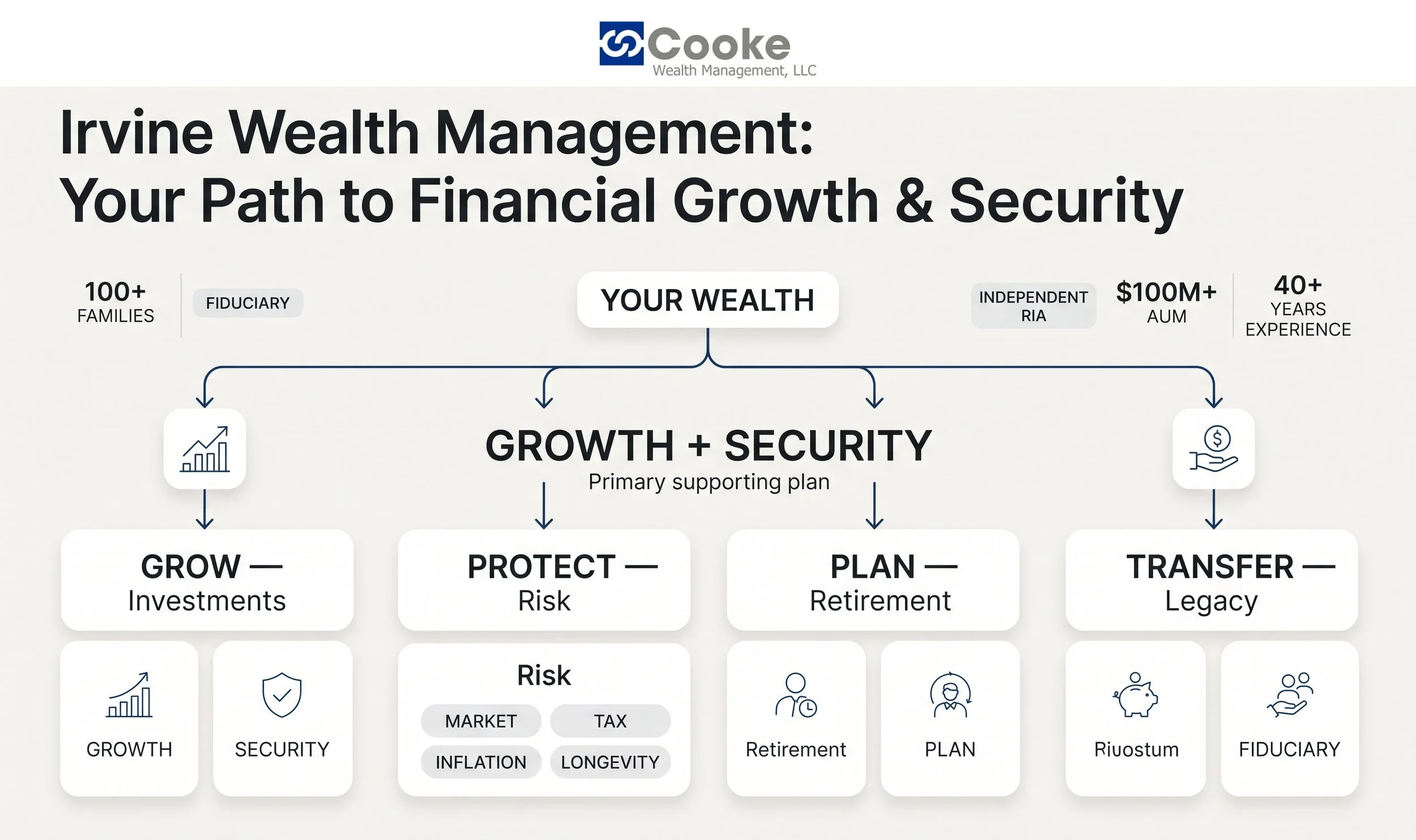
Cooke Wealth Management organizes its work around a few core areas: investment management, retirement planning, financial planning, and wealth transfer guidance. Each area is meant to work together rather than operate as a standalone service, so a change in one part of a client's life — a new job, an inheritance, a health event — gets reflected across the whole plan.
Why Choose an Independent, Fiduciary Advisor in Irvine
The Fiduciary Standard, Explained Simply
Under the Investment Advisers Act of 1940, Registered Investment Advisers generally owe clients a fiduciary duty, meaning they're legally required to act in the client's best interest. Independent firms structured this way differ from advisors tied to a single company's product lineup, since there's less incentive to steer clients toward proprietary investments.
What Independence Looks Like in Practice
An independent firm can select investments and strategies from a broad universe rather than a limited menu. Cooke Wealth Management operates as an independent Registered Investment Adviser, which means its recommendations aren't built around a parent company's product line. That structure matters most when a recommendation involves a tradeoff — a lower-cost fund versus a proprietary one, for instance — since the incentive to favor one over the other is reduced.
The Financial Planning Process, Step by Step
Starting With the Full Picture
Effective planning starts with a complete view of a client's finances: income, expenses, existing investments, insurance coverage, tax situation, and long-term goals. Skipping this step is one of the most common reasons financial plans fail to hold up — a strategy built on incomplete information tends to break down the moment life changes.
Building and Adjusting the Plan Over Time
From there, a personalized plan gets built around the client's specific goals rather than a generic template. Cooke Wealth Management frames this as an ongoing relationship: clients meet with their advisor to implement the plan, then revisit and adjust it as circumstances change, rather than receiving a one-time document that sits untouched for years.
A Few Milestones That Typically Trigger a Plan Review
Certain life events tend to require an updated plan, including:
A career change, promotion, or job loss
Marriage, divorce, or the birth of a child
Buying or selling a home in Orange County's competitive market
An inheritance or unexpected windfall
Approaching retirement within the next five to ten years
What Financial Security Actually Means in a Wealth Management Plan
Security Is About Managing Risk, Not Avoiding It
Financial security is more than keeping a portfolio conservative. It means identifying the different risks that could prevent your wealth from supporting your goals, and addressing them as part of one coordinated plan. The SEC notes that every investment involves some degree of risk, while FINRA identifies liquidity, market, and inflation risk among the factors investors need to weigh.
Liquidity Risk and Market Risk
Liquidity risk arises when you don't have enough readily accessible cash for emergencies or major expenses, forcing you to sell investments at an unfavorable time. Market risk is the possibility that stocks and other investments decline, potentially disrupting a plan if withdrawals are required during a downturn — diversification and appropriate asset allocation can help manage, though not eliminate, that exposure.
Inflation Risk and Longevity Risk
Inflation risk is the loss of purchasing power over time, making excessive reliance on cash or low-growth assets potentially problematic for long-term goals. Longevity risk is the possibility of outliving your assets, which makes sustainable retirement-income planning an important part of financial security.
Risks Outside the Portfolio
There are also risks that live outside the investment account itself. Tax risk can arise when withdrawals or other financial decisions create unnecessary tax costs — retirement-account distributions, for example, can be taxable and may carry additional taxes in certain circumstances. Concentration risk can develop when too much wealth depends on one company, employer, property, or asset class, while insurance risk involves having insufficient protection against major financial losses, and income risk can emerge from job loss, business disruption, or an unexpected change in earnings.
Why This Matters for Your Plan
A comprehensive wealth management plan considers these risks together, balancing the need for growth with the need to keep your financial goals resilient when circumstances change. Treating security as a single decision — like "stay conservative" — misses most of what actually threatens a long-term plan.
Choosing the Right Irvine Wealth Management Firm
Questions Worth Asking Before You Sign
A few questions can reveal a lot about how a firm actually operates: Are you a fiduciary at all times, or only in certain situations? How are you compensated, and do you receive commissions on any products? What is your typical client profile, and does my situation fit?
Why Local Knowledge Still Matters
An Irvine-based advisor who understands Orange County's cost of living, real estate market, and California tax rules brings context that a remote generalist firm may not. That local familiarity, combined with a genuinely personalized process, is often what separates a firm clients trust from one they simply hired.
Why Families Choose Cooke Wealth Management
Experience and Track Record
Cooke Wealth Management has served more than 100 families and manages over $100 million in assets, with its advisors bringing more than 40 years of combined industry experience. The firm's stated goal is to help clients avoid costly financial mistakes and build confidence in their financial future through honest guidance and customized planning.
A Values-Informed, Client-First Approach
The firm also incorporates biblical principles and academic research into its planning process, offering a perspective that some Orange County families specifically look for. Combined with its fiduciary structure as a Registered Investment Adviser, that approach gives clients a planning relationship built around their stated priorities rather than a product to sell.
Your Next Step Toward Financial Confidence
Building financial growth and security isn't a one-time decision — it's an ongoing process that should adapt as your life changes. The right Irvine wealth management partner treats that process as a long-term relationship, not a single transaction.
Cooke Wealth Management works with individuals and families throughout Irvine, Orange County, and Southern California to build personalized financial plans grounded in fiduciary guidance. If you're ready to talk through your goals, scheduling a Discovery Session is a straightforward way to see whether the fit is right.
Frequently Asked Questions
What does a wealth management firm in Irvine actually do?
A wealth management firm typically coordinates investment management, retirement planning, tax-aware strategy, insurance review, and wealth transfer guidance into a single plan. The goal is to align financial decisions across all these areas rather than treating them as separate, unrelated tasks. Firms vary in scope, so it's worth confirming which services are actually included.
How is an independent wealth management firm different from a bank or brokerage?
An independent firm isn't tied to a parent company's proprietary products, which can reduce certain conflicts of interest when making recommendations. Bank and brokerage advisors may have incentives to recommend in-house funds or products. Confirming an advisor's independence and fiduciary status is a reasonable first step in any evaluation.
How much money do I need to work with a wealth management firm?
Asset minimums vary significantly by firm, and some Irvine-based firms work with clients across a range of net worth levels. Flat-fee or hourly planning arrangements can also be an option for those who don't meet a firm's asset minimum for ongoing investment management. It's worth asking directly rather than assuming you don't qualify.
What's the difference between financial planning and investment management?
Financial planning covers the full picture — retirement income, taxes, insurance, and estate considerations — while investment management focuses specifically on building and managing a portfolio. Many wealth management firms, including Cooke Wealth Management, offer both as part of a coordinated approach. Some clients want only one service, while others want both combined.
How often should I review my financial plan with my advisor?
Most advisors recommend at least an annual review, with additional check-ins after major life events like a job change, inheritance, or approaching retirement. A plan that isn't revisited regularly can become outdated as circumstances shift. Ongoing communication is often a better indicator of a strong advisor relationship than performance alone.
Can I work with an Irvine wealth management firm if I don't live in Orange County?
Yes. Many advisory relationships happen remotely through video meetings, secure portals, and electronic signatures, which makes location less of a barrier than it once was. That said, a local Irvine advisor may still offer advantages for California-specific tax questions or in-person planning conversations.
How do I get started with Cooke Wealth Management?
Cooke Wealth Management offers a free Discovery Session to discuss your financial goals and determine whether the firm's approach fits your needs. From there, the firm builds a personalized plan rather than applying a generic template. You can schedule that initial conversation directly through the firm's contact page.
*We recommend that you consult a tax or financial advisor about your individual situation.