
Financial Advisor in Newport Beach: Comprehensive Wealth Management

Finding a financial advisor in Newport Beach often starts with a specific moment — a sale of a business, an inheritance, an approaching retirement, or simply a growing sense that your finances have outgrown a do-it-yourself approach. The right advisor should be able to handle that complexity as one coordinated plan, not a series of disconnected recommendations.
Cooke Wealth Management is an independent, fee-based wealth management firm based in nearby Irvine, serving families throughout Newport Beach, Orange County, and Southern California. The firm's model centers on comprehensive financial planning rather than a narrow focus on investment returns alone.
Why "Comprehensive" Is the Operative Word
A lot of financial advice addresses one problem at a time — pick better investments, buy the right insurance, minimize taxes this year. Comprehensive wealth management ties those pieces together, since a decision in one area routinely affects the others. A Roth conversion, for instance, changes both your tax bill and your future required distributions.
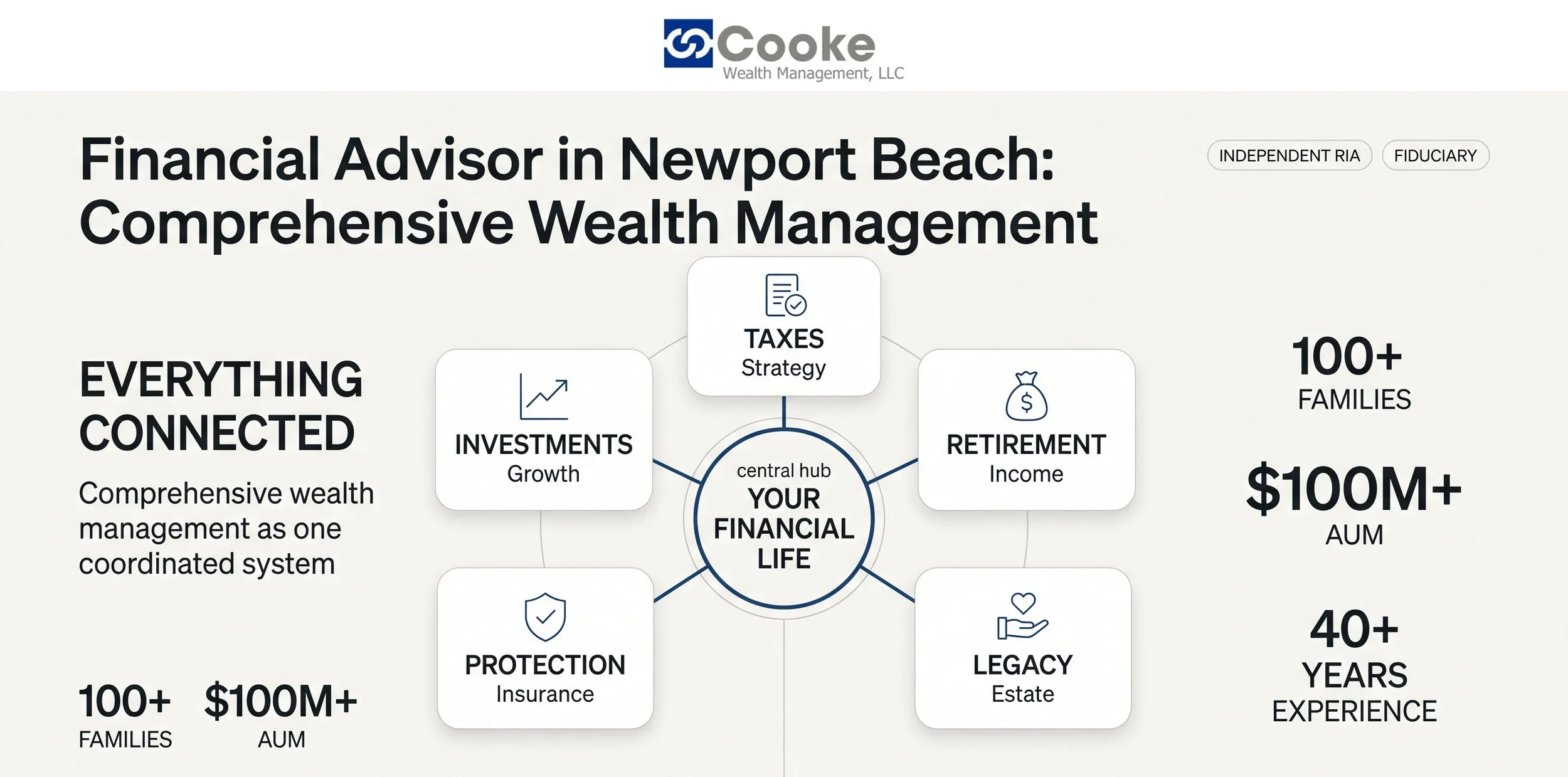
What a Truly Comprehensive Wealth Management Plan Should Connect
How Financial Planning Is Actually Defined
A comprehensive plan should do more than place investments under one roof — it should connect the financial decisions that influence one another and evaluate them against a client's broader goals. CFP Board defines financial planning as a process that integrates relevant elements of a client's personal and financial circumstances, rather than treating each decision as separate.
Investments, Taxes, and Retirement Together
Investments should be evaluated based on goals, time horizon, liquidity needs, and capacity for risk — not simply recent performance. Taxes should be considered alongside investment and retirement decisions, since the timing and structure of withdrawals, gains, and other transactions can affect the overall plan. Retirement planning should answer when retirement may be financially sustainable and how assets can support spending over time.
Insurance, Estate, and Real Estate
Insurance addresses risks that could otherwise disrupt a family's financial position, while estate planning considers how assets, beneficiary designations, and other arrangements should be handled after death. Real estate deserves consideration as part of total wealth, particularly when property represents a substantial portion of a household's assets. Business planning can become critical for owners approaching a sale, succession, or other transition.
Cash Flow, Liquidity, and Legacy
The plan should also examine cash flow and liquidity, including whether sufficient accessible assets are available for near-term needs and emergencies — CFP Board specifically identifies cash-flow management and maintaining appropriate liquid assets as components of financial planning. Legacy planning can then address how wealth should be transferred to heirs or directed toward charitable goals.
Coordination Is the Real Test
The key distinction is simple: a comprehensive plan isn't defined by the number of services a firm advertises. It's defined by whether those decisions are coordinated. CFP Board's planning process similarly calls for recommendations to be implemented, monitored, and updated as circumstances change, rather than delivered once and left alone.
How Cooke Wealth Management Approaches This
Cooke Wealth Management organizes its work around financial planning, investment management, retirement planning, and wealth transfer strategy. The firm builds a personalized plan for each client rather than applying a standard template, then works with clients on an ongoing basis to implement and adjust it as life changes.
Why Newport Beach Clients Have Distinct Planning Needs
Higher Concentration of Complex Assets
Newport Beach households often carry a different planning profile than the broader population — concentrated equity positions from a career at a public company, business ownership, significant real estate holdings, or a recent liquidity event. Each of those situations introduces planning considerations that a generic retirement calculator doesn't capture.
Real Estate, Taxes, and Timing
Real estate is a particularly common factor in Newport Beach financial plans, given the area's property values. Decisions about selling a home, using a 1031 exchange, or managing capital gains on investment property often need to be coordinated with the rest of a client's tax and investment picture, not handled as a separate transaction.
The Fiduciary Standard and Why It Matters Locally
What Fiduciary Duty Actually Requires
Under the Investment Advisers Act of 1940, Registered Investment Advisers generally owe clients a fiduciary duty, meaning they must act in the client's best interest rather than simply recommend a "suitable" product. That standard applies across the advisory relationship, not just at the moment a specific transaction is recommended.
Independence Reduces Certain Conflicts
An independent, fee-only firm is not tied to a parent company's proprietary product lineup, which reduces the incentive to steer clients toward in-house investments. Cooke Wealth Management operates as an independent Registered Investment Adviser, meaning its recommendations are drawn from a broad universe of options rather than a limited menu tied to one company's revenue goals.
How the Planning Process Works
Starting With a Full Financial Picture
Comprehensive planning starts with a complete view of income, expenses, investments, insurance, taxes, and long-term goals. Skipping this step is one of the most common reasons plans fail to hold up over time — recommendations built on incomplete information tend to break down the first time circumstances change.
An Ongoing Relationship, Not a One-Time Document
From there, the plan gets built around a client's specific goals and revisited as circumstances evolve. Cooke Wealth Management frames this as an ongoing relationship: clients work with their advisor to implement the plan, then adjust it over time rather than receiving a static document that goes untouched for years.
Events That Typically Call for a Plan Update
Certain events tend to require a fresh look at an existing plan, including:
Selling a business or receiving a liquidity event
Selling or purchasing Newport Beach real estate
A significant change in income, such as a bonus, RSU vesting, or promotion
Marriage, divorce, or a change in family structure
Retirement approaching within the next five to ten years
Managing Risk as Part of a Comprehensive Plan
Growth and Security Aren't Opposites
A comprehensive plan doesn't treat growth and safety as competing goals — it sequences them based on a client's timeline and specific needs. The SEC notes that every investment involves some degree of risk, and FINRA outlines several categories of risk that investors need to weigh, including market, liquidity, and inflation risk.
Concentration Risk Deserves Special Attention
Concentration risk — having too much wealth tied to a single company, employer, or property — is a common issue for Newport Beach clients with equity compensation or a concentrated real estate portfolio. Addressing it usually requires a deliberate diversification strategy, since selling a large position all at once can create its own tax consequences.
Longevity and Inflation Risk in Retirement
Longevity risk, the possibility of outliving your assets, and inflation risk, the gradual loss of purchasing power, both become more relevant as retirement approaches. A sustainable withdrawal strategy needs to account for both, rather than optimizing only for near-term market performance.
Choosing a Financial Advisor in Newport Beach
Questions That Reveal How a Firm Operates
A few direct questions can clarify how an advisor actually works: Are you a fiduciary 100% of the time? How are you compensated, and do you receive any commissions? What does your typical client's situation look like, and does mine fit that profile?
Why Local Experience Still Counts
An advisor familiar with Newport Beach and the broader Orange County market brings context that matters — local real estate dynamics, California-specific tax considerations, and access to in-person meetings when they're useful. That local grounding, paired with a genuinely comprehensive planning process, is often what distinguishes a firm worth hiring from one that simply has a nearby office.
Why Clients Choose Cooke Wealth Management
A Track Record Built on Long-Term Relationships
Cooke Wealth Management has served more than 100 families and manages over $100 million in assets, with advisors bringing more than 40 years of combined industry experience. The firm's stated goal is to help clients avoid costly mistakes and build genuine confidence in their financial future, rather than simply managing a portfolio.
A Values-Informed, Fiduciary Structure
The firm also incorporates biblical principles and academic research into its planning process, which resonates with some Orange County and Newport Beach clients specifically. Paired with its structure as an independent Registered Investment Adviser, that approach gives clients a planning relationship built around their stated priorities rather than a product to sell.
Start Building a Comprehensive Plan
A financial life this complex deserves a plan that treats every piece as connected — not a portfolio review here and a tax question there. Comprehensive wealth management means someone is looking at the whole picture, consistently, over time.
Cooke Wealth Management works with individuals and families throughout Newport Beach, Orange County, and Southern California to build personalized financial plans grounded in fiduciary guidance. If you're ready to talk through your goals, scheduling a Discovery Session is a straightforward way to see whether the fit is right.
Frequently Asked Questions
What does comprehensive wealth management include?
Comprehensive wealth management typically covers retirement planning, tax-aware investment strategy, insurance review, and wealth transfer guidance, coordinated as a single plan. The goal is to make sure a decision in one area doesn't create an unintended problem in another. Scope varies by firm, so it's worth confirming exactly what's included before signing on.
Why do Newport Beach clients often need more specialized planning?
Newport Beach households frequently have concentrated equity positions, business ownership, or significant real estate holdings that require more coordination than a standard retirement plan. Decisions involving property sales, stock options, or a liquidity event usually intersect with taxes and investment strategy at the same time. A generalist plan can miss those interactions.
Is a fee-only advisor better than a commission-based advisor?
Fee-only advisors are compensated directly by clients and don't earn commissions on products they recommend, which reduces certain conflicts of interest. Commission-based advisors may have incentives tied to specific products, which is worth understanding before committing to a relationship. Neither structure guarantees good advice, so it's still worth evaluating the advisor's process and track record.
How does real estate factor into a Newport Beach financial plan?
Real estate decisions, including selling a home or using strategies like a 1031 exchange, can have significant tax implications that should be coordinated with the rest of a client's investment and tax picture. Treating a property sale as a standalone transaction can lead to missed planning opportunities. A comprehensive advisor typically factors real estate into the broader plan.
What is concentration risk, and why does it matter for equity compensation?
Concentration risk is the risk of amplified losses from having too much wealth tied to a single investment, company, or asset class. Employees with significant stock compensation are particularly exposed to this risk if a large share of their net worth depends on their employer's performance. Diversification strategies can help manage this exposure over time, though tax consequences need to be considered.
How often should a comprehensive financial plan be updated?
Most advisors recommend at least an annual review, along with updates after major life events such as a business sale, real estate transaction, or approaching retirement. A plan that isn't revisited regularly can quickly become outdated as circumstances change. Consistent communication with your advisor is often a better sign of quality than short-term investment performance.
How do I get started with Cooke Wealth Management?
Cooke Wealth Management offers a free Discovery Session to discuss your financial goals and determine whether the firm's approach is the right fit. From there, the firm builds a personalized plan rather than applying a generic template. Interested clients can schedule that initial conversation directly through the firm's contact page.
*We recommend that you consult a tax or financial advisor about your individual situation.