
Your Independent Fiduciary Financial Advisor in Newport Beach

Finding a financial advisor in Newport Beach who is both independent and a true fiduciary narrows the search more than most people expect. Many advisors use fiduciary language loosely, so understanding exactly what those two words mean — and confirming them before signing anything — is worth the extra diligence.
Cooke Wealth Management is an independent, fee-based Registered Investment Adviser based in nearby Irvine, serving families throughout Newport Beach, Orange County, and Southern California.
Why Both Words Matter Together
"Independent" and "fiduciary" solve two different problems. Independence addresses who an advisor's recommendations ultimately serve, while fiduciary duty addresses the legal standard they're held to — and a Newport Beach client's financial complexity usually calls for both.
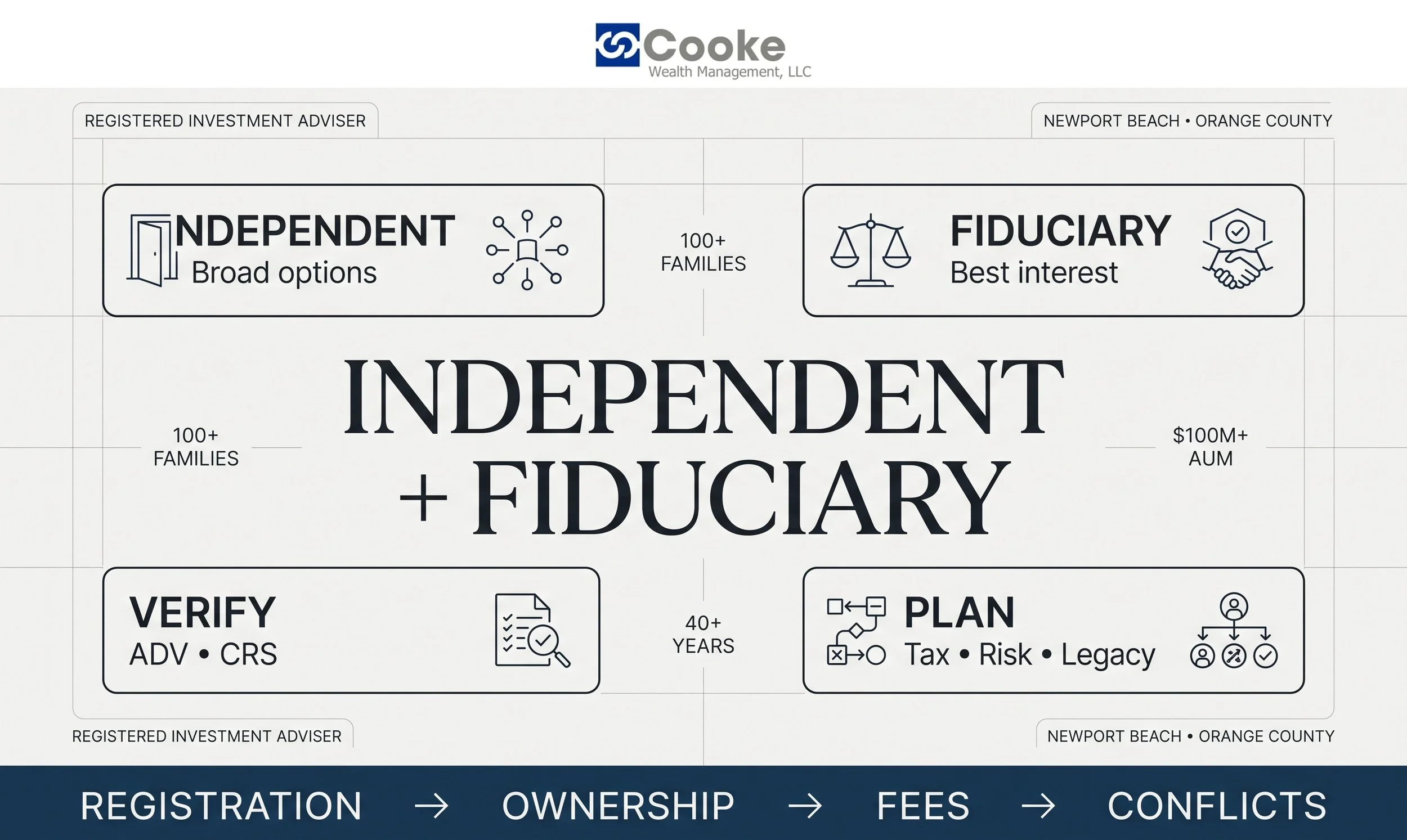
What "Fiduciary" Actually Means
A Legal Obligation, Not a Marketing Claim
Under the Investment Advisers Act of 1940, Registered Investment Advisers generally owe clients a fiduciary duty, which means they're legally required to act in the client's best interest across the advisory relationship. This is a higher bar than a "suitability" standard, which only requires a recommendation to be appropriate at the time it's made.
The Practical Difference Between the Two Standards
A suitability standard can allow an advisor to recommend a product that's appropriate while still earning more from it than a comparable alternative would pay. A fiduciary standard is designed to reduce that conflict by tying the advisor's legal obligation directly to the client's outcome rather than their own compensation.
What "Independent" Actually Means
Not Tied to a Parent Company's Products
An independent firm isn't owned by, or built around promoting, a specific bank's or brokerage's proprietary investment lineup. Cooke Wealth Management operates as an independent Registered Investment Adviser, which means its recommendations are drawn from a broad universe of investment options rather than a narrower menu tied to one company's revenue goals.
Why This Reduces Certain Conflicts
Independence matters most when a recommendation involves a genuine tradeoff — a lower-cost fund versus a proprietary one, for example. Without a parent company's product lineup to favor, an independent advisor has less structural incentive to steer a client toward one option over another for reasons unrelated to the client's own goals.
How to Verify an Independent Fiduciary Advisor
Claims Aren't Proof — Disclosures Are
Calling an advisor "independent" or "fiduciary" is not enough — prospective clients can verify those claims through the advisor's regulatory disclosures. Start with the SEC's Investment Adviser Public Disclosure database, which provides public information about registered investment advisers and their representatives.
What Form ADV Actually Discloses
The firm's Form ADV Part 1 can help you examine its business, ownership, and control structure, while Part 2 provides more detailed information about advisory services, fees, business practices, and conflicts of interest. Reading both parts gives a fuller picture than relying on a firm's own marketing materials.
What Form CRS Adds to the Picture
Next, review the firm's Form CRS, or Relationship Summary. The SEC designed Form CRS to give investors a standardized, plain-English way to compare advisory relationships, including services, fees and costs, conflicts of interest, standards of conduct, and disciplinary history.
A Quick Reference for What to Check and Where
| What to check | Where to verify it | What it can reveal |
|---|---|---|
| Registration | SEC/IAPD | Registration status |
| Ownership | Form ADV | Who controls the firm |
| Compensation | Form ADV Part 2 | How the firm gets paid |
| Conflicts | Form ADV / CRS | Potential financial incentives |
| Affiliations | Form ADV | Other businesses or relationships |
| Disciplinary history | Form ADV / IAPD / CRS | Reportable regulatory history |
| Standard of conduct | Form CRS | How the firm describes its obligations |
Pay Close Attention to Compensation and Conflicts
Pay particular attention to compensation and conflicts. The SEC identifies incentives such as commissions, asset-based compensation, revenue sharing, proprietary products, and third-party payments as potential sources of conflicts worth understanding before hiring an advisor.
Documentation Beats Marketing Language
This process gives you something stronger than an advisor's marketing description: independent documentation you can compare before establishing a relationship. It takes a bit more time than taking someone's word for it, but it's time well spent given how long an advisory relationship typically lasts.
Why Newport Beach Clients Often Need Both
Complex Financial Pictures Require Both Protections
Newport Beach households frequently carry a mix of concentrated equity, business ownership, and significant real estate holdings, each of which introduces its own conflicts of interest if not handled carefully. An independent, fiduciary advisor is structurally positioned to navigate that complexity without the added layer of proprietary product incentives.
Real Estate and Equity Decisions Benefit From Both
A recommendation about selling a concentrated stock position or a piece of investment property should be driven entirely by what's right for the client's broader plan. Independence removes one source of bias from that decision, while fiduciary duty provides the legal backing to hold the advisor accountable to it.
How Fiduciary and Independent Status Show Up in Practice
Recommendations Built Around Your Goals
In practice, this combination means recommendations are built around a client's specific goals, tax situation, and risk tolerance rather than a product a firm needs to sell. Cooke Wealth Management's investment management process reflects this — portfolios are constructed to align with each client's circumstances rather than following a standard model.
Transparency About Compensation and Conflicts
A genuinely independent fiduciary advisor should be able to explain clearly how they're compensated and disclose any conflicts of interest that could affect a recommendation. If an advisor is vague or evasive about either question, that's worth treating as a red flag regardless of how the rest of the conversation goes.
What Comprehensive Planning Looks Like in Newport Beach
The Core Areas of a Coordinated Plan
Comprehensive wealth management typically includes retirement income planning, tax-aware investment strategy, insurance review, and wealth transfer guidance, evaluated together rather than as isolated decisions. Cooke Wealth Management's financial planning approach is built around this kind of coordination, since a decision in one area — a Roth conversion, for instance — routinely affects several others.
An Ongoing Relationship, Not a One-Time Recommendation
Because fiduciary duty applies across the advisory relationship, not just at a single transaction, an independent fiduciary advisor's role tends to be ongoing. Cooke Wealth Management frames its work this way: a personalized plan is built, then implemented and adjusted over time as a client's circumstances evolve.
Managing Risk Under a Fiduciary Standard
Risk Management Is Part of the Fiduciary Obligation
A fiduciary's obligation extends to how risk is managed within a portfolio, not just which specific investments are chosen. The SEC notes that every investment involves some degree of risk, and an advisor bound to your best interest should be building a risk profile around your specific timeline and goals rather than a generic model.
Concentration Risk in Particular
Concentration risk — too much wealth tied to a single stock, employer, or property — is common among Newport Beach clients with equity compensation or significant real estate holdings. FINRA warns that concentration can amplify losses even within an otherwise reasonable-looking portfolio, making this a particularly important area for a fiduciary advisor to address directly rather than leave unmentioned.
Why Families Choose Cooke Wealth Management
Experience Built on Long-Term Client Relationships
Cooke Wealth Management has served more than 100 families and manages over $100 million in assets, with advisors bringing more than 40 years of combined industry experience. The firm's stated goal is to help clients avoid costly mistakes and build genuine confidence in their financial future.
A Values-Informed Approach Layered on a Fiduciary Foundation
The firm also incorporates biblical principles and academic research into its planning process, an approach that resonates with some Orange County and Newport Beach clients specifically. That values-informed layer sits on top of, rather than replaces, the firm's fiduciary and independent structure.
Work With an Advisor Who Is Actually on Your Side
Independence and fiduciary duty aren't marketing terms — they're structural protections that determine whose interests actually get prioritized when a recommendation is made. Confirming both before hiring an advisor, using their actual regulatory disclosures rather than their pitch, is one of the most consequential steps in the process.
Cooke Wealth Management works with individuals and families throughout Newport Beach, Orange County, and Southern California as an independent, fiduciary Registered Investment Adviser. If you're ready to talk through your goals, scheduling a Discovery Session is a straightforward way to see whether the fit is right.
Frequently Asked Questions
What's the difference between an independent advisor and a fiduciary advisor?
Independence refers to whether an advisor is tied to a parent company's proprietary products, while fiduciary duty refers to a legal standard requiring the advisor to act in the client's best interest. An advisor can technically be one without fully being the other, so it's worth confirming both separately. The strongest combination for reducing conflicts of interest is typically an advisor who is both.
How can I confirm an advisor is really a fiduciary?
Reviewing an advisor's Form ADV through the SEC's Investment Adviser Public Disclosure database can confirm their registration status and disclosed fee structure, while Form CRS offers a shorter, standardized summary of services, fees, and conflicts. It's also reasonable to ask directly whether they're a fiduciary 100% of the time or only in certain circumstances. These steps together provide more reliable confirmation than an advisor's self-description alone.
What's the difference between Form ADV and Form CRS?
Form ADV is a longer, more detailed regulatory filing covering a firm's business, ownership, fees, and conflicts of interest, split into Part 1 and Part 2. Form CRS is a shorter, standardized summary designed to be easier for retail investors to read and compare across firms. Reviewing both gives a more complete picture than relying on just one.
Are all Registered Investment Advisers independent?
Not necessarily. Some Registered Investment Advisers are affiliated with or owned by larger financial institutions that also sell proprietary products, which can create conflicts even under a fiduciary structure. True independence generally means the firm isn't built around promoting one company's product lineup. It's worth asking directly about ownership and affiliations when evaluating a firm.
Why does independence matter for Newport Beach clients specifically?
Newport Beach clients often have complex financial situations involving concentrated equity, business ownership, or significant real estate holdings, where the right recommendation should be based entirely on the client's circumstances. An independent advisor has less structural incentive to steer these decisions toward a proprietary product. That reduces one potential source of bias in an already complex planning process.
What kinds of compensation create conflicts of interest for financial advisors?
Commissions, asset-based compensation, revenue sharing, proprietary product incentives, and third-party payments are all sources of potential conflicts identified by securities regulators. Not every conflict means an advisor is acting improperly, but understanding how an advisor is paid helps clarify where those incentives might point. This information is generally disclosed in Form ADV and Form CRS.
How do I get started with Cooke Wealth Management?
Cooke Wealth Management offers a free Discovery Session to discuss your financial goals and determine whether the firm's independent, fiduciary approach fits your needs. From there, the firm builds a personalized plan rather than applying a generic template. You can schedule that initial conversation directly through the firm's contact page.