
Financial Planning for Seniors in Orange County: Retirement, Legacy, and Estate Planning

Seniors in Orange County face financial planning considerations that differ from many other parts of the country. Healthcare costs, California’s tax structure, high living expenses, and estate planning complexity all influence how retirement strategies are built and maintained.
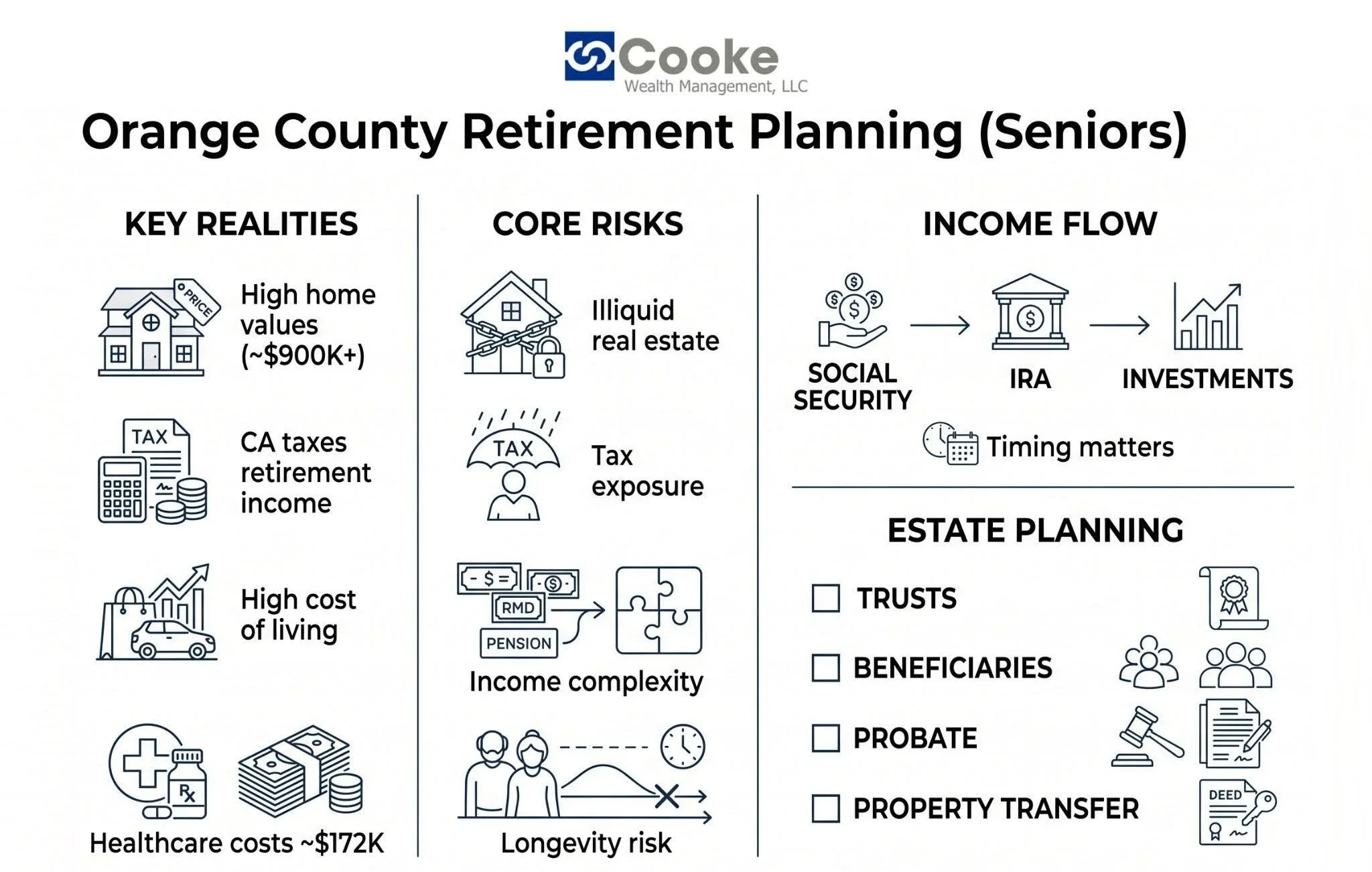
Fidelity’s 2025 estimate suggests a 65-year-old couple may need over $172,500 for healthcare expenses in retirement, excluding long-term care. At the same time, property values and cost of living across cities such as Irvine and Newport Beach can significantly shape income needs.
At Cooke Wealth Management, we work with Orange County seniors to develop retirement income strategies, estate plans, and long-term frameworks that reflect both financial realities and personal priorities.
Why Seniors in Orange County Need More Than a Standard Retirement Plan
Retirement planning in Orange County often requires adjustments beyond what may work in lower-cost regions.
Real estate frequently represents a large portion of net worth, with median home values often exceeding $900,000. This concentration can create planning considerations around liquidity, taxation, and how property is transferred to heirs.
Demographic trends also play a role. According to U.S. Census estimates, the senior population in Orange County continues to grow, increasing the need for planning strategies that reflect longer retirements and evolving financial needs.
A plan designed for a different region may not fully address these local factors.
Retirement Income Planning in a High-Cost Region
Many retirees in Orange County draw income from multiple sources, including Social Security, retirement accounts, pensions, and investment portfolios.
Each source is taxed differently under California law, which makes coordination important. A structured withdrawal strategy can help manage tax exposure across a retirement that may span several decades.
The timing of Social Security is one of the more impactful decisions. Claiming benefits later can increase monthly income, while earlier claims may reduce it. The appropriate timing depends on factors such as health, income needs, and other available assets.
A coordinated approach considers how each income source interacts rather than treating them independently.
Estate and Legacy Planning Unique to California
Estate planning is a key component of financial planning for seniors in Orange County.
California’s probate process can be time-consuming and is based on gross estate value rather than net equity. For estates with significant real estate holdings, this can lead to higher administrative costs.
Recent updates to California law have introduced simplified procedures for certain estates, but many properties in Orange County exceed those thresholds.
A structured estate plan may include tools such as revocable living trusts, updated beneficiary designations, and powers of attorney. These elements help establish how assets are managed and transferred.
Coordination between financial accounts and legal documents is an important part of maintaining consistency within an estate plan.
What We Do for Orange County Seniors
Whether a client is newly retired or has been drawing down assets for several years, the planning priorities shift at each stage. Early retirees often need help with income sequencing and Social Security timing.
Clients further into retirement tend to focus on RMD management, investment management, and beginning the process of distributing wealth to heirs. Surviving spouses face a distinct set of challenges around sudden changes to household income, account ownership, and tax filing status.
We structure our services around the planning needs that are most common for seniors in Orange County, including:
Retirement income planning and withdrawal strategy
Investment portfolio management aligned with income needs
Financial planning for life transitions
Tax-efficient wealth transfer strategies
Social Security timing and spousal benefit analysis
These areas are evaluated within the context of each client’s broader financial picture rather than as isolated decisions.
What to Expect When You Start Working with Us
Beginning a relationship with our team is often less formal than most people expect. The first meeting is usually a conversation, not a document review, but having certain materials ready makes the process more productive and helps us build an accurate picture from the start.
Common items to gather before an initial meeting include:
Recent Social Security statement (available at ssa.gov)
Tax returns from the past two years
Statements for all retirement accounts (IRAs, 401(k)s, pensions)
Brokerage or investment account statements
Current trust documents, will, and power of attorney
Life insurance policy summaries
Medicare card and any supplemental insurance documents
From there, projections and planning scenarios can be developed to evaluate different approaches.
Retirement planning involves variables such as market returns, inflation, and longevity. A structured process can help assess how different assumptions may affect long-term outcomes.
Understanding Financial Advisor Fees in Orange County
Pricing Variables
Our fees vary based on the services provided and the complexity of each client’s financial situation. All fees are clearly defined and agreed upon before any engagement begins.
We use two primary fee structures: a quarterly flat fee for financial planning and a percentage of assets under management (AUM) for investment management. For clients with a specific, one-time need, project-based planning engagements are also available.
AUM fees typically follow a tiered structure, with rates that may decrease as portfolio size increases. Industry research from 2024 indicates average fees of approximately 1.0% to 1.2% annually for portfolios under $1 million, with lower ranges often applied to larger portfolios.
Budgeting Tips for Senior Financial Planning Services
Before engaging any advisor, it can be helpful to understand what services are included in the quoted fee and whether the advisor receives compensation from third-party product recommendations.
Cooke Wealth Management operates as a fee-only firm, meaning we are compensated directly by clients and do not receive commissions from financial products. This structure reduces many of the conflicts associated with commission-based compensation.
A written engagement agreement established at the outset helps clarify the scope of services and fee structure. For those seeking more focused guidance, we also offer project-based engagements, such as a Social Security analysis or retirement income review, which can serve as an initial step before ongoing planning.
Why Orange County Seniors Work with Cooke Wealth Management
Regional Experience and Local Client Knowledge
We are based in Irvine and serve clients throughout Orange County, including Newport Beach, Laguna Beach, Huntington Beach, Anaheim, and surrounding communities. This regional focus provides direct experience with the financial conditions many seniors face locally.
These considerations include California’s tax treatment of retirement income, elevated real estate values that can create concentrated net worth, and the estate planning complexities associated with significant property holdings.
We work with clients across all stages of retirement, from individuals in their late 50s and 60s to those in their 70s and 80s managing required distributions and early stages of wealth transfer. With over 20 years of combined experience, our approach is tailored to each client’s situation rather than applying a single framework.
Ongoing Planning and Support
Financial planning is not static. Changes in tax law, account balances, and personal circumstances can affect existing strategies.
At Cooke Wealth Management, planning is approached as an ongoing process, with periodic reviews to help maintain alignment over time.
Services include retirement income planning, investment management, Social Security guidance, and coordination of broader financial considerations.
Build a Retirement Plan That Reflects Where You Actually Live
Retirement in Orange County involves both opportunities and constraints. High property values, state tax considerations, and estate planning complexity all influence how financial decisions are made.
Many of the issues that affect long-term outcomes are not large one-time decisions, but smaller details such as outdated beneficiary designations, uncoordinated account structures, or income strategies that do not reflect tax considerations.
Addressing these elements as part of a structured plan can help bring clarity to the overall picture.
At Cooke Wealth Management, we work with seniors to organize these moving parts into a coordinated financial strategy.
Frequently Asked Questions
What does a financial advisor do for seniors already in retirement?
A financial advisor helps retirees evaluate income strategies, tax considerations, and account structure to support ongoing financial needs. This often includes Social Security timing, required distributions, and coordination across accounts.
Does Cooke Wealth Management work with both spouses?
Planning is typically approached at the household level, which can help address considerations related to income, account ownership, and long-term transitions.
How much does a financial advisor cost in Orange County?
Fees vary depending on the advisor and services provided. Common models include asset-based fees, flat planning fees, and project-based engagements.
When should an estate plan be reviewed?
Estate plans are often reviewed after major life events or periodically over time to reflect changes in assets, family structure, or legal considerations.
Do I need both a financial advisor and an estate attorney?
A financial advisor focuses on financial strategy and account structure, while an estate attorney prepares legal documents. These roles often complement each other within a broader plan.
Does California tax Social Security income?
California does not tax Social Security benefits at the state level. However, retirement account distributions and pension income are generally taxed as ordinary income.