
California Estate Planning: Legacy Wealth Advisors

You have spent a lifetime building something meaningful. A home, a portfolio, a business, a family. Estate planning is how those efforts are carried forward according to your intentions.
In California, that process involves considerations that differ from many other states. Legal structures, tax rules, and probate procedures can affect how assets are transferred and how efficiently that transfer occurs.
At Cooke Wealth Management, we work with California families to integrate estate planning into a broader financial strategy centered on clarity, coordination, and long term purpose.
What California Estate Planning Actually Involves
The Scope of a Complete Estate Plan
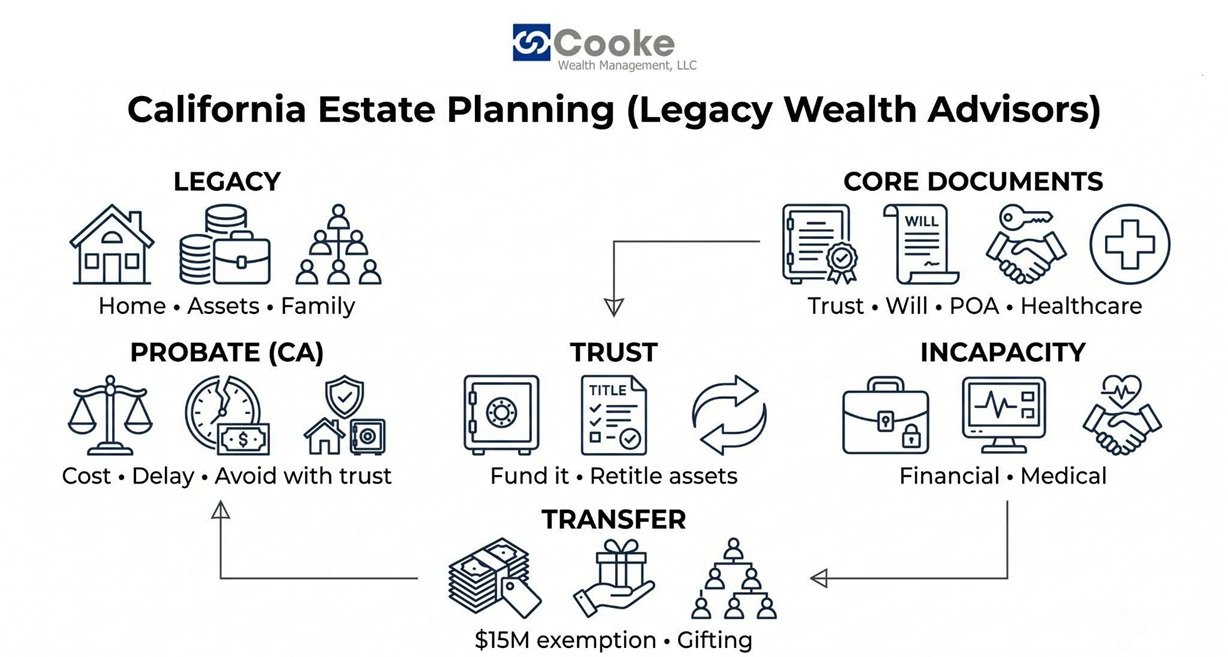
Estate planning in California involves more than preparing a will. A comprehensive plan often includes a revocable living trust, a pour-over will, durable powers of attorney, healthcare directives, and coordinated beneficiary designations.
Each component serves a specific role. When these elements are not aligned, gaps can lead to delays, added costs, or unintended outcomes.
A will alone does not avoid probate in California. It provides instructions to the court, but assets typically pass through the probate process unless they are held in a properly structured trust or transferred through beneficiary designations.
For individuals reviewing an existing plan, identifying how these components work together is an important step.
California's Probate System and Why It Matters
California’s probate process can be both time consuming and costly.
Attorney and executor fees are based on the gross value of an estate rather than net equity. This means real estate with a mortgage is still valued at its full market value when calculating fees.
In higher property value areas such as coastal Orange County, this structure can result in meaningful costs and delays for beneficiaries.
Recent updates to California law have introduced simplified procedures for certain estates, including primary residences under specific thresholds. However, many properties in coastal markets exceed those limits.
Understanding how your estate may be treated under current probate rules is a foundational part of planning.
The Fundamentals of California Estate Planning
Revocable Living Trusts as a Planning Foundation
A revocable living trust allows assets to be managed during your lifetime and transferred according to your instructions without going through probate.
For many California residents, a properly structured and funded trust can reduce administrative delays and costs associated with estate settlement.
Funding the trust is a critical step. Assets such as real estate, financial accounts, and investment portfolios must be retitled in the name of the trust for the structure to function as intended.
Coordinating this process alongside a broader financial plan can help ensure consistency across accounts and legal documents.
Powers of Attorney and Healthcare Directives
Estate planning also includes preparation for potential incapacity.
A durable financial power of attorney designates someone to manage financial matters if you are unable to do so. A healthcare directive outlines medical preferences and appoints an individual to make healthcare decisions on your behalf.
Without these documents, a court may appoint a conservator to manage financial or medical decisions. This process can involve additional time, cost, and administrative oversight.
These tools are relevant regardless of asset level and are an important part of a complete plan.
Key Details That Shape a California Estate Plan
Federal Estate Tax and the New Exemption Landscape
Federal estate tax planning has shifted significantly going into 2026. The One Big Beautiful Bill Act established a permanent federal estate and gift tax exemption of $15 million per individual and $30 million for married couples, effective January 1, 2026, with annual inflation adjustments going forward.
Current law provides a significant exemption per individual, with assets above that threshold subject to federal estate tax. While California does not impose a state estate or inheritance tax, federal considerations may still apply.
Planning strategies may include trust structures, gifting approaches, and charitable planning, depending on the size and composition of an estate.
Evaluating how your estate aligns with current exemption levels can help inform long term decisions.
Gifting Strategies and Multigenerational Wealth Transfer
Gifting can be one way to transfer assets over time.
Annual gift exclusions allow individuals to transfer a set amount per recipient without reducing lifetime exemption levels. For families with multiple beneficiaries, this approach can gradually reduce the size of an estate.
Additional strategies, such as education-focused accounts or certain trust structures, may also be considered depending on planning goals.
These decisions are often most effective when evaluated as part of a broader financial and estate strategy rather than in isolation.
How Cooke Wealth Management Approaches Estate Planning in California
Integrating Estate Planning With Your Financial Plan
Estate planning and financial planning are most effective when they are coordinated.
When handled separately, inconsistencies can arise between account titling, beneficiary designations, and legal documents. This can create confusion or unintended outcomes over time.
At Cooke Wealth Management, we take an approach that considers both financial and legal elements within an estate plan. Alignment across these areas can support consistency between current assets and long term intentions.
This structured approach is a core part of how we serve California families, including helping clients understand when it may be appropriate to seek legal advice.
A Values-Based Approach to Legacy
For many families, estate planning reflects more than financial structure.
John Cooke, CFP and Certified Kingdom Advisor, founded the firm in 2003 with the belief that financial decisions can reflect a person’s broader values. Juliette Cooke, CFP and Certified Kingdom Advisor, continues that approach in client relationships today.
For families who want their financial plan to reflect both their priorities and their balance sheet, this framework provides an additional layer of alignment.
Whether considering generational wealth transfer, charitable giving, or how to approach financial decisions with intention, these discussions can be integrated into the planning process.
Build Your California Legacy Plan With Cooke Wealth Management
Estate planning in California requires more than preparing documents. The interaction between legal structures, tax considerations, and financial strategy creates a planning environment that benefits from coordination.
A structured approach can help bring these elements together so that decisions reflect the full scope of your financial picture.
At Cooke Wealth Management, we work with individuals and families to organize these components into a clear and intentional strategy.
If you are evaluating your current plan or considering updates, you may contact our team to continue the conversation.
Frequently Asked Questions
How does California’s community property law affect estate planning for married couples?
California is a community property state, meaning most assets acquired during marriage are considered jointly owned. Each spouse typically has the ability to transfer their portion of those assets.
What is a pour-over will and how does it work with a living trust?
A pour-over will directs assets not already held in a trust to be transferred into the trust at death. Those assets may still pass through probate, which is why properly funding a trust during life is important.
What is a generation-skipping trust?
A generation-skipping trust allows assets to pass to future generations, such as grandchildren, and may reduce certain transfer taxes depending on how it is structured.
What should be considered with digital assets?
Digital assets, including online accounts and cryptocurrencies, require clear documentation and authorization within an estate plan. Without this, access may be limited for beneficiaries.
How do Medi-Cal rules affect estate planning?
Changes to Medi-Cal eligibility rules, including asset limits and look-back periods, can affect long-term care planning. These rules are subject to change and should be reviewed as part of a broader strategy.
Can a trustee terminate a small trust in California?
Recent updates to California law allow trustees to terminate certain smaller trusts without court approval under specific conditions, simplifying administration in some cases