
Retirement Financial Planning Serving Seniors Near San Diego: Retirement, Legacy, and Estate Planning

For seniors near San Diego, retirement planning involves a set of financial considerations that are often more complex than standard frameworks account for. California’s probate process is among the most expensive in the country, the state taxes pension income and IRA distributions as ordinary income, and home values in communities like La Jolla, Del Mar, and Coronado mean that real estate frequently represents a significant portion of net worth.
Healthcare costs also remain a central factor. Fidelity’s 2025 Retiree Health Care Cost Estimate suggests that a 65-year-old retiring today may need approximately $172,500 in after-tax savings for healthcare alone, excluding long-term care.
These variables create a meaningful gap between a generic retirement plan and one designed for this region. A structured approach that accounts for local tax rules, estate laws, and cost of living can help align financial decisions with long-term objectives.
This article outlines the planning considerations most relevant for San Diego seniors and how these areas are typically addressed within a comprehensive plan.
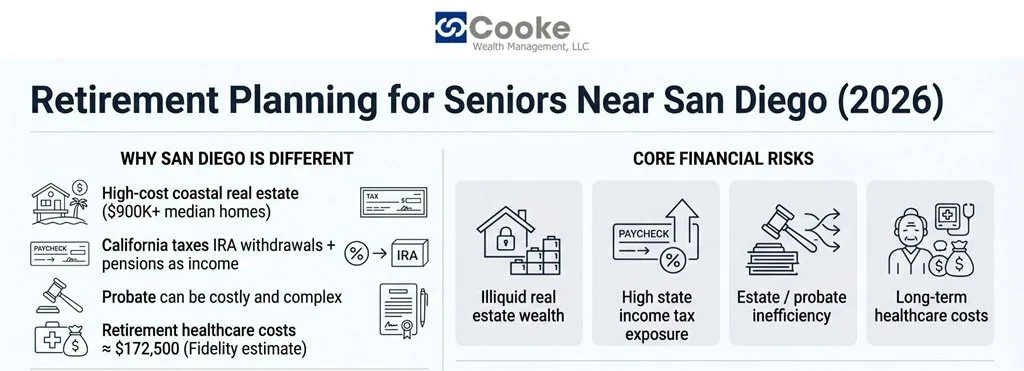
The Financial Challenges That Make San Diego Retirement Planning Different
Retirement near San Diego often involves a concentration of wealth in real estate. Property values in coastal areas frequently exceed $900,000, which can create liquidity constraints and complicate income planning, tax strategy, and wealth transfer decisions.
This concentration raises practical questions. Generating income from a largely illiquid asset, transferring property efficiently to heirs, and managing potential tax exposure all require coordination across planning areas.
Demographic trends also reinforce the need for region-specific planning. According to 2023 U.S. Census estimates, adults aged 65 and older represent 17% of the Southern California population, with projections reaching 36% by 2060. As this population grows, the demand for retirement strategies that reflect California-specific conditions continues to increase.
Estate and Legacy Planning Under California Law
California’s probate system can introduce both cost and delay if assets are not structured appropriately. Many estates are drawn into probate due to outdated account titling or incomplete planning, rather than intentional design.
As of April 1, 2025, probate is generally required for estates with personal property exceeding $208,850. A separate 2025 update allows primary residences valued up to $750,000 to bypass full probate, though this threshold may not fully apply in higher-value coastal markets.
For many seniors, a revocable living trust serves as a central component of estate planning. When coordinated properly, it can help align asset ownership with intended distribution. Financial accounts, beneficiary designations, and legal documents must be structured consistently to support this outcome.
This process often involves coordination between financial advisors and estate attorneys, as each plays a distinct role. Financial advisors may review account structure and beneficiary designations, while attorneys handle legal document preparation and updates.
Retirement Income Strategy for a High-Cost Region
The sequence in which retirement income sources are drawn can have a meaningful impact on long-term outcomes, particularly in a high-tax state like California.
Social Security benefits, required minimum distributions (RMDs), pension income, and portfolio withdrawals are each treated differently for tax purposes. The order and timing of these withdrawals can influence overall tax exposure across retirement.
Delaying Social Security from age 62 to 70 can increase monthly benefits by approximately 77%. However, the appropriate timing depends on individual factors such as health, income needs, and household structure.
A coordinated income strategy may involve evaluating these variables together rather than in isolation. When structured carefully, this approach can help support consistency in income while managing tax considerations over a retirement that may span multiple decades.
How We Work With Seniors Near San Diego
Planning priorities often shift depending on the stage of retirement. Individuals early in retirement may focus on income sequencing, Social Security timing, and reviewing estate documents. Those further along may prioritize RMD management, portfolio adjustments, and wealth transfer planning.
Rather than applying a fixed model, planning is typically aligned with the client’s current stage and evolving needs. This may include retirement income planning, portfolio alignment to income requirements, financial planning around major life transitions, and evaluation of tax-efficient wealth transfer strategies.
An advisor familiar with California’s tax structure and cost of living can incorporate these factors into the planning process, rather than relying on generalized assumptions.
What the Planning Process Looks Like from the Start
Initial conversations are generally structured as discovery sessions. The purpose is to understand the client’s financial position, goals, and existing plan before making recommendations.
While not required, having relevant documents available can improve the quality of the discussion. These may include Social Security statements, recent tax returns, retirement account statements, investment accounts, and estate documents such as trusts or wills.
From there, projections can be developed to evaluate different strategies. Because retirement planning involves variables such as market returns, inflation, and longevity, scenarios are typically modeled across a range of assumptions rather than a single outcome.
As a fee-only, SEC-registered investment advisor, Cooke Wealth Management operates under a fiduciary standard. This means advice must be provided in the client’s best interest, without commissions tied to product recommendations.
Understanding Financial Advisor Fees Near San Diego
Fee Structures
Advisory fees are generally established in advance of any engagement. Common structures include flat fees for financial planning, asset-based fees for investment management, and project-based fees for specific planning needs.
Asset-based fees often follow a tiered structure. Industry research from 2024 indicates average fees of approximately 1.0% to 1.2% annually for portfolios under $1 million, with lower rates typically applied as asset levels increase.
For example, a $1 million portfolio at a 1% annual fee would result in $10,000 in yearly advisory costs, with adjustments as assets grow or decline.
What to Know Before You Engage an Advisor
One of the key distinctions among advisors is whether they operate as fee-only or receive commissions from product recommendations. Fee-only structures can reduce potential conflicts of interest by aligning compensation directly with advice provided.
A written engagement agreement can help clarify the scope of services and fee structure before work begins. Some advisors also offer limited-scope engagements for specific planning needs, such as Social Security analysis or retirement income reviews.
Why San Diego Seniors Work with Cooke Wealth Management
Regional Knowledge and Client Experience
Cooke Wealth Management is based in Irvine and serves clients throughout Southern California, including the San Diego area. The firm works regularly with planning considerations specific to California, including taxation of retirement income, high property values, and estate planning complexity.
With over 40 years of combined industry experience, the team has worked with clients across different stages of retirement, from early planning through later-stage wealth transfer considerations.
The firm holds CFP® certification and operates under a fiduciary standard.
Services and Ongoing Support
Planning is typically approached as a coordinated process rather than a series of separate decisions. Retirement income, investment management, and estate planning are evaluated together, with adjustments made as circumstances change.
This coordination can help maintain consistency across different areas of a financial plan, particularly as variables such as RMD levels, tax exposure, or personal goals evolve over time.
Start With a Plan Built for Where You Live
Retirement near San Diego involves financial variables that extend beyond general planning assumptions. State tax treatment, probate rules, and local cost of living all influence how a plan is structured.
Seemingly minor details can carry long-term implications. Beneficiary designations, trust alignment, and Social Security timing decisions are often evaluated within a broader plan to ensure consistency with overall objectives.
Working with a financial advisor familiar with these regional factors can help identify gaps and evaluate potential strategies before they become more complex to address.
Cooke Wealth Management focuses on building retirement income strategies, estate structures, and legacy plans that reflect the realities of retirement in Southern California. Seniors considering a review of their current plan may benefit from a structured evaluation of these areas.
Frequently Asked Questions
What should seniors near San Diego look for in a financial advisor?
Key considerations include fiduciary status, fee transparency, and experience working with California retirees. State-specific tax rules and probate laws can materially affect planning decisions, making regional familiarity relevant.
How does Cooke Wealth Management approach retirement income planning?
Retirement income planning typically involves evaluating withdrawal sequencing, Social Security timing, and how different income sources interact. California tax treatment is incorporated into this analysis to assess overall impact.
How much does a financial advisor near San Diego typically charge?
Fees vary based on structure and scope. Industry averages suggest asset-based fees of 1.0% to 1.2% for portfolios under $1 million, with lower rates for larger portfolios. Advisors generally provide a clear fee schedule prior to engagement.
Does California’s probate process affect seniors in San Diego differently than other states?
California’s probate process is generally more complex and costly than in many other states. For seniors with significant real estate holdings, this can increase the importance of proper estate structuring. Thresholds and exemptions may apply, depending on asset type and value.
When is the right time for a San Diego senior to start working with a financial advisor?
Planning can begin at various stages, though individuals approaching retirement often have greater flexibility in structuring income and estate strategies. Those already retired may still benefit from reviewing withdrawal strategies and account structures.
Does California tax Social Security income?
California does not tax Social Security benefits at the state level. However, pension income, IRA distributions, and 401(k) withdrawals are generally taxed as ordinary income, which can influence withdrawal sequencing decisions.