
Charitable Giving Financial Planning for High-Income Families: Aligning Biblical Generosity With Tax Efficiency

Charitable giving financial planning sits at the intersection of personal values, tax strategy, and long-term wealth management. For high-income families, the structure and timing of charitable gifts can materially affect investment decisions, retirement planning, estate strategies, and tax exposure.
Giving decisions are rarely as simple as writing a check. The type of assets donated, the timing of contributions, and the vehicle used for giving can each produce meaningfully different financial outcomes.
At Cooke Wealth Management, we work with families who want their generosity to reflect both their values and their broader financial goals. Whether evaluating a donor-advised fund, coordinating charitable giving with retirement income planning, or integrating philanthropy into a wealth transfer strategy, the objective is typically the same: building a giving framework that operates coherently across the full financial picture.
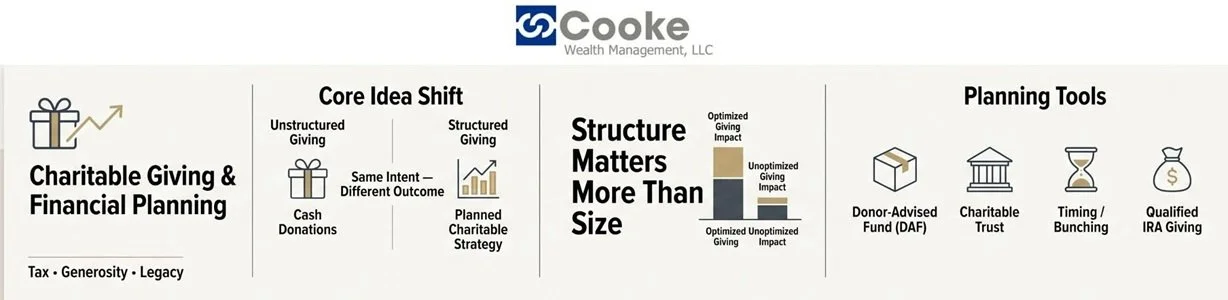
More Than a Tax Write-Off: What Charitable Giving Planning Is Designed to Do
Charitable giving financial planning involves integrating philanthropic goals into a broader financial strategy rather than treating donations as isolated transactions.
For high-income households, uncoordinated giving can create avoidable inefficiencies. A large year-end donation made without reviewing taxable income, capital gains exposure, or retirement account distribution requirements may produce a different outcome than intended from both a tax and cash flow perspective.
In many situations, appreciated assets provide more efficient giving opportunities than cash. Donating appreciated securities held longer than one year, for example, may allow the donor to deduct fair market value while avoiding recognition of embedded capital gains, according to IRS Publication 526.
The structure of a gift often matters as much as the size of the gift itself.
Why Charitable Planning Becomes More Important for High-Income Families
The relationship between philanthropy and financial planning becomes more significant as income and asset complexity increase.
High-income families frequently navigate:
Higher marginal tax rates
Concentrated investment positions
Significant unrealized capital gains
Retirement accounts subject to required minimum distributions (RMDs)
Estate values approaching federal exemption thresholds
Each of these factors can create charitable planning opportunities.
For retirees, qualified charitable distributions (QCDs) allow individuals age 70½ or older to transfer up to $108,000 annually from an IRA directly to a qualified charity while satisfying RMD requirements without recognizing the amount as taxable income.
Structured giving vehicles have also become increasingly common. According to NPTrust, donor-advised fund (DAF) grantmaking reached $64.89 billion in fiscal year 2024, reflecting growing use of charitable structures as part of broader tax and wealth planning strategies.
The Giving Vehicles Worth Understanding Before You Write the Check
Donor-Advised Funds: Give Now, Grant Later
A donor-advised fund is an account maintained by a sponsoring charitable organization into which donors make irrevocable contributions and receive an immediate tax deduction.
Assets inside the account can remain invested and grow tax-free while grants are distributed to charities over time.
DAFs are often useful during unusually high-income years. A business owner anticipating a liquidity event or large bonus may choose to front-load several years of charitable contributions into a single tax year while distributing grants gradually afterward.
Current deduction limits generally allow:
Cash contributions up to 60% of adjusted gross income (AGI)
Appreciated asset contributions up to 30% of AGI
Five-year carryforwards for unused deductions
Beginning in 2026, the new above-the-line charitable deduction for non-itemizers does not apply to donor-advised fund contributions, which may affect planning decisions for some households.
Charitable Remainder Trusts
Charitable remainder trusts (CRTs) are irrevocable trusts that provide income to the donor or beneficiaries for a specified term, with remaining assets eventually passing to charity.
CRTs are commonly used for highly appreciated assets such as concentrated stock positions, real estate, or closely held business interests because they may allow diversification without immediate recognition of capital gains.
Depending on structure, CRTs can provide:
Partial charitable deductions
Income streams for beneficiaries
Diversification opportunities for concentrated assets
Charitable Lead Trusts
Charitable lead trusts (CLTs) operate in the opposite direction. Income payments are made to charity for a set period, after which remaining assets pass to heirs.
CLTs are often used in estate planning strategies involving appreciating assets because future appreciation may pass outside the taxable estate at reduced transfer tax values.
Because CLTs involve interactions across income, gift, and estate tax rules, they generally require coordination with legal and tax advisors.
Bunching and Timing Strategies
The 2017 Tax Cuts and Jobs Act significantly increased the standard deduction, reducing the number of households that itemize deductions annually.
As a result, many charitable families now use “bunching” strategies, concentrating several years of planned giving into one tax year to exceed the standard deduction threshold and maximize itemized deductions.
This approach often becomes more relevant during years involving:
Business sales
Roth conversions
Large capital gains
Significant bonuses or deferred compensation events
The timing of contributions can materially affect overall tax efficiency.
Donor-Advised Funds vs. Private Foundations e
As charitable intent grows, some families evaluate whether a private foundation offers advantages over a donor-advised fund.
The structures differ meaningfully.
Donor-advised funds generally offer:
Lower administrative burden
No mandatory annual distributions
No excise tax on investment income
Private foundations may provide:
Greater operational control
Family governance structures
More direct involvement in grantmaking and investments
However, private foundations are subject to additional reporting obligations, annual distribution requirements, and excise taxes on investment income.
Some families use both structures simultaneously, maintaining a DAF for flexible giving while operating a private foundation for legacy or family governance purposes.
Planning Areas Families Often Overlook
2026 Tax Law Changes
Beginning in 2026, itemized charitable deductions are subject to a new 0.5% AGI floor for high earners. Contributions below that threshold are not deductible.
Changes to deduction treatment for top-bracket taxpayers may also reduce the effective tax value of charitable deductions compared to prior years, increasing the importance of timing and bunching strategies.
Estate and Wealth Transfer Coordination
Charitable planning often intersects directly with estate planning decisions.
One commonly overlooked strategy involves naming charities as beneficiaries of retirement accounts such as IRAs, since charities do not pay income tax on distributions while individual heirs generally do.
Asset location can materially affect after-tax wealth transfer outcomes.
AGI Limitations and Carryforwards
Large charitable gifts may exceed annual AGI deduction limits. Excess deductions can generally be carried forward for up to five years, though the applicable percentage limitations continue applying during carryforward years.
State Tax Considerations
State-level deduction treatment may differ from federal rules, particularly for families relocating or maintaining multi-state residency ties.
Values and Philanthropic Intent
The most effective charitable plans generally begin with clarity around intent.
Some families prioritize faith-based stewardship principles or recurring giving commitments. Others focus on legacy planning, charitable efficiency, or intergenerational involvement in philanthropy.
The planning structure should support the family’s priorities rather than override them.
Where Generosity and Financial Planning Intersect
Charitable decisions rarely exist independently from the broader financial plan.
A significant charitable gift may affect:
Investment allocation decisions
Retirement account strategy
Estate structures
Tax planning
Cash flow management
This coordination is often where fiduciary planning provides the most value.
Cooke Wealth Management integrates charitable planning into broader conversations involving investment management, retirement planning, and wealth transfer strategy.
This may include:
Reviewing appreciated assets suitable for donation
Coordinating charitable timing with income events
Evaluating charitable beneficiary designations
Aligning giving strategies with estate plans
As a fee-only fiduciary firm, recommendations are made within the context of the client’s broader financial goals rather than product commissions or sales incentives.
John Cooke and Juliette Cooke work with families who want charitable planning to reflect both financial stewardship and long-term philanthropic intent.
Four Questions Every Family Should Answer Before Making a Major Gift
Before making a significant charitable contribution, many families benefit from reviewing four core areas:
What is the primary purpose of the gift?
Clarifying whether the objective is faith-based giving, family legacy, tax efficiency, or support for a specific cause often shapes the appropriate structure.
Which assets are best suited for donation?
Appreciated securities, IRA assets, or real estate may produce different tax outcomes than cash contributions.
What does this year’s income picture look like?
High-income years may create more valuable deduction opportunities, particularly when coordinated with major liquidity events or capital gains.
How does the gift affect the estate plan?
Beneficiary designations, trust structures, and retirement account treatment should generally be reviewed before finalizing substantial gifts.
Generosity Is Usually Most Effective When It Is Structured Intentionally
Charitable giving financial planning is not limited to ultra-high-net-worth families or private foundations. It is often relevant for any high-income household seeking to align generosity with broader financial goals.
The available planning tools, including donor-advised funds, qualified charitable distributions, charitable trusts, and contribution bunching strategies, each address different planning objectives.
As 2026 tax law changes reshape deduction treatment for higher earners, coordination across investment, retirement, tax, and estate planning becomes increasingly important.
Families evaluating how charitable giving fits within their long-term financial strategy may benefit from reviewing those decisions within a broader fiduciary planning framework.
Frequently Asked Questions
Can you donate non-cash assets to a donor-advised fund?
Yes. Donor-advised funds can accept assets such as appreciated securities, business interests, real estate, and cryptocurrency. In many cases, donating appreciated assets may provide greater tax efficiency than donating cash because donors may avoid recognizing capital gains while still receiving a deduction based on fair market value.
What is a qualified charitable distribution (QCD)?
A QCD allows IRA owners age 70½ or older to transfer up to $108,000 annually from an IRA directly to a qualified charity without recognizing the amount as taxable income. QCDs can also help reduce adjusted gross income, which may affect Medicare premium calculations.
What happens if charitable deductions exceed AGI limits?
Excess charitable deductions can generally be carried forward for up to five additional tax years, subject to applicable AGI limitations.
How does charitable giving fit into an estate plan?
Charitable giving can support estate planning goals by reducing taxable estates and improving asset-location efficiency. Retirement accounts are often among the most tax-efficient assets to leave to charity because charities generally do not pay income tax on distributions.
What is the difference between a charitable lead trust and a charitable remainder trust?
A charitable remainder trust (CRT) provides income to beneficiaries first, with remaining assets eventually passing to charity. A charitable lead trust (CLT) distributes income to charity first, with remaining assets later transferring to heirs.
Can charitable giving align with a faith-based financial philosophy?
Yes. Many families structure charitable plans around biblical stewardship principles and long-term philanthropic priorities. John Cooke and Juliette Cooke incorporate Certified Kingdom Advisor principles alongside fiduciary financial planning for families seeking values-aligned guidance.