
Stewardship in Practice: How Christian High Earners Think About Wealth, Investing, and Legacy

Biblical stewardship asks a different question than traditional financial planning: what is wealth ultimately for?
For Christian professionals and high-income families, financial decisions often involve more than optimization alone. Investment choices, charitable giving, retirement planning, and wealth transfer may all reflect broader convictions about responsibility, generosity, and legacy.
At Cooke Wealth Management, we work with Christian families throughout Southern California who want their financial plans to align with both long-term financial goals and biblical stewardship principles.
As a fee-only fiduciary firm based in Irvine, our team includes CFP® professionals who also hold the Certified Kingdom Advisor® (CKA®) designation. This article outlines how stewardship-based financial planning can shape investing, giving, and legacy decisions for high earners.
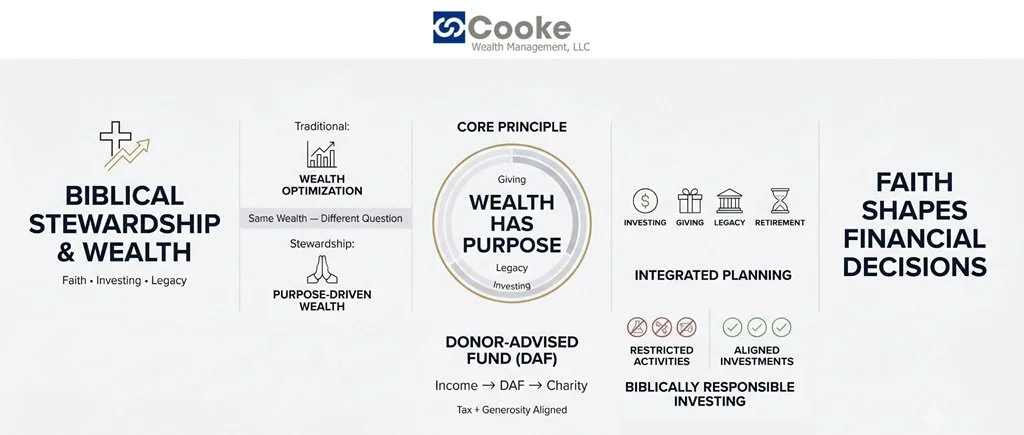
Biblical Stewardship Changes the Way Financial Planning Is Approached
When the end goal includes responsible management and distribution, financial planning changes in practice. Tax efficiency now preserves a God-given resource for the things you care about. Investment strategy isn’t simply about returns, it really matters what you’re funding.
When stewardship becomes part of the planning framework, financial decisions are evaluated differently.
Tax efficiency may support long-term generosity goals. Investment strategy may reflect both financial objectives and the types of businesses or industries a family wants to support through ownership. Estate planning may prioritize intentional wealth transfer rather than asset accumulation alone.
For many families, these questions become more important during major financial transitions such as:
Business sales
Executive compensation increases
Inheritance events
Retirement preparation
Significant liquidity events
A 2019 study by the Christian Investment Forum examining biblically responsible investing (BRI) funds across a 15-year period found that participating equity and bond funds compared favorably to conventional peers over time, including during periods of market stress.
While investment outcomes always vary, the study challenged the assumption that values-based investing necessarily requires sacrificing long-term performance objectives.
At Cooke Wealth Management, these conversations are often structured around our 5 Pillars of Christian Financial Planning, which integrates stewardship, generosity, investment alignment, retirement planning, and legacy considerations into a coordinated financial framework. Rather than separating faith from financial decision-making, the goal is to evaluate how each area of the plan supports the others over time.
Integrating Stewardship During Active High-Income Years
For professionals in active earning years, stewardship conversations often center around charitable giving, tax coordination, and investment alignment.
Many families already give consistently but have not integrated those decisions into a broader financial strategy.
Donor-advised funds (DAFs), for example, can provide a structured way to coordinate giving with taxable income and appreciated investments. Contributing appreciated securities directly to a DAF may allow donors to avoid capital gains recognition while receiving a charitable deduction based on fair market value.
This approach can become especially relevant during high-income years involving:
Business sales
Bonuses
Equity compensation events
Concentrated stock diversification
Significant capital gains
Rather than treating giving as a separate conversation, stewardship-based planning often coordinates philanthropy alongside tax planning, investment management, and retirement strategy.
Planning for Legacy and Major Financial Transitions
Stewardship considerations often become more visible during estate and legacy planning conversations.
Families frequently evaluate how wealth should support future generations, charitable priorities, and long-term family values simultaneously.
Common planning areas include:
Balancing inheritance and charitable giving goals
Structuring distributions to support long-term financial responsibility
Establishing donor-advised funds or charitable trusts
Coordinating estate documents with stewardship objectives
Evaluating family governance and multi-generational planning structures
These decisions generally require coordination across legal, tax, investment, and estate planning considerations rather than isolated product recommendations.
What Biblically Responsible Investing Looks Like in Practice
Biblically responsible investing is a portfolio framework designed to align investment holdings with Christian values.
BRI strategies generally use screening methodologies that exclude companies involved in activities viewed as inconsistent with biblical principles while still maintaining diversified investment exposure.
Common screening categories may include:
Gambling
Pornography
Tobacco
Alcohol
Certain abortion-related activities
Human trafficking concerns
The Biblically Responsible Investing Institute (BRII) maintains research databases covering thousands of public companies across numerous screening categories.
In practice, BRI portfolios are typically constructed using diversified allocations across equities and fixed income while applying faith-based screening standards.
For many clients, the starting point is reviewing current holdings to evaluate whether existing portfolios align with their stated values.
What to Expect When Aligning a Portfolio With Your Faith
Clients considering a faith-based investment strategy often want clarity around how implementation works in practice.
What BRI portfolios may include:
Diversified stock and bond exposure
Faith-screened mutual funds and ETFs
Active and passive investment strategies
Broad asset allocation across major sectors and markets
What BRI portfolios often avoid:
Gambling-related companies
Tobacco and alcohol producers
Pornography-related businesses
Certain abortion-related revenue sources
Companies flagged for severe labor or trafficking concerns
The goal is not necessarily to eliminate diversification but to apply values-based screening within a long-term portfolio framework.
Advisory Fees and the Fiduciary Structure
Cooke Wealth Management operates as a fee-only fiduciary firm, meaning compensation comes directly from clients rather than commissions tied to financial products.
For stewardship-oriented planning, this structure matters because recommendations involving charitable strategies, investment screening, or estate planning are not tied to product incentives.
Several factors generally affect advisory costs:
Portfolio size
Planning complexity
Estate and tax coordination needs
Investment implementation structure
One-time versus ongoing planning engagements
Some faith-based investment funds may also carry different expense ratios than traditional index-based investments, which can affect overall implementation costs.
How Christian Families Evaluate Faith-Based Financial Advice
Before engaging any advisor for stewardship-focused planning, many families benefit from reviewing both their current costs and the advisor’s planning philosophy.
Important distinctions often include:
Fee-only versus fee-based compensation
Fiduciary obligations
Experience with charitable planning
Familiarity with biblically responsible investing
Credentials such as the CKA® designation
The Certified Kingdom Advisor® designation specifically focuses on applying biblical financial principles within financial planning and advisory work.
Why Christian Professionals in Southern California Work With Cooke
Regional Experience and Client Focus
Southern California households often navigate a combination of high income, elevated living costs, concentrated real estate exposure, and complex tax considerations.
Cooke Wealth Management works with physicians, executives, business owners, retirees, and multi-generational families across Orange County and Southern California.
The firm integrates retirement planning, investment management, charitable planning, and estate coordination into a broader stewardship-based planning process.
John Cooke brings decades of financial planning experience grounded in biblical stewardship principles, while Juliette Cooke works with families navigating complex financial transitions, long-term planning, and values-based decision-making.
The firm’s approach is built around ongoing advisory relationships designed to integrate investment management, charitable planning, retirement strategy, and legacy conversations within a single planning framework.
A Plan That Reflects What You Actually Believe
Traditional financial planning often emphasizes optimization without addressing how clients view the purpose of wealth itself.
For Christian families, stewardship may involve evaluating whether investment strategies, charitable giving, retirement planning, and wealth transfer decisions operate consistently with long-term values and priorities.
A comprehensive financial plan can help coordinate:
Investment strategy
Giving goals
Tax planning
Retirement income
Estate and legacy structures
When these areas are evaluated together, families may gain greater clarity around both financial decision-making and long-term stewardship priorities.
Frequently Asked Questions
What does biblical stewardship mean in financial planning?
Biblical stewardship generally views wealth as something entrusted to individuals to manage responsibly rather than simply accumulate. In practice, this often influences decisions involving investing, charitable giving, retirement planning, and legacy strategy.
Is biblically responsible investing different from ESG investing?
Yes. While BRI and ESG approaches may use some similar screening methods, BRI frameworks are specifically built around biblical principles and theological considerations rather than broader environmental or social scoring systems alone.
Can donor-advised funds work well for Christian high earners?
Yes. Donor-advised funds can help coordinate charitable giving with high-income years, appreciated assets, and long-term philanthropic goals while allowing grants to charities over time.
What is the CKA® designation?
The Certified Kingdom Advisor® designation is a credential focused on applying biblical financial principles within financial planning and advisory work.
Can biblically responsible investing be used inside a 401(k)?
Sometimes. Employer-sponsored retirement plans may offer limited investment menus, though BRI strategies can often be implemented more fully within IRAs, taxable accounts, or rollover retirement accounts after leaving an employer.