
Estate Tax Exemption 2026: What Changed and What Didn't

For several years, high-net-worth families planned around the scheduled sunset of the Tax Cuts and Jobs Act (TCJA) provisions that had significantly increased the federal estate tax exemption.
Financial advisors and estate attorneys spent much of 2024 and 2025 modeling “use it or lose it” strategies as families considered accelerated gifting before the exemption potentially declined.
That framework changed when the One Big Beautiful Bill Act (OBBBA), signed into law on July 4, 2025, eliminated the scheduled sunset and established a new baseline exemption beginning in 2026.
The result is a more stable planning environment, but not a simplified one. While the exemption amount increased and the immediate sunset pressure disappeared, many of the core mechanics of estate and transfer tax planning remain unchanged.
This article explains what changed under the 2026 rules, what remained the same, and where estate planning considerations still require attention.
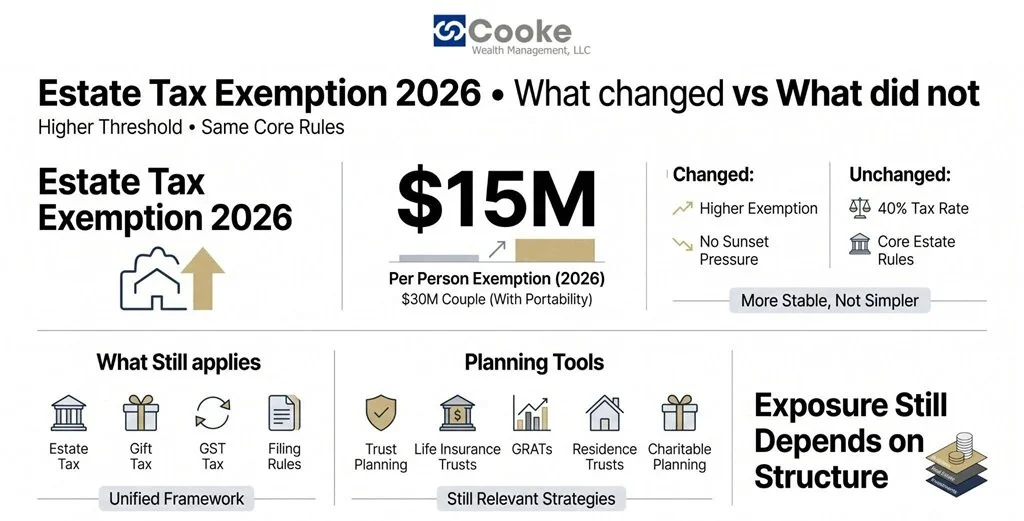
How the 2026 Estate Tax Exemption Was Reset
For decedents dying in 2026, the federal estate tax exemption increased to $15 million per individual, up from $13.99 million in 2025.
With proper portability elections, married couples may shield up to $30 million combined from federal estate tax. Inflation adjustments are scheduled to resume beginning in 2027.
Why the Sunset No Longer Applies
Under the original TCJA framework, the increased exemption was scheduled to expire at the end of 2025, which would likely have reduced the exemption by roughly half.
OBBBA repealed that sunset provision and established the $15 million exemption as the new statutory baseline.
For many families, this removed the urgency that drove large gifting programs and compressed planning timelines during 2024 and 2025. Estate plans can now be evaluated within a more stable framework rather than against a rapidly approaching expiration date.
This shift may affect how families approach:
Multi-year gifting strategies
Trust funding timelines
Insurance planning structures
Long-term wealth transfer modeling
The removal of the immediate sunset pressure also allows more flexibility around sequencing decisions that previously carried tight year-end deadlines.
What "Permanent" Actually Means
Although the new exemption is considered permanent under current law, Congress retains the authority to amend transfer tax legislation in the future.
As a result, many estate plans still benefit from flexibility provisions that allow adjustments if exemption levels change later.
These may include:
Disclaimer provisions
Powers of appointment
Trust protector provisions
Flexible distribution standards
For larger estates, flexibility often remains an important design consideration even within a more stable legislative environment.
What the 2026 Exemption Increase Covers
The 2026 exemption applies across three related federal transfer taxes:
Federal estate tax
Lifetime gift tax
Generation-skipping transfer (GST) tax
All three now share the same $15 million per-person exemption structure.
Lifetime gifts continue reducing the same unified exemption that applies at death. For example, a $2 million taxable gift made during life reduces the remaining estate tax exemption available to that individual.
The alignment of the GST exemption is particularly relevant for families considering dynasty trusts or multi-generational planning structures because it simplifies coordination across different transfer strategies.
What Did Not Change in 2026
While the exemption amount increased, many of the core mechanics of estate tax planning remained unchanged.
The federal estate tax rate continues to top out at 40%, and several longstanding planning rules remain fully intact.
Key provisions that did not change include:
The 40% top federal estate tax rate
Portability requirements between spouses
The unlimited marital deduction for U.S. citizen spouses
Step-up in cost basis at death
Annual gift exclusion rules
Valuation discount structures for certain entities and interests
Several filing and reporting requirements also remain important:
The annual gift tax exclusion remains $19,000 per recipient for 2026
Gifts to a non-U.S. citizen spouse remain subject to separate limits
Form 709 filing requirements still apply for taxable gifts
Portability elections still require timely filing of Form 706
For many families, the larger issue is not the exemption increase itself but whether older estate documents still operate as intended under current law.
Documents drafted before portability became available or before exemption amounts increased substantially may contain formula clauses that now produce unintended outcomes.
For example, bypass trust formulas tied to “the maximum amount passing free of estate tax” may allocate significantly more assets than originally intended.
Factors That Still Drive Estate Tax Exposure
Variables That Affect Your Exposure
Whether a family remains exposed to estate tax depends on more than total net worth alone.
Concentrated business interests, real estate holdings, and illiquid assets can create valuation and liquidity challenges even when an estate appears manageable on paper.
Factors that commonly affect exposure include:
Closely held business ownership
Concentrated stock positions
Significant real estate holdings
Multi-state residency or property ownership
Liquidity constraints within the estate
While California does not impose a state estate tax, clients with ties to states such as Oregon, Washington, New York, or Massachusetts may still face state-level estate tax exposure at substantially lower exemption thresholds.
Planning Strategies That Still Matter
The larger exemption does not eliminate the usefulness of traditional estate planning tools. Instead, it changes which families are most likely to benefit from them.
Strategies that may still provide value include:
Irrevocable life insurance trusts (ILITs)
Spousal lifetime access trusts (SLATs)
Grantor retained annuity trusts (GRATs)
Qualified personal residence trusts (QPRTs)
Charitable planning structures
Donor-advised funds
For many families, the focus has shifted from emergency exemption preservation toward long-term flexibility, income tax management, and future appreciation planning.
Why Work with Cooke Wealth Management on Your 2026 Plan
Fiduciary Guidance Rooted in Southern California
Cooke Wealth Management is a fee-only fiduciary registered investment advisor based in Irvine, serving families throughout Orange County and Southern California.
The firm works with business owners, retirees, real estate investors, and multi-generational families across a wide range of estate planning situations.
Because the firm operates on a fee-only basis, recommendations are not tied to insurance commissions or proprietary investment products, which can be particularly relevant in estate planning conversations involving high-cost implementation strategies.
How We Approach 2026 Estate Plan Reviews
Estate plan reviews typically begin with a review of existing documents and structures, including:
Trust agreements
Wills
Beneficiary designations
Prior gift tax filings
Existing portability elections
From there, the estate is evaluated under the 2026 exemption framework to determine whether exposure still exists, whether formula clauses operate appropriately, and whether simplification opportunities are available.
For families whose estates remain above the combined exemption threshold, planning often focuses on preserving flexibility and coordinating with estate attorneys and CPAs.
For others, the shift in exemption levels may allow greater attention toward basis management, retirement income coordination, and long-term tax efficiency.
Rethinking Your Estate Plan Under the 2026 Rules
The 2026 exemption reset provides many families with an opportunity to revisit existing estate plans under a more stable framework.
Families who accelerated gifting before the anticipated TCJA sunset may want to reevaluate whether those transfers still align with broader goals. Others who delayed planning decisions may now have greater flexibility in structuring long-term strategies.
Estate documents drafted under significantly different exemption environments may also warrant review to ensure formula clauses and trust structures continue functioning as intended.
For larger family business or agricultural estates, specialized valuation rules may still materially affect planning outcomes. Revenue Procedure 2025-32, for example, sets the Section 2032A cap at $1,460,000 for 2026 decedents, which may influence valuations for qualifying closely held business or farming interests.
At Cooke Wealth Management, John Cooke and Juliette Cooke work with families evaluating how estate planning, investment management, and long-term wealth transfer strategies interact under the updated 2026 framework.
Frequently Asked Questions
Did the TCJA estate tax sunset actually happen in 2026?
No. OBBBA repealed the scheduled sunset before it took effect and increased the exemption to $15 million per person beginning January 1, 2026.
How much can a married couple shield from federal estate tax in 2026?
With proper portability elections, married couples may shield up to $30 million combined from federal estate tax.
What is the federal estate tax rate on amounts above the exemption?
The top federal estate tax rate remains 40%.
Does California have its own estate tax on top of the federal tax?
No. California does not currently impose a state estate tax, inheritance tax, or gift tax.
Should I still consider making large lifetime gifts if my estate is below $15 million?
In some situations, lifetime gifting may still support long-term planning goals by shifting future appreciation outside the taxable estate or supporting multi-generational planning strategies.
Could Congress change the exemption again in the future?
Yes. Although the current exemption is considered permanent under existing law, Congress retains authority to modify transfer tax legislation in the future.