
Does California Have an Inheritance Tax? What Heirs May Owe

An inheritance tax is a levy a state imposes on the transfer of property or assets from someone who has died to a beneficiary. California does not currently impose one.
That is welcome news if you are inheriting real estate, an investment account, or a retirement plan. It doesn't mean there is nothing to plan for. Federal rules, another state's rules, and the assets themselves can each create a tax bill.
Cooke Wealth Management works with Orange County families through these transitions. We assist clients in managing the complex administrative and legal requirements that follow the passing of a spouse or parent, ensuring that all tax obligations are addressed with precision during a challenging time.
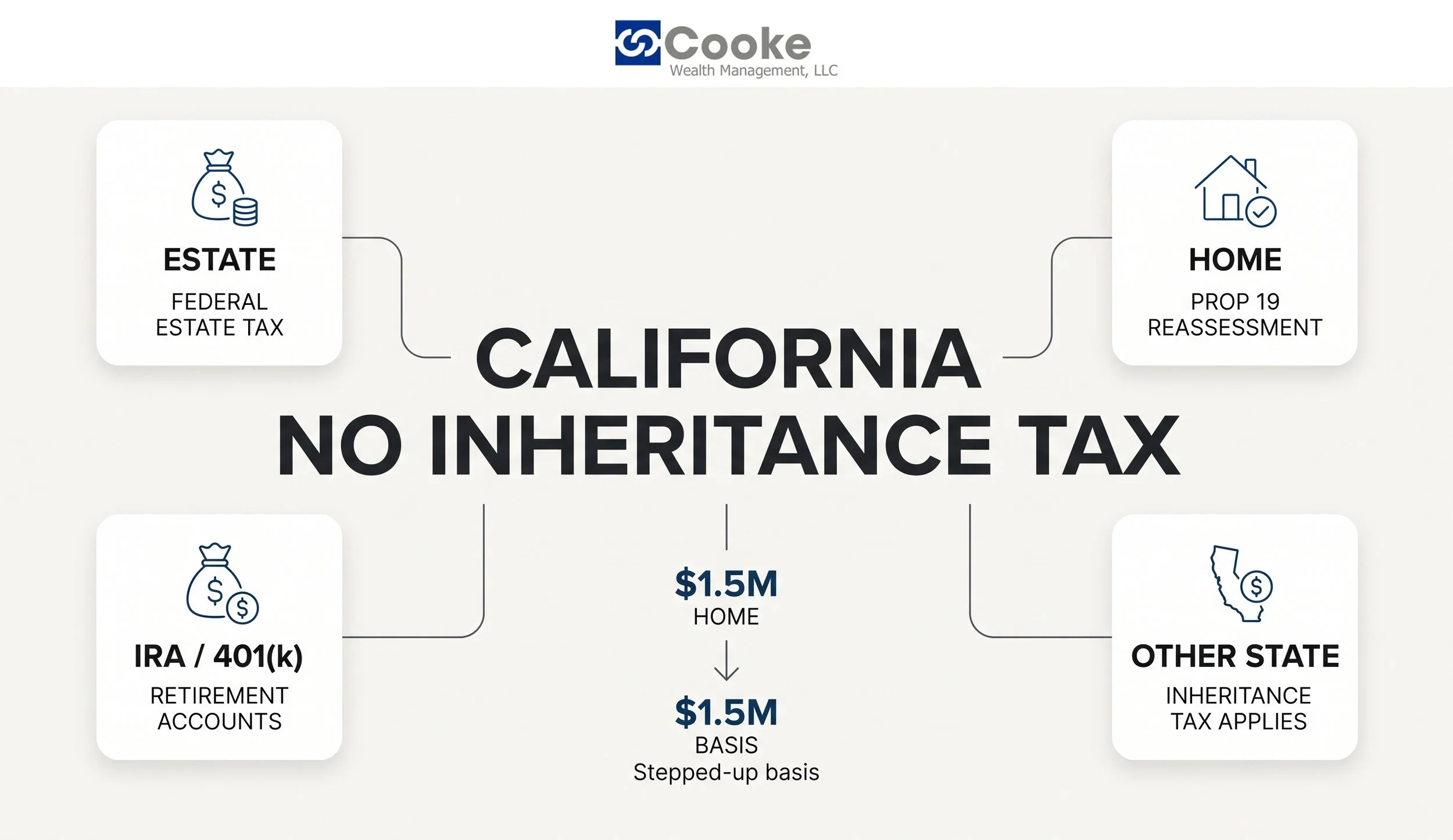
California Policy: No Inheritance or State Estate Tax
This policy has been in effect since January 1, 2005, following the federal Economic Growth and Tax Relief Reconciliation Act of 2001. That legislation phased out the federal state death tax credit to which California's estate tax was linked. According to the California State Controller's Office, once the federal credit was eliminated, the mechanism for funding the state-level tax also ceased to exist.
One historical exception remains : California retains the authority to collect inheritance tax on estates of individuals who passed away prior to June 8, 1982. For all estates settled after 2005, however, there is no requirement to file a California estate tax return or pay state-level taxes solely on the basis of an inheritance.
Federal Estate Tax Exposure
The federal government maintains an estate tax regime applicable to the fair market value of an estate prior to the distribution of assets to beneficiaries. However, exposure to this levy is limited to estates that exceed substantial statutory thresholds.
Effective in 2026, the federal estate and gift tax exemption is codified at $15 million per individual under the One Big Beautiful Bill Act. This exemption is indexed for inflation and lacks a scheduled sunset provision, providing a stable planning horizon for high-net-worth families. Furthermore, married couples may utilize portability and other strategies to effectively shield up to $30 million from federal estate taxation, as detailed in Morgan Lewis's legal analysis.
The elevated thresholds effectively exclude the vast majority of estates from federal liability. Generally, if an inheritance involves a total estate value of less than $15 million, inclusive of real property and investment portfolios, no federal estate tax is incurred.
Beneficiaries should also note that the generation-skipping transfer tax (GSTT) aligns with this $15 million exemption for the 2026 tax year, ensuring consistency across multi-generational transfer strategies.
The Benefit of Stepped-Up Basis
A critical tax advantage for heirs is not related to inheritance tax, but rather to the cost basis of the assets. Under IRC Section 1014, the basis of most inherited assets is "stepped up" to their fair market value as of the date of the original owner's death, rather than the price the decedent originally paid.
This adjustment significantly reduces potential capital gains liabilities. For example, if a parent purchased a residence for $150,000 that is valued at $1.5 million upon their passing, the heir's basis becomes $1.5 million.
If the heir subsequently sells the property, they only owe capital gains tax on appreciation exceeding that new basis, potentially saving hundreds of thousands of dollars in taxes compared to a sale occurring prior to the owner's death.
California residents benefit further from the state's community property laws. Under IRC Section 1014(b)(6), a surviving spouse may receive a full step-up on the basis of the entire value of community property, including the half already owned by the survivor. This provides a significant advantage over common-law states, where typically only the decedent's half of the property receives the basis adjustment.
For highly appreciated assets, this distinction is financially substantial. We explore these strategies further in our comprehensive overview of California capital gains taxation.
Proposition 19 and Property Tax Reassessment
While income tax liabilities may be mitigated, inheriting real estate in California involves property tax complexities. Proposition 19, enacted in 2020, established new regulations regarding the reassessment of inherited property that can lead to unexpected tax increases for many families.
Previously, parent-to-child transfers often allowed beneficiaries to retain the decedent's original assessed value. Under current law, this exclusion is only available if the property was the parent's primary residence and the child establishes it as their own primary residence within one year of the transfer.
The exclusion is limited to $1,044,586 of added value over the original assessed value, a figure adjusted periodically by the State Board of Equalization. Any value exceeding this limit is reassessed at current market rates. Failure to meet the residency requirement or utilizing the property as a rental will trigger a full reassessment, which may substantially increase the annual property tax obligation.
Taxation of Inherited Retirement Accounts
Retirement accounts, such as 401(k)s or IRAs, do not receive a stepped-up basis. Because contributions to traditional retirement accounts were made with pre-tax dollars, distributions are taxed as ordinary income to the beneficiary upon withdrawal.
Under the SECURE Act, most non-spouse beneficiaries must fully distribute the assets of an inherited IRA within 10 years. If the original owner had already commenced required minimum distributions (RMDs), the beneficiary is generally required to continue annual RMDs during years one through nine, rather than deferring the entire distribution to the tenth year.
Failure to take a required distribution may result in a 25% excise tax on the amount that should have been withdrawn. This penalty may be reduced to 10% if corrected within the designated window defined in IRS Publication 590-B. Conversely, while Roth IRA distributions remain tax-free, they are still subject to the 10-year distribution rule.
Surviving spouses maintain greater flexibility and may often treat the inherited account as their own. Determining the most advantageous rollover strategy is a key component of our investment management services.
Multi-State Jurisdictional Considerations
While California does not tax inheritances, other states may. Five states—Kentucky, Maryland, Nebraska, New Jersey, and Pennsylvania—currently impose their own inheritance taxes, with top rates reaching 16%. According to the Tax Foundation, these taxes typically apply based on the decedent's state of residence or the physical location of real property.
Therefore, a California resident inheriting assets from a decedent in Pennsylvania or receiving real property located in New Jersey may be liable for those states' inheritance taxes. Beneficiaries should verify the specific laws of the relevant jurisdiction to avoid unforeseen liabilities.
Administrative and Filing Requirements for Executors
The absence of a state inheritance tax does not eliminate all filing obligations. An heir inheriting a parent's primary residence must file Form BOE-19-P to claim the Prop 19 reassessment exclusion. This must be filed within three years of the transfer or before the property is subsequently sold. Failure to meet this deadline may result in the loss of the exclusion.
Federal reporting is generally not required for estates valued under $15 million. However, a surviving spouse may choose to file a federal estate tax return to establish "portability," allowing them to preserve the decedent's unused exemption for their own future use.
Under Revenue Procedure 2022-32, an estate not otherwise required to file may submit a simplified Form 706 within five years of the decedent's death to make a portability election. As noted in The Tax Adviser, this is a critical planning step that is often overlooked in smaller estates.
Key Considerations for Beneficiaries
Does the estate value exceed the federal exemption? Estates below $15 million (or $30 million for couples) are generally exempt from federal estate tax.
Did the decedent reside or own property in a state with an inheritance tax? Residents of Kentucky, Maryland, Nebraska, New Jersey, or Pennsylvania may be subject to state-level levies.
Is the inherited asset a retirement account? Such accounts are taxed as ordinary income and are ineligible for a stepped-up basis.
Will the inherited property be utilized as a primary residence? Adherence to residency requirements is necessary to maintain the Prop 19 tax exclusion.
Does the estate qualify as a "small estate"? Estates under $208,850 in California may be eligible for simplified procedures that avoid full probate.
Professional Guidance for Estate Planning
Navigating the tax implications of an inheritance requires a nuanced understanding of varying state and federal regulations. The optimal strategy depends on the specific types of assets involved and the jurisdictions in which they are held.
Whether you are settling an estate or planning for future transfers in Irvine, Newport Beach, or the broader Orange County area, Cooke Wealth Management offers professional expertise in Prop 19 compliance and basis planning. Schedule a Discovery Session to ensure your financial decisions are based on accurate data and professional analysis.
Frequently Asked Questions
Do I have to pay tax on money I inherit in California?
No, California doesn't tax inheritances, and it hasn't imposed a state estate or inheritance tax on any death since January 1, 2005. Whatever tax exposure exists comes from federal estate tax on very large estates, income tax on inherited retirement accounts, or another state's inheritance tax if the decedent lived elsewhere.
What is the federal estate tax exemption for 2026?
The federal estate and gift tax exemption is $15 million per individual for 2026, or $30 million for a married couple, made permanent under the One Big Beautiful Bill Act with no scheduled expiration. Estates below that threshold owe no federal estate tax at all.
Does my inherited house get reassessed for property taxes?
Only if you don't move in. Under Proposition 19, a parent's primary residence keeps its original assessed value if the child moves in as their own primary residence within one year and the added value stays under $1,044,586; otherwise the county reassesses the property at current market value.
Do I owe tax on an inherited IRA?
Yes, generally as ordinary income when you withdraw it, since the money was never taxed going into a traditional retirement account. Most non-spouse beneficiaries must empty the account within 10 years of the original owner's death, with annual withdrawals required in years one through nine if the owner had already started taking RMDs.
What if the person I inherited from lived in another state?
You could still owe that state's inheritance tax even though California doesn't have one. Kentucky, Maryland, Nebraska, New Jersey, and Pennsylvania all currently collect inheritance tax based on where the decedent lived or where their real estate was located, not where the heir lives.
Do I need to report an inheritance on my tax return?
An inheritance itself generally isn't taxable income to the person receiving it, so there's usually nothing to report on the inheritance alone. What is taxable is whatever the assets earn afterward, like interest, dividends, or retirement account withdrawals; if an estate or trust distributes income earned after the death, that typically shows up on a Schedule K-1 rather than as the inheritance itself being taxed.