
Capital Gains Tax on a Home Sale in California: The Section 121 Exclusion

The capital gains tax implications of a California residential property sale can frequently exceed seller expectations. This discrepancy often arises because the statutory exclusions established decades ago have not kept pace with the substantial asset appreciation characteristic of the modern California real estate market. For homeowners who have held property for several decades, the financial environment has evolved significantly, yet the foundational tax frameworks have remained static since 1997.
While Section 121 of the Internal Revenue Code continues to provide essential tax relief for the majority of sellers, its protective scope is often narrower than perceived in high-value markets.
Cooke Wealth Management works with families throughout Orange County to weigh these variables before the home is listed: what a sale may do to your tax picture for the year, how it fits your long-term retirement income plan, and what to do with the proceeds. Having that conversation early can bring clarity well before the closing statement. What follows covers the pieces that tend to drive the outcome: the federal exclusion limits, California's treatment of capital gains, and how the two interact.
What Section 121 Covers
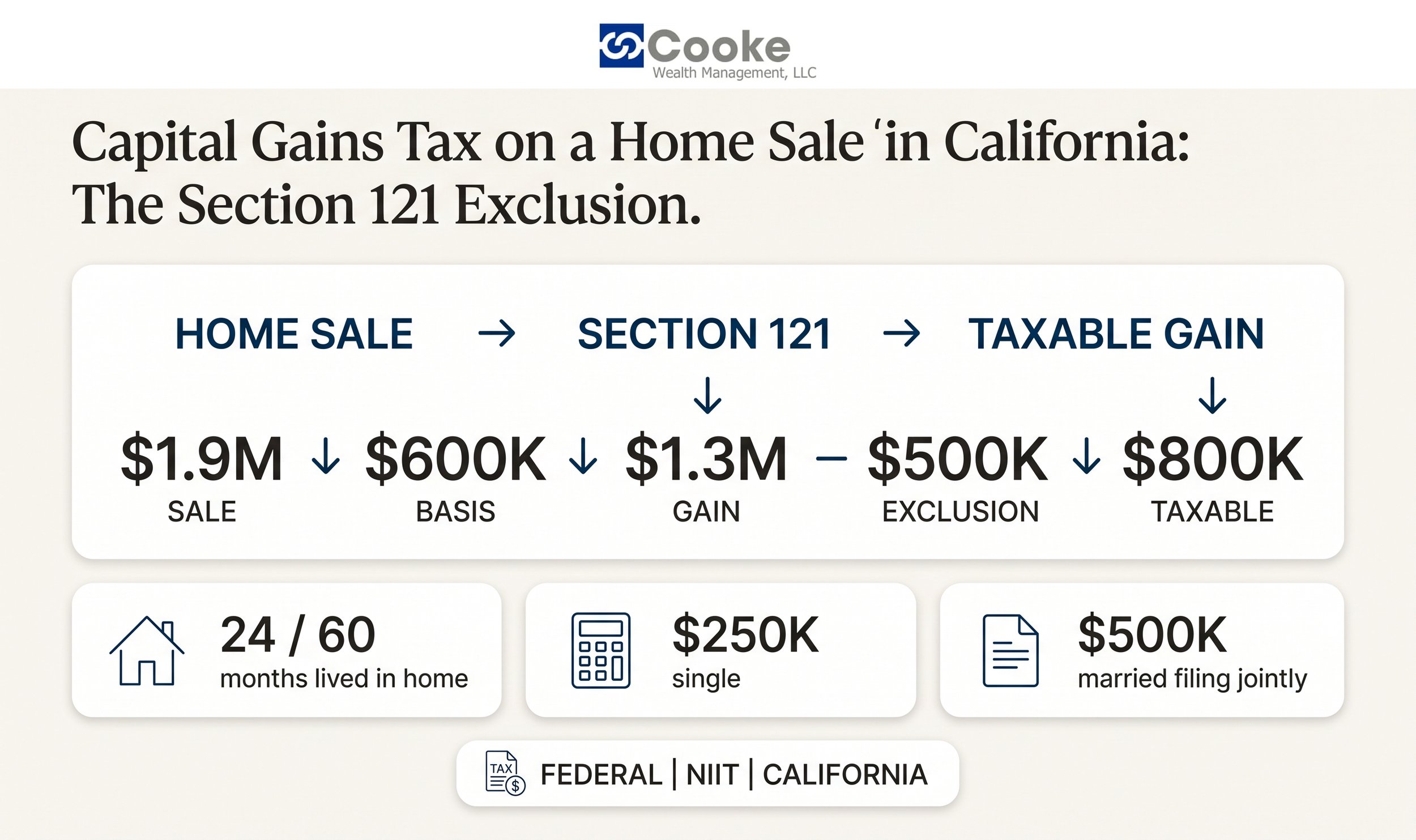
Section 121 excludes up to $250,000 of gain for a single filer and up to $500,000 for a married couple filing jointly, provided the home was your primary residence. Two tests decide whether you qualify.
The ownership test covers whether you owned the home for at least 24 months of the five years before the sale. The use test covers whether you lived in it as your main residence for that same stretch. Those 24 months don't need to run back-to-back; the IRS just adds up the days, and generally you need 730..
For a married couple, only one spouse needs to satisfy the ownership test, but both must independently meet the use test to claim the full $500,000. Fall short and the exclusion typically drops to $250,000 per spouse. There's also a frequency limit: you generally can't use the exclusion twice within a two-year span, even if you owned more than one qualifying home.
Those thresholds haven't moved since Congress wrote them into the Taxpayer Relief Act of 1997, and they were never indexed for inflation. California's statewide median home price now sits at $904,640, and Orange County's hit $1.49 million in June 2026, according to the California Association of Realtors. A $250,000 exclusion doesn't go nearly as far against those numbers once did.
A bill in Congress, the No Tax on Home Sales Act (H.R. 4327), would eliminate the dollar caps on Section 121 entirely. It was introduced in July 2025, counts California Rep. Luis Correa among its sponsors, and was still sitting in the House Ways and Means Committee as of September 2026, with no floor vote scheduled. Until that changes , the $250,000 and $500,000 limits remain the law sellers plan around.
California State Tax Treatment
California conforms to IRC Section 121 through Revenue and Taxation Code Section 17152: the same $250,000 and $500,000 amounts apply on your state return, and there's no separate, more generous version at the state level.
The two systems diverge above those thresholds. The federal government applies preferential long-term capital gains rates, while California treats gains as ordinary income, so the 0%, 15%, and 20% federal brackets have no state equivalent. The remaining gain is taxed at your marginal rate, which can reach 13.3%: a 12.3% statutory ceiling plus a 1% Mental Health Services Act surcharge on taxable income above $1 million.
Once the exclusion is used up, the remaining gain generally folds into your total income for the year, as we cover in our detailed look at California capital gains taxation.
When the Median Price Beats the Exclusion
Consider a typical Orange County scenario: a couple purchased a home in Irvine for $600,000 in the mid-2000s and sold it today for $1.9 million, resulting in a gain of $1.3 million. After applying the $500,000 joint exclusion, $800,000 remains subject to taxation.
That $800,000 gets taxed in three layers. Federal long-term capital gains tax applies at 20% once joint income clears $613,700 for 2026, which a gain this size almost certainly does.
The 3.8% Net Investment Income Tax applies once modified adjusted gross income passes $250,000 for joint filers, a threshold that's never been adjusted for inflation since it took effect in 2013. California then taxes the same $800,000 as ordinary income, up to its 13.3% top rate.
Add those three together and the combined rate on that $800,000 approaches 37%, roughly $296,000 in tax before basis adjustments.
Partial Exclusions and Exceptions Worth Knowing
Selling before the two-year mark doesn't automatically forfeit the exclusion. The IRS allows a reduced exclusion when the sale is driven primarily by a new job at least 50 miles farther from the home, a health issue requiring a move for diagnosis or treatment, or an unforeseeable circumstance such as divorce, death, or job loss.
The reduced amount is calculated by dividing the shortest of three periods, your ownership time, your use time, or time since your last exclusion, by 24 months, then multiplying by $250,000 (or $500,000 for joint filers). Nine months of qualifying ownership works out to roughly 37.5% of the full exclusion.
Widowed sellers get a separate accommodation. Under IRC Section 121(b)(4), a surviving spouse who sells within two years of the other spouse's death can still claim the full $500,000 exclusion, even though they now file as single. Miss that two-year window and the exclusion drops to $250,000.
Complexities in Applying the Exclusion
Two specific scenarios frequently complicate the tax outcome for sellers, particularly within the California real estate market.
Renting the Home Out Before You Moved In
If a property was rented prior to becoming your primary residence, a portion of the gain may not qualify for the exclusion. The IRS classifies this as "nonqualified use." Any period after January 1, 2009, during which the property was not used as your main home is carved out and taxed on a pro-rata basis, even if the ownership and use tests are otherwise met.
There's an important exception. Nonqualified use only counts time before you moved in, not time after you moved out. Someone who buys a rental in 2015, moves in as a primary residence in 2020, and sells in 2026 after living there the required two years would owe tax on the gain allocated to those five rental years, prorated against the full eleven years of ownership.
Someone who lives in a home first and converts it to a rental only after moving out doesn't lose the exclusion the same way, as long as the sale happens within the normal two-of-five-year window. IRS Publication 523 walks through how that allocation gets calculated.
California Withholds Before You Even File
In California, tax obligations may be satisfied, in part, at the point of sale. Under state real estate withholding mandates, title companies are typically required to withhold 3.33% of the gross sales price at closing, remitting these funds to the Franchise Tax Board (FTB) as a prepayment toward the seller's estimated tax liability.
Sellers qualifying for the full Section 121 exclusion may seek exemption from this requirement by certifying their eligibility on FTB Form 593, specifically by verifying ownership and use of the property as a principal residence for at least two of the five years preceding the sale.
Failure to complete this step, or inability to meet the qualification criteria, results in the 3.33% being deducted from gross proceeds at closing, irrespective of the final tax liability. While this constitutes a refundable prepayment rather than an additional tax obligation, it may result in a net distribution lower than anticipated, necessitating proactive planning.
Reducing the Taxable Gain Before You Sell
The exclusion isn't the only lever available. Taxable gain is the sale price minus your adjusted basis, and the basis is usually larger than sellers realize once it's calculated correctly.
Capital improvements, a new roof, a kitchen remodel, an added bathroom, add to basis as long as you kept the receipts. Routine repairs and maintenance don't count. Selling costs reduce the gain too: real estate commissions, title fees, and transfer taxes all come off the top before the exclusion is even applied.
If the gain still exceeds the exclusion after that, spreading part of the payment across future years through an installment sale can push some of the tax liability into years with lower income. That's a decision to make before the purchase agreement is signed, not after, which is why we go over it with clients ahead of time as part of financial planning in Irvine.
Five Questions to Ask Before You Claim the Exclusion
Have you lived in the home for 24 of the last 60 months? Ownership alone doesn't qualify you. The IRS counts days you lived there as your main residence, not days you held the title.
Have you claimed this exclusion on another home in the last two years? If so, you generally have to wait out that two-year window before you can use it again.
Did you ever rent the property out, especially before you moved in? That history could carve part of your gain out of the exclusion entirely under the nonqualified use rule above.
Is your gain likely to land above $250,000 single or $500,000 joint? If it is, the planning conversation shifts from whether the exclusion applies to what you do with the rest.
Will this sale push your income into NIIT or California's top bracket for the year? A large one-time gain can trigger both, even if your regular income wouldn't otherwise come close.
The Value of Pre-Sale Planning
The sale of a primary residence is a significant financial event that can substantially alter your tax profile. Accurate Section 121 calculations, strategic timing, and a clear plan for the resulting capital are most effective when addressed as a single, cohesive strategy.
Whether you are selling a home in Irvine, Newport Beach, or throughout Orange County, Cooke Wealth Management provides the expertise to navigate these complexities as part of your broader investment strategy. We invite you to schedule a Discovery Session to ensure your financial plan is optimized before you list your property.
Frequently Asked Questions
Do I have to report a home sale on my taxes if it's under the exclusion?
Generally, you don't have to report a home sale if the gain is fully covered by the Section 121 exclusion and you didn't receive a Form 1099-S at closing. If you did receive a 1099-S, or your gain exceeds the exclusion, the sale must be reported on Schedule D even when no tax ends up being owed.
Does refinancing my home reset the two-year ownership clock?
No, refinancing has no effect on the ownership and use test. The IRS measures both from the date you took title to the property, not from mortgage transactions, so a cash-out refinance or a rate-and-term refinance doesn't change your eligibility timeline.
What if I rented out part of my home before selling it?
Renting out part of the home, a converted garage, an ADU, or a spare room, generally doesn't disqualify you from the exclusion as long as the space was part of your primary residence. Any depreciation you claimed on that rental portion must still be recaptured and taxed separately, typically at a 25% rate, regardless of the Section 121 exclusion.
What if I lived in the home for less than two years before selling because of a job relocation?
You may still qualify for a partial exclusion if the sale is primarily due to a work-related move at least 50 miles farther from the home, a health issue, or another unforeseeable circumstance. The exclusion gets prorated based on how much of the required 24 months you met, calculated as a fraction of that period multiplied by the full $250,000 or $500,000 limit.
Do I still owe California withholding at closing if I qualify for the full exclusion?
No, you can avoid California's standard 3.33% real estate withholding by certifying your Section 121 eligibility on FTB Form 593 at closing. Without that certification, escrow withholds the percentage from your proceeds regardless of your actual tax liability, though you'd get it back as a credit when you file. It's worth confirming this with your escrow officer ahead of closing rather than being surprised by a smaller wire than expected.
How does California tax capital gains differently from the IRS?
California taxes capital gains as ordinary income at rates up to 13.3%, while the federal government uses separate long-term capital gains brackets of 0%, 15%, and 20%. Both systems apply the same $250,000/$500,000 Section 121 exclusion before taxing whatever gain remains.
Can a married couple claim the full $500,000 exclusion if only one spouse is on the title?
Yes, a married couple can claim the full $500,000 exclusion even if only one spouse is on the title, as long as both spouses meet the use test by living in the home as their primary residence for at least 24 months. This comes up often when one spouse purchased the home before the marriage.