
Christian Wealth Management Tustin: Local Fee-Only Fiduciary Support

Wealth management in Tustin, California, often begins with a focus on charitable giving. For many Christian families, tithing is the first line item in the household budget. Additionally, about half of Tustin residents rent their homes, with only 48.8% of housing units being owner-occupied, according to Census QuickFacts. For those who both rent and tithe, key tax updates in 2026 introduce important deductions worth considering.
Cooke Wealth Management is a fee-only fiduciary firm serving Tustin and the broader Orange County community. Founders John and Juliette Cooke both hold CFP® and Certified Kingdom Advisor® credentials. Our financial planning framework integrates giving, savings, tax strategies, and retirement planning into a cohesive financial vision.
To align your charitable giving with your long-term financial goals, schedule a discovery session with our team.
What Christian Wealth Management in Tustin Covers
Christian wealth management employs established financial planning methods, including portfolio strategy, tax optimization, retirement planning, and estate coordination. The primary distinction is the underlying framework: giving is prioritized as a core commitment of faithful stewardship rather than allocated solely from remaining cash flow.
Learn more about aligning faith with investment strategy in our comprehensive guide to Christian wealth management.
The 2026 Tithe Deduction for Non-Itemizing Families
Most taxpayers claim the standard deduction, which reaches $32,200 for married couples filing jointly in 2026. Historically, non-itemizers could not deduct charitable tithes and offerings on their federal tax returns.
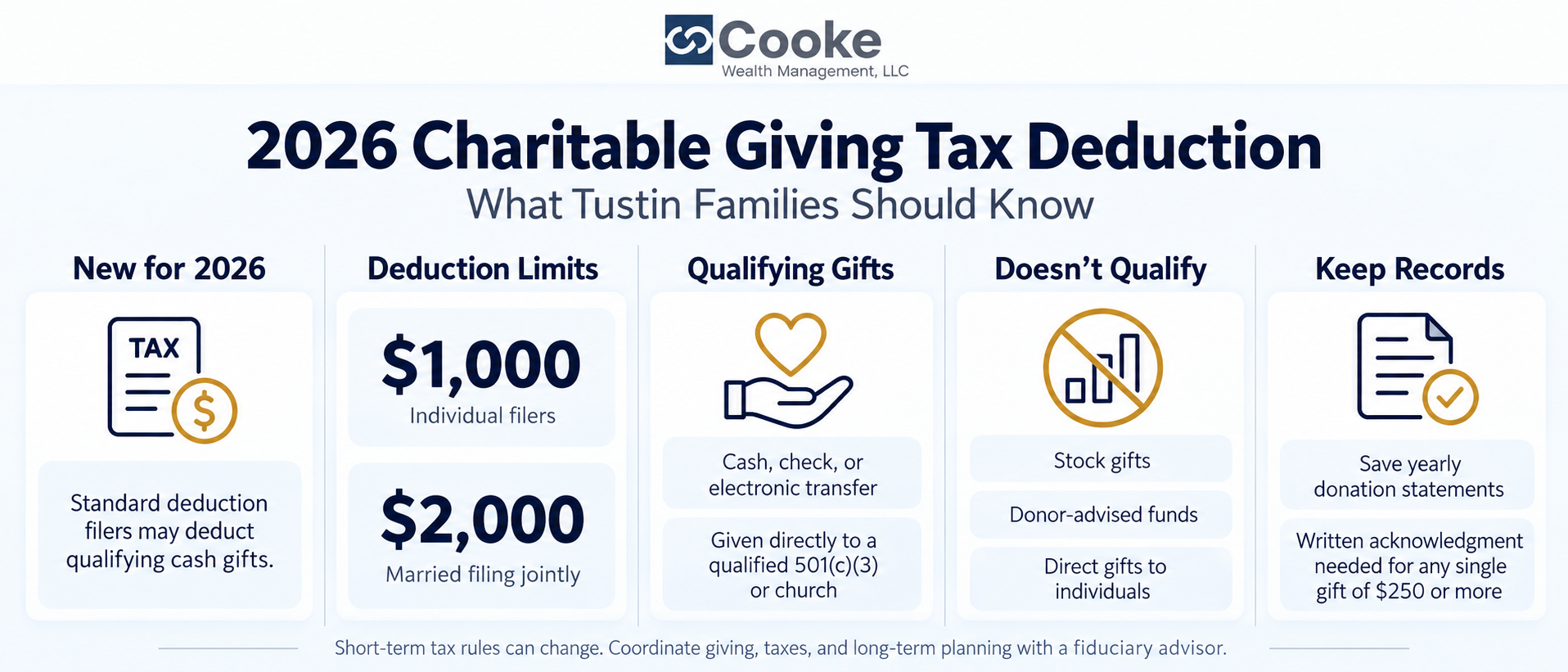
This rule shifts in 2026 under provisions of the One Big Beautiful Bill Act. Taxpayers claiming the standard deduction may now deduct up to $1,000 in qualifying cash contributions, or $2,000 for married couples filing jointly (Taft Law).
For example, a Tustin household earning the median city income of $112,503 and tithing 10% contributes $11,250 annually. Under the updated tax code, up to $2,000 of that contribution becomes tax-deductible even when taking the standard deduction.
Key criteria govern whether a gift qualifies for this deduction:
Contributions must be direct monetary gifts (cash, check, or electronic transfer); stock gifts do not qualify.
Gifts must be made directly to a qualified 501(c)(3) public charity, such as a local church, rather than a donor-advised fund.
Unused deduction amounts cannot be carried forward to subsequent tax years.
Always maintain annual donation receipts. According to IRS guidelines, written acknowledgment from the recipient charity is required for any single contribution of $250 or more.
Homeowners Who Itemize Again
Tustin homeowners face distinct tax considerations. With median owner-occupied home values at $950,400, many residents benefit significantly from state and local tax (SALT) deductions. The SALT deduction cap increased from $10,000 to $40,000 in 2025, with scheduled 1% annual adjustments through 2029 before phasing down at higher income thresholds (CPA Practice Advisor).
When combining property taxes, state income taxes, and mortgage interest, many homeowners exceed the $32,200 standard deduction threshold. Those who itemize follow standard charitable deduction guidelines rather than the above-the-line provision, making strategies such as charitable bunching particularly effective.
A helpful rule of thumb: Sum your property taxes, state income taxes, mortgage interest, and planned charitable contributions. If the total exceeds your standard deduction, itemizing is likely the more advantageous approach.
Non-Deductible Charitable Giving
Several forms of Christian generosity do not qualify for standard IRS tax deductions. Per IRS Publication 526, non-deductible contributions include:
Direct financial assistance to specific individuals, even if channeled through a church designation
Personal expenses paid for a family member's volunteer or mission work
Direct gifts to foreign charities, subject to specific treaty exceptions (e.g., certain Canadian, Mexican, or Israeli organizations)
The calculated monetary value of personal volunteer time
With 34% of Tustin residents born outside the United States according to Census data, many local families support relatives or international ministries. Accounting for these gifts directly within your financial plan ensures clear, realistic budgeting despite the lack of tax deductibility.
Retirement Planning When You Rent
Because over half of Tustin households rent, many families plan for retirement without using home equity as a foundation. While achieving financial independence remains fully achievable, cash flow and investment models require specific adjustments.
Unlike homeowners who eventually pay off a mortgage, renters maintain perpetual housing overhead. California's Tenant Protection Act caps annual rent increases on qualifying properties at 5% plus local inflation (up to a 10% maximum, per the California Attorney General). Retirement distribution strategies must incorporate these compounding costs over time.
For example, a monthly rent payment of $3,000 at age 65 escalating at 4% annually increases to approximately $4,440 by age 75 and $6,570 by age 85. A homeowner with a paid-off mortgage does not experience this continuing escalation.
To offset persistent housing expenses, renters often benefit from higher savings targets, expanded liquidity reserves, and strategic Social Security optimization. Our planning process projects these cash flows on a year-by-year basis.
Partner With Cooke Wealth Management
Effective Christian wealth management blends intentional generosity with disciplined strategy, ensuring your giving is aligned with tax efficiency and long-term financial security.
As fee-only fiduciaries, Cooke Wealth Management delivers objective guidance free from product commissions. To evaluate your tax, charitable giving, and investment strategies, schedule a discovery session with our team today.
Frequently Asked Questions
Is my tithe tax-deductible if I don't itemize?
Starting in 2026, eligible taxpayers taking the standard deduction can deduct up to $1,000 in cash contributions ($2,000 for married couples filing jointly) made directly to qualifying charities and churches.
Can I deduct money I send to support a missionary I know?
Contributions supporting specific individual missionaries are tax-deductible only if made directly to a recognized 501(c)(3) organization that maintains full control and discretion over the funds. Direct personal payments are not tax-deductible under IRS rules.
Does a Christian financial advisor cost more?
Advisor compensation depends on firm structure rather than faith affiliation. Common models include assets-under-management (AUM) fees, flat planning fees, or sales commissions. As a fee-only firm, Cooke Wealth Management is compensated exclusively by clients, eliminating commission-related conflicts of interest.
How do I check a Christian financial advisor's background?
You can verify any registered investment advisor using the SEC's Investment Adviser Public Disclosure database. Reviewing Form ADV Parts 1 and 2A offers transparency regarding fee structures, business practices, and disciplinary history. Faith-based credentials should always be paired with thorough regulatory verification.
Can renters in Tustn still build long-term wealth?
Yes. Renters can accumulate significant wealth through disciplined investing in diversified investment accounts, tailored tax strategies, and systematic retirement savings designed to account for ongoing rental growth.
This article is provided for educational purposes and does not constitute legal or tax advice. Please consult a qualified tax professional regarding your specific situation.