
California Prop 19 Explained: How Inherited Property Gets Reassessed

California Prop 19 changed how a parent's house gets taxed the day you inherit it.
Until February 2021, a child could take over a parent's home and keep its decades-old tax basis, regardless of what the property was worth or whether anyone moved in. Under Prop 19, that basis only carries over when the home becomes your own primary residence and you file the paperwork on time. Miss a condition and the county reassesses at market value, which can push the annual bill to several times what your parents paid.
Cooke Wealth Management works with Orange County families on this exact handoff, pairing the estate planning decisions with the property tax bill attached to them. As a fee-only, fiduciary firm, our planning focuses on lowering your family's tax exposure rather than selling a product. In practice that means reviewing how your trust is written, timing the transfer with your estate attorney, and showing what passing the property down today does to a beneficiary's tax basis later.
What Getting This Wrong Costs
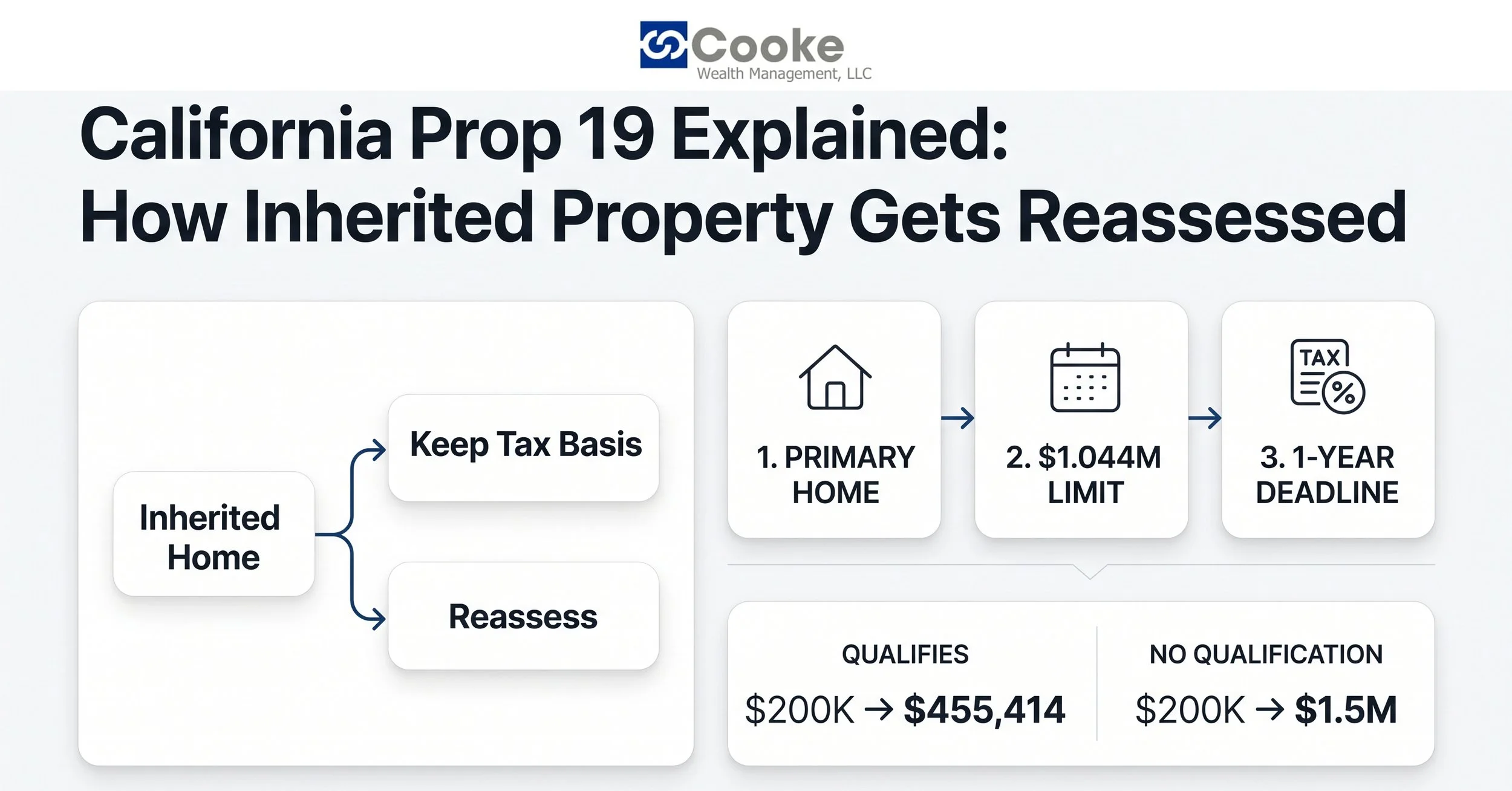
A home your parents bought decades ago might carry a taxable value of $200,000. The same home is worth $1.5 million when it transfers to you.
Here's the math when you qualify. You keep the $200,000 base plus the $1,044,586 exclusion, a limit of $1,244,586. The home beats that by $255,414, so that overage gets added to the base and your new taxable value lands at $455,414. Your annual bill still more than doubles, but it's built on $455,414, not on $1.5 million.
Now the version where you miss a condition. No move-in, no exemption claim on time, or a property nobody lived in, and the exclusion disappears. The county assesses the full $1.5 million. At a 1% base rate that's the difference between roughly $4,500 a year and $15,000, on the same house, decided entirely by choices made in the first year after the transfer.
The Three Things That Decide Your Outcome
Three factors settle whether you keep your parent's tax basis: who lives in the home, what it's worth, and how fast you file. Miss any one and the exclusion can shrink or disappear.
The residence rule
The exclusion only applies if the home was your parent's primary residence and it becomes yours too. The Orange County Assessor requires you to move in and file a homeowners' exemption claim within one year of the transfer. A home left to anyone other than a child, or a grandchild when both parents have died, doesn't qualify. Neither does a home none of the heirs move into.
The $1,044,586 limit
Meeting the residence rule doesn't make the break unlimited. You keep your parent's factored base year value plus $1,044,586, a figure the California Board of Equalization adjusts every two years using the Federal Housing Finance Agency's House Price Index for California. That amount holds through February 15, 2027.
Anything above the limit gets added to the base year value rather than triggering a full reassessment, which is what produced the $455,414 taxable value in the example above.
The deadlines
Two clocks start the day the property changes hands. You have one year to file the homeowners' exemption claim, which locks in your status as principal resident from the transfer date. The exclusion claim itself, filed on BOE-19-P for parent-child transfers or BOE-19-G for grandparent-grandchild transfers, gives you three years from the transfer date or until you sell, whichever comes first. You file both with the county assessor where the property sits.
Where Families Can Get Caught
Two situations account for most of the surprises, and both are easy to see coming.
The first is a rental or second home. If your parents didn't live in it, you get nothing. A rental house, a vacation home, any non-primary property gets reassessed at full market value the day it transfers, the same as if it was sold to a stranger. A rental that carried a low tax basis for thirty years can hand the next owner a bill several times higher the year it changes hands. Family farms are the one exception, as long as the land stays in agricultural use.
The second is siblings inheriting together. Splitting ownership doesn't split the exclusion into portions everyone keeps. At least one heir has to move in and claim the home as a principal residence within the year. If none of you do, the county reassesses at market value no matter how the title is divided, and the low basis is gone for all of you.
Inheritance Decisions You Can't Undo
Before the transfer, most of it is still adjustable. You can decide who inherits the home, who plans to live in it, whether to move a rental out of the estate or accept the reassessment, and how the trust names its successor trustee. Each of those choices changes the tax outcome, and each one is free to make while your parents are living or the estate is still open.
After the deadline, the options close. There is generally no appeal for a missed move-in date. There's no retroactive fix for a property that was never eligible. In our experience, families who come out ahead tend to have the property tax conversation before anyone files a claim, not after the county sends the new bill.
Who May Want to Talk to an Advisor Now
Some situations carry enough at stake that a conversation before the transfer usually pays for itself. Talk to an advisor now if you own a rental or second home headed to your kids, if a parent is still living and you're planning the eventual handoff, if you and your siblings will inherit a home together, or if the property is worth more than roughly $2 million, where the exclusion covers only a fraction of the value.
If any of those apply, the property tax outcome is still yours to shape. Reach out to Cooke Wealth Management and talk through what Prop 19 means for your specific property, while the base value is still protectable and the paperwork clock hasn't started.
Frequently Asked Questions
Does Prop 19 Apply to a Home I Inherited Before 2021?
It depends on when the change in ownership occurred, not simply when the estate finished distributing the property.
Prop 19's parent-child and grandparent-grandchild rules apply to qualifying transfers occurring on or after February 16, 2021. Transfers completed on or before February 15, 2021 generally remain under Proposition 58 or Proposition 193 instead.
That distinction can matter with trusts. For property inherited through a trust, will, or intestate succession, the date of death can be the date of change in ownership. The terms of a trust can also affect when beneficial ownership actually transfers.
The old rules were also substantially more generous. A qualifying principal residence could pass between parent and child without a value limit, and up to $1 million of assessed value in other real property could potentially qualify for the exclusion.
What Happens If My Siblings and I Inherit a House Together?
You don't all have to move in.
If a parent transfers the family home to multiple children, the property can qualify as long as at least one eligible child makes it their family home within one year of the transfer and the other requirements are satisfied.
That creates an important planning question for siblings: who is actually willing to make the inherited house their principal residence?
There's another wrinkle. The exclusion generally continues only while the property remains the family home of an eligible transferee. If the sibling living there later moves out, another eligible sibling who inherited the property may be able to maintain the exclusion by making the property their own family home. If no eligible transferee continues to qualify, the exclusion can be removed.
Can I Avoid Prop 19 Reassessment by Putting the Property in a Trust?
Not simply by putting the house into a trust.
For property-tax purposes, California looks at who has beneficial ownership and when that ownership changes. A revocable trust that leaves beneficial ownership with the parent generally doesn't turn a later inheritance into a pre-Prop 19 transfer simply because the trust itself was created years earlier.
Does Prop 19 Affect the Stepped-Up Basis I Get for Capital Gains Taxes?
No. These are two separate tax concepts.
Prop 19 deals with the assessed value used to calculate California property taxes. Federal income-tax basis determines the gain or loss when the property is eventually sold.
That means an inherited house can potentially have two very different numbers attached to it: a relatively low assessed value for California property-tax purposes and a much higher income-tax basis based on the property's value at death.
Keeping those two numbers separate is important when deciding whether an heir should keep the house, rent it, or sell it.
How Much Can My Property Tax Bill Increase Under Prop 19?
There isn't one percentage increase that applies to everyone.
If the home qualifies for the parent-child exclusion but its market value exceeds the applicable Prop 19 value limit, only the excess is added to the transferred factored base year value.
For example, using a $200,000 factored base year value and a $1.5 million market value with a $1,044,586 exclusion amount:
Factored base year value: $200,000
Prop 19 exclusion amount: $1,044,586
Protected value threshold: $1,244,586
Market value: $1,500,000
Amount above threshold: $255,414
New taxable value: $455,414
That is dramatically better than a full reassessment to $1.5 million.
What If I Qualify for Prop 19 and Then Move Out?
This is one of the less obvious consequences of Prop 19.
Qualifying when you inherit the house does not necessarily preserve the exclusion forever.
The property must continue to qualify as the family home of an eligible transferee. If you later move out and the property no longer qualifies for the homeowners' exemption, the Prop 19 exclusion can be removed.
BOE guidance gives an example in which an heir inherits a home, lives in it for three years, and then converts it to a rental. The property's taxable value is then recalculated using its fair market value at the original inheritance date, adjusted for the intervening inflation factors.
What If I Miss the One-Year Deadline to Move Into the Inherited Home?
The one-year deadline and the Prop 19 claim deadline are two different things.
For a family home to qualify, an eligible transferee must make the property their principal residence and file for the homeowners' or disabled veterans' exemption within one year of the change in ownership.