
Financial Planner Costa Mesa: Expertise for Retirement and Investment Planning

Retirement and investment planning are often treated as two separate conversations, but for most Costa Mesa households, they're really the same problem viewed from different angles. How you invest today shapes what retirement looks like later, and retirement goals should drive how a portfolio gets built in the first place.
Cooke Wealth Management is an independent, fee-based Registered Investment Adviser based in nearby Irvine, providing retirement planning and investment management for families throughout Costa Mesa, Orange County, and Southern California.
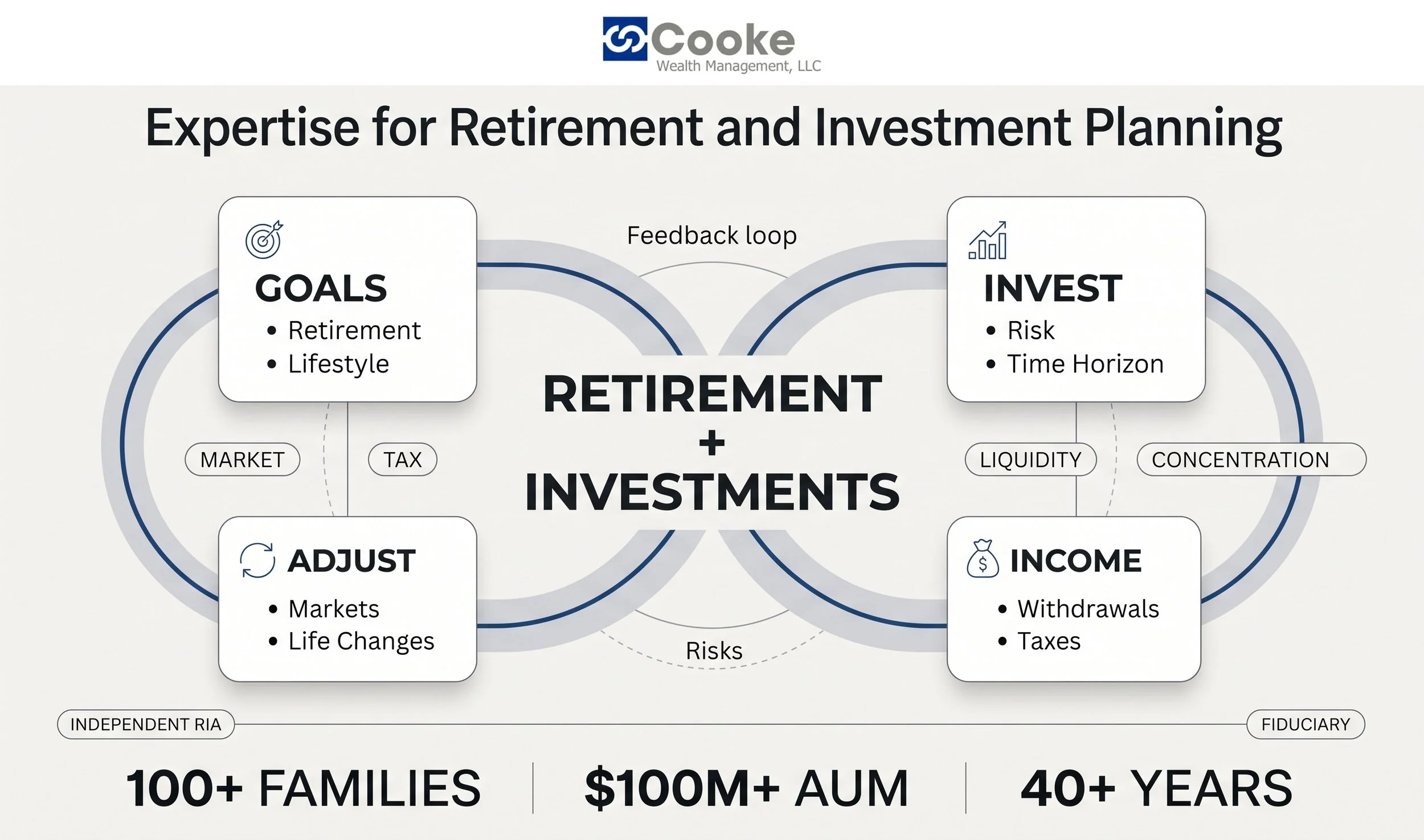
A Better Way to Think About Retirement and Investment Planning
One Connected Process, Not Two Separate Ones
Retirement planning and investment management work best as one connected process. Your expected retirement date, spending needs, income sources, and tolerance for investment losses should influence how your portfolio is structured, while portfolio performance can change what retirement timing is financially realistic. The SEC identifies time horizon and risk tolerance as important factors when determining an appropriate asset allocation.
How Retirement Timing and Spending Shape the Portfolio
A coordinated plan connects several decisions. Retirement timing affects portfolio risk: retiring earlier can leave less time to recover from market declines. Spending needs influence investment allocation, too, since a portfolio must eventually generate withdrawals rather than focus exclusively on growth.
How Account Types Affect Withdrawal Decisions
Account types affect withdrawal decisions in a similar way: traditional IRAs generally become subject to required minimum distributions at age 73, while original owners of Roth IRAs don't face lifetime RMD requirements. Which accounts get drawn down first, and when, can meaningfully change a retiree's tax picture.
Tax and Concentration Considerations
Tax considerations can also influence which accounts are used and when, while concentrated holdings may require diversification decisions before retirement income begins. FINRA notes that excessive concentration in a particular investment, asset class, or market segment can amplify losses.
A Feedback Loop, Not a Single Correct Portfolio
The objective isn't to identify one permanently "correct" portfolio. It's to create a feedback loop: retirement goals shape investment decisions, investment results inform retirement projections, and major life changes trigger a reassessment of both.
The Question That Actually Matters
That coordination lets you evaluate the question that ultimately matters most: do your investments and retirement strategy actually work together to support the life you want? A planner who treats these as separate services can't easily answer that question with confidence.
What Investment Planning Actually Involves
Building a Portfolio Around Time Horizon and Risk Tolerance
A well-constructed portfolio looks different for a 35-year-old accumulating savings than for a 65-year-old drawing income. Cooke Wealth Management's investment management process is built around this kind of individualized allocation rather than a generic model.
Diversification and Cost Awareness
Diversification can help reduce the impact of any single investment performing poorly, but cost matters too — even small ongoing fees can meaningfully reduce portfolio value over time. A financial planner should be able to clearly explain both how a portfolio is diversified and what it costs.
What Retirement Planning Actually Involves
Answering "How Much Is Enough?"
Retirement planning starts with a deceptively simple question: how much is actually enough, given a client's goals and expected lifestyle. Answering it well requires coordinating investment withdrawals, Social Security timing, and tax planning rather than relying on a single savings target.
Sequencing Withdrawals and Managing Required Distributions
Sustainable retirement income depends on sequencing withdrawals across taxable, tax-deferred, and tax-free accounts in a way that manages the overall tax burden year to year. Getting this sequencing wrong can mean paying more in taxes than necessary over the course of retirement.
Why Costa Mesa Clients Have Specific Planning Needs
A Mix of Careers, Business Owners, and Renters-Turned-Homeowners
Costa Mesa's economy includes a mix of corporate professionals, small business owners, and families connected to the area's retail, hospitality, and creative industries. Each situation introduces its own planning considerations — equity compensation, business cash flow, or a recent home purchase — that a generic financial plan doesn't address well.
Real Estate as Part of the Overall Picture
Home equity often represents a significant share of net worth for Costa Mesa homeowners, given the area's property values. Decisions about home equity, downsizing, or purchasing investment property typically need to be coordinated with both the investment portfolio and retirement timeline, not treated as a separate transaction.
Managing Risk Across a Retirement and Investment Plan
Multiple Risks Require Multiple Responses
A coordinated plan needs to manage several types of risk simultaneously, since addressing one can sometimes create another. FINRA identifies market, inflation, liquidity, and concentration as distinct forms of investment risk, each of which calls for a different planning response rather than a single blanket strategy.
Sequence-of-Returns Risk Near Retirement
A market downturn shortly before or after retirement can do more lasting damage than the same downturn a decade earlier, since there's less time to recover before withdrawals begin. Managing this risk typically involves cash reserves, flexible withdrawal rates, and diversified income sources rather than relying entirely on portfolio performance.
The Fiduciary Standard Behind This Kind of Planning
A Legal Obligation Across the Relationship
Under the Investment Advisers Act of 1940, Registered Investment Advisers generally owe clients a fiduciary duty, meaning they're legally required to act in the client's best interest across the advisory relationship. This matters especially when retirement and investment decisions are coordinated together, since the fiduciary's obligation covers the full scope of that relationship.
Fiduciary Duty and Disclosed Conflicts
Being a fiduciary doesn't mean an advisor has zero conflicts of interest — nearly every advisor has some form of compensation that creates potential incentives. What matters is whether those conflicts are identified and disclosed, which can be verified through an advisor's Form ADV on the SEC's Investment Adviser Public Disclosure database.
Independence as a Structural Safeguard
Cooke Wealth Management operates as an independent Registered Investment Adviser, meaning it isn't built around promoting a parent company's proprietary product lineup. That independence supports recommendations drawn from a broad universe of options rather than a narrower menu tied to one company's revenue goals.
How the Planning Process Brings These Pieces Together
Starting With a Complete Financial Picture
Effective planning starts with a full view of income, expenses, investments, insurance, taxes, and long-term goals. Skipping this step is one of the most common reasons plans fail to hold up — recommendations built on incomplete information tend to break down the first time circumstances change.
An Ongoing Relationship, Not Separate One-Time Services
From there, a personalized plan gets built connecting retirement goals to investment strategy, then revisited as circumstances evolve. Cooke Wealth Management frames this as one ongoing relationship rather than two disconnected services, since retirement and investment decisions affect each other continuously.
Milestones That Typically Call for Revisiting Both
Certain life events tend to require a fresh look at both retirement and investment strategy together, including:
A career change, promotion, or business transition
Marriage, divorce, or the birth of a child
Buying or selling a home in Costa Mesa's market
An inheritance or unexpected windfall
Retirement approaching within the next five to ten years
Choosing a Financial Planner in Costa Mesa
Questions Worth Asking Before You Commit
A few direct questions can reveal how a planner actually works: Do you coordinate retirement and investment planning together, or treat them as separate services? Are you a fiduciary at all times, and how are you compensated? What does your typical client's situation look like, and does mine fit that profile?
Why Local Familiarity Still Matters
An advisor familiar with Costa Mesa and the broader Orange County market brings context that matters — local real estate dynamics, California-specific tax considerations, and access to in-person meetings when useful. That local grounding, paired with genuinely coordinated planning, often distinguishes a firm worth hiring from one that simply has a nearby office.
Why Families Choose Cooke Wealth Management
A Track Record Built on Long-Term Relationships
Cooke Wealth Management has served more than 100 families and manages over $100 million in assets, with advisors bringing more than 40 years of combined industry experience. The firm's stated goal is to help clients avoid costly mistakes and build genuine confidence in their financial future.
A Values-Informed, Fiduciary Structure
The firm also incorporates biblical principles and academic research into its planning process, which resonates with some Orange County families specifically. Paired with its structure as an independent Registered Investment Adviser, that approach gives clients a planning relationship built around their stated priorities rather than a product to sell.
Start Planning Retirement and Investments Together
Retirement and investment planning work best as one connected feedback loop, not two separate conversations happening on different timelines. A planner who treats them together can make tradeoffs explicit and build a plan that actually holds up as circumstances change.
Cooke Wealth Management works with individuals and families throughout Costa Mesa, Orange County, and Southern California to build coordinated financial plans grounded in fiduciary guidance. If you're ready to talk through your goals, scheduling a Discovery Session is a straightforward way to see whether the fit is right.
Frequently Asked Questions
Why should retirement and investment planning be handled together?
Retirement goals should shape how a portfolio is built, and investment performance affects what retirement timeline is realistic, so treating them separately can lead to conflicting advice. A coordinated planner creates a feedback loop between the two rather than leaving clients to reconcile them on their own. This typically results in a more coherent, adaptable plan.
How does asset allocation change as I get closer to retirement?
Asset allocation should reflect an investor's time horizon and risk tolerance, both of which typically shift as retirement approaches and the portfolio moves from an accumulation focus to an income focus. A portfolio built for someone in their 30s usually looks different from one built for someone in their 60s. A financial planner can help determine the right allocation for your specific stage and goals.
What is concentration risk, and why should Costa Mesa clients care?
Concentration risk is the risk of amplified losses from having too much wealth tied to a single investment, property, or employer. This is common for Costa Mesa clients with equity compensation or significant home equity. A coordinated plan evaluates diversification alongside retirement income needs rather than addressing it separately.
How do required minimum distributions affect retirement withdrawal planning?
Required minimum distributions generally begin at age 73 for traditional IRAs and retirement plans and are taxable as income, while Roth IRA owners aren't required to take them during their lifetime. Failing to plan for RMDs can push retirees into a higher tax bracket than expected. Coordinating these distributions with the broader investment and withdrawal strategy helps manage this impact.
Is a fiduciary financial planner automatically free of conflicts of interest?
No. Fiduciary duty requires an advisor to identify and either eliminate or fully disclose conflicts of interest, not to have none at all. Understanding how conflicts are disclosed and managed matters more than assuming a fiduciary label means conflict-free advice.
How often should my retirement and investment plan be reviewed together?
Most advisors recommend at least an annual review of both together, with additional check-ins after major life events like a job change, inheritance, or approaching retirement. Reviewing them separately can miss important interactions, like how a market downturn affects retirement timing. Consistent, coordinated communication is often a better sign of quality than short-term investment performance alone.
How do I get started with Cooke Wealth Management?
Cooke Wealth Management offers a free Discovery Session to discuss your retirement and investment goals and determine whether the firm's coordinated approach fits your needs. From there, the firm builds a personalized plan rather than applying a generic template. You can schedule that initial conversation directly through the firm's contact page.