
Wealth Management in San Clemente for Coastal Residents

San Clemente's coastal lifestyle comes with its own financial complexity — significant home equity, a retiree population weighing whether to stay or downsize, and a local economy that mixes small business ownership with residents commuting to jobs elsewhere in Orange County. Wealth management here often needs to address real estate and retirement income together, not as separate conversations.
Cooke Wealth Management is an independent, fee-based Registered Investment Adviser based in nearby Irvine, providing financial planning and investment management for families throughout San Clemente, Orange County, and Southern California.
Why Coastal Residents Face a Distinct Financial Picture
Real Estate as a Dominant Share of Net Worth
Many San Clemente homeowners hold a significant share of their net worth in a single coastal property, given the area's real estate values. Decisions about staying, downsizing, or using home equity in retirement need to be evaluated alongside the rest of a financial plan, not treated as an isolated real estate transaction.
A Retiree Population With Specific Income Needs
San Clemente has a notable population of retirees and pre-retirees, many of whom are weighing how to convert home equity and investment accounts into sustainable income. This shifts the planning focus from pure accumulation to a coordinated withdrawal and income strategy earlier than in many other markets.
A Coastal Wealth Stress Test for San Clemente Families
Net Worth Can Look Strong While Being More Concentrated Than It Appears
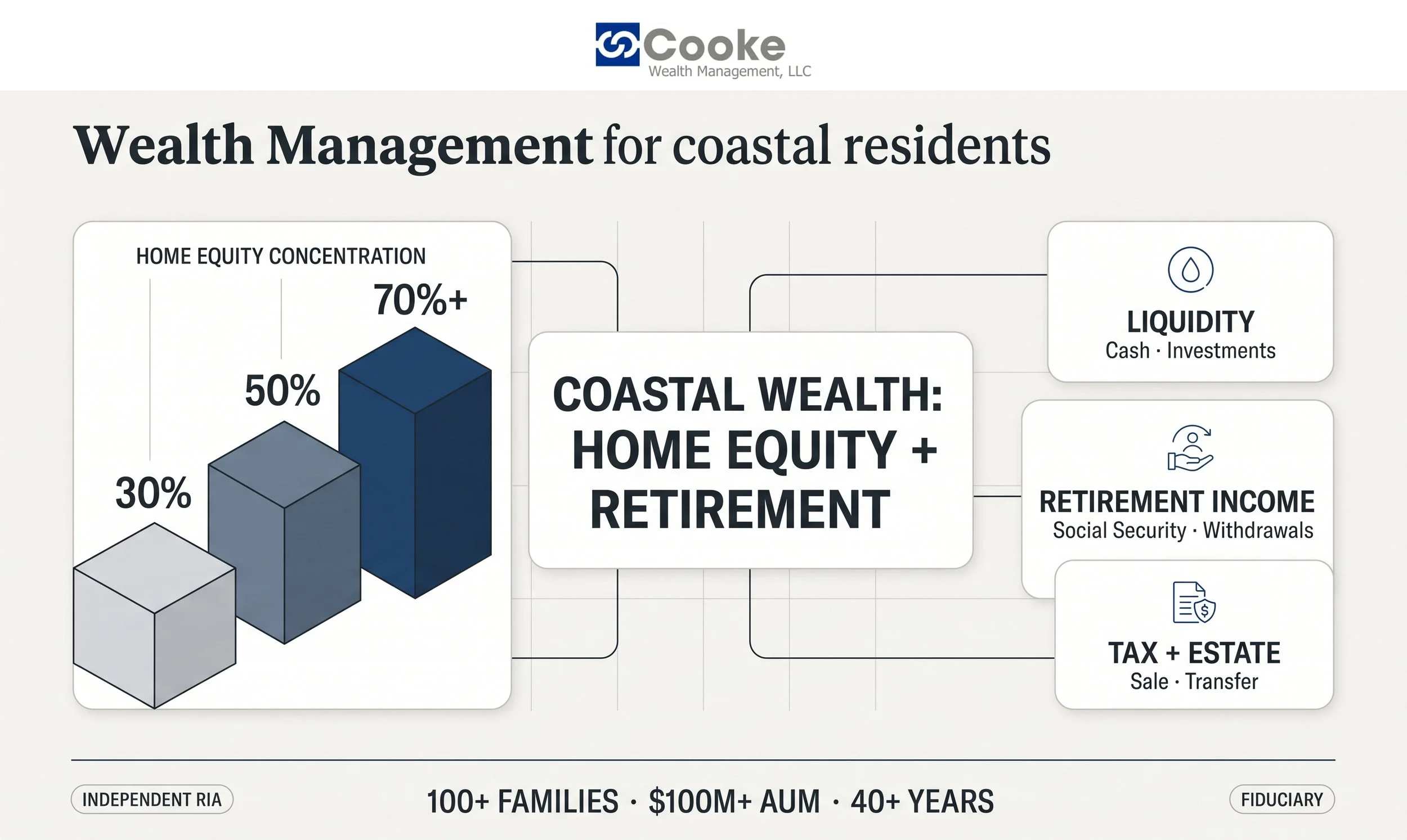
For a San Clemente homeowner, total net worth can look strong while the financial plan remains more concentrated than it first appears. A useful starting point is to calculate home equity as a percentage of total net worth. If a family has $1 million in home equity and $2 million in total net worth, for example, 50% of its wealth is tied to one property.
Three Levels of Concentration Worth Examining
| Home equity as % of net worth | What to examine |
|---|---|
| 30% | Whether the remaining assets provide sufficient diversification and liquidity |
| 50% | Whether retirement income depends too heavily on investment assets outside the home |
| 70%+ | Whether downsizing, relocation, or another source of liquidity needs to be part of the long-term plan |
Why These Aren't Universal Thresholds
These percentages aren't universal risk thresholds. The SEC explains that appropriate asset allocation depends on factors including an investor's time horizon and risk tolerance, while diversification is intended to reduce risk by spreading assets across different investments. FINRA similarly warns that concentration in a particular asset class can amplify losses and emphasizes considering how easily assets can be converted to cash.
The Questions a Real Stress Test Should Ask
For coastal homeowners, the stress test should go beyond asking whether the house has appreciated. What happens if the family needs substantial cash during retirement — would selling be necessary, or could investment assets cover the need? What happens if the homeowner wants to remain in San Clemente for another 15 years? And if downsizing eventually becomes necessary, how would the resulting proceeds affect retirement income, taxes, and the portfolio?
The Goal Is Understanding, Not Automatic Reduction
The goal isn't automatically to reduce real-estate exposure. It's to understand how much of the family's financial future depends on one illiquid asset — and whether the rest of the plan is built accordingly.
What Coastal Real Estate Means for a Financial Plan
Evaluating Home Equity as Part of the Balance Sheet
Home equity should be reviewed as part of an overall financial picture, including its tax basis and how easily it could be converted to cash if needed. The IRS notes that a property's basis is important when determining gain or loss on a future sale, which matters given how much coastal property values have appreciated over time.
California's Tax Treatment of Capital Gains
Selling a highly appreciated coastal property can carry significant tax consequences, particularly since California doesn't provide a separate lower capital-gains rate — gains are generally taxed as ordinary income at the state level. This makes the timing and structure of a potential sale worth planning for well in advance.
Liquidity Risk When Wealth Is Tied Up in Property
A financial plan heavily weighted toward an illiquid coastal home needs a clear strategy for generating accessible income without forcing an unfavorable sale. FINRA identifies liquidity as a distinct investment risk, and it's an especially relevant one in a market where home values can represent the bulk of a household's wealth.
Retirement Income Planning for San Clemente Residents
Coordinating Social Security, Investments, and Real Estate
A sustainable retirement income strategy for coastal residents typically coordinates Social Security timing, investment withdrawals, and any real estate-related proceeds into one sequenced plan. Cooke Wealth Management's retirement planning work is built around this kind of coordination rather than treating each income source separately.
Sequence-of-Returns Risk Near Retirement
A market downturn shortly before or after retirement can do more lasting damage than the same downturn a decade earlier, since there's less time to recover before withdrawals begin. Managing this risk typically involves cash reserves, flexible withdrawal rates, and diversified income sources rather than relying entirely on portfolio performance.
What Comprehensive Wealth Management Includes
Investment Management Aligned With Your Timeline
Investment management involves building and maintaining a portfolio suited to a client's specific timeline, risk tolerance, and objectives. A portfolio built for a coastal retiree drawing income looks different from one built for a younger accumulator, which is why a well-constructed allocation needs to account for the real estate exposure already present.
Wealth Transfer Guidance for Coastal Property
Wealth transfer planning coordinates the tax-efficient movement of assets to heirs, which for many San Clemente families includes a coastal property with significant embedded appreciation. Addressing this directly, well before it becomes an urgent estate matter, tends to produce better outcomes for the next generation.
The Fiduciary Standard Behind This Kind of Planning
A Legal Obligation Across the Relationship
Under the Investment Advisers Act of 1940, Registered Investment Advisers generally owe clients a fiduciary duty, meaning they're legally required to act in the client's best interest across the advisory relationship. This matters particularly for coastal residents whose planning often spans real estate, retirement, and estate decisions together.
Fiduciary Duty and Disclosed Conflicts
Being a fiduciary doesn't mean an advisor has zero conflicts of interest — nearly every advisor has some form of compensation that creates potential incentives. What matters is whether those conflicts are identified and disclosed, which can be verified through an advisor's Form ADV on the SEC's Investment Adviser Public Disclosure database.
Independence as a Structural Safeguard
Cooke Wealth Management operates as an independent Registered Investment Adviser, meaning it isn't built around promoting a parent company's proprietary product lineup. That independence supports recommendations drawn from a broad universe of options rather than a narrower menu tied to one company's revenue goals.
Choosing a Wealth Management Firm in San Clemente
Questions Worth Asking Directly
A few direct questions can reveal how a firm actually operates: How do you approach clients whose wealth is concentrated in real estate? Are you a fiduciary at all times, and how are you compensated? What does your typical client's situation look like, and does mine fit that profile?
Why Local Familiarity Still Matters
An advisor familiar with San Clemente and the broader Orange County coastline brings context that matters — local real estate dynamics, California-specific tax considerations, and an understanding of the area's retiree population. That local grounding, paired with genuinely coordinated planning, often distinguishes a firm worth hiring from one that simply has a nearby office.
Why Coastal Families Choose Cooke Wealth Management
A Track Record Built on Long-Term Relationships
Cooke Wealth Management has served more than 100 families and manages over $100 million in assets, with advisors bringing more than 40 years of combined industry experience. The firm's stated goal is to help clients avoid costly mistakes and build genuine confidence in their financial future.
A Values-Informed, Fiduciary Structure
The firm also incorporates biblical principles and academic research into its planning process, which resonates with some Orange County families specifically. Paired with its structure as an independent Registered Investment Adviser, that approach gives clients a planning relationship built around their stated priorities rather than a product to sell.
Start Building a Plan for Coastal Living
Wealth management for coastal residents needs to treat real estate, retirement income, and estate planning as one connected picture, not separate conversations happening on different timelines. Running a simple stress test on how much of your net worth is tied to your home is often the first step toward understanding whether the rest of your plan is built accordingly.
Cooke Wealth Management works with individuals and families throughout San Clemente, Orange County, and Southern California to build coordinated financial plans grounded in fiduciary guidance. If you're ready to talk through your goals, scheduling a Discovery Session is a straightforward way to see whether the fit is right.
Frequently Asked Questions
How do I know if too much of my net worth is tied to my home?
A useful starting point is calculating home equity as a percentage of total net worth — for example, $1 million in home equity against $2 million in total net worth means 50% concentration. There's no universal threshold that applies to everyone, since the right level depends on your time horizon, retirement income needs, and risk tolerance. A financial planner can help evaluate whether your specific level of concentration is a concern.
How does owning a home in San Clemente affect my financial plan?
Home equity often represents a significant share of net worth for San Clemente homeowners, which can create both an opportunity and a liquidity challenge in retirement. Decisions about downsizing, selling, or holding the property need to be coordinated with the rest of a financial plan rather than treated as a standalone transaction.
How does California tax the sale of an appreciated coastal property?
California doesn't offer a preferential rate for long-term capital gains the way the federal government does, so gains are generally taxed as ordinary income at California's regular rates. This can significantly affect the total tax owed on a highly appreciated property sale. Planning for this in advance, rather than at the time of sale, can help manage the tax impact.
What is concentration risk, and why should San Clemente residents care?
Concentration risk is the risk of amplified losses from having too much wealth tied to a single investment, property, or employer. Many San Clemente residents have a large share of net worth concentrated in their home, which can create this kind of imbalance without a coordinated plan. Addressing it doesn't necessarily mean selling the property — it means understanding the tradeoff.
How should retirement income planning account for coastal real estate?
A sustainable retirement income strategy should coordinate Social Security timing, investment withdrawals, and any real estate-related decisions into a single sequenced plan. Treating a home as a separate asset from the rest of the retirement strategy can lead to missed opportunities or unexpected liquidity gaps.
How do I get started with Cooke Wealth Management?
Cooke Wealth Management offers a free Discovery Session to discuss your financial goals and determine whether the firm's approach fits your needs. From there, the firm builds a personalized plan rather than applying a generic template. You can schedule that initial conversation directly through the firm's contact page.